On this page
A new house needs maintenance from the first month, and in some ways more of it than an older one. The systems have never run through a full year, the finishes have never seen a winter, and the construction itself left dust in the ducts, grit in the gutters, and debris in the drains. The first year's schedule is partly upkeep and partly discovery: each task is also an inspection, and what you find is what you report to the builder while the warranty is widest.
Below is the schedule we would set for a typical single-family new build in a mixed climate, month by month. Adjust it to your equipment's manuals and your climate; the manual wins every time. If you use Property Station, onboarding or claiming a builder home creates a starter version of this from the systems on file, and the maintenance schedule is where you tune it.
Why is the first year different?
Three things set a new build apart: construction debris (drywall dust in the ducts, sawdust and nails in the gutters, sealant in the drains), the settling period as lumber dries and the foundation takes load, and the warranty, because the first year is the workmanship window in most builder warranties and the schedule doubles as the inspection that feeds it.
The first filter change, the first gutter cleaning, and the first drain flush are the dirtiest the house will ever have. The warranty timeline covers the reporting side; this post covers the doing.
What is the month-by-month schedule?
The schedule below runs from the month-one filter check and shutoff labels through two HVAC service visits, two gutter cleanings, the first freeze protection, and a full house inspection in month eleven, a month before the workmanship window closes in most warranties. Every row is a task and an inspection at once; what you find feeds the builder report.
| When | Task | Note for a new build |
|---|---|---|
| Month 1 | Check the HVAC filter; change it if it is gray | Construction dust loads the first filter fast; check it monthly all year |
| Month 1 | Test every smoke and CO alarm, and record the manufacture dates | New alarms; the dates set the 10-year and 5-year replacement reminders |
| Month 1 | Find and label the main water shutoff, the gas shutoff, and the electrical panel | Shutoffs & Key Locations in the app is built for this |
| Month 1 | Put a dry paper towel under every sink trap for a day | Finds slow leaks at fresh connections |
| Month 1 | Set the water heater to 120°F and note the model and serial | Starts the manufacturer warranty record |
| Month 2 | First heavy rain: walk the exterior and photograph where water goes | Grading and downspout problems are warranty items now, foundation problems later |
| Month 3 | Change the HVAC filter; check the condensate drain is flowing | The first summer is the first real test of the drain line |
| Month 3 | Run every rarely used drain and fixture | Keeps traps full and finds debris |
| Month 3 | Walk every room in raking light and note nail pops, cracks, and trim gaps | Do not report yet; the list grows, and many builders address it once near the end of year one |
| Month 4 | Clean the gutters for the first time | Shingle grit and construction debris |
| Month 4 | Check exterior caulk at windows, doors, and penetrations | New caulk shrinks; gaps let water behind the siding |
| Month 5 | Test the garage door's safety reverse and lubricate the rollers | Manufacturer warranty item; the manual has the test |
| Month 6 | Change the HVAC filter; book the seasonal HVAC service | Fall service before heating season; spring service before cooling |
| Month 6 | Flush a quart from the water heater | Sediment in a new tank is often construction debris from the supply lines |
| Month 6 | Check every exhaust fan actually moves air (hold a tissue to it) | Bath fans that vent into the attic are a common new-build defect |
| Month 7 | Deep clean tile and grout in wet areas; recaulk any corner joint that cracked | Grout and caulk cracks are the settling period's signature |
| Month 8 | Inspect the roof from the ground and the attic | After a full season each way; check the attic for daylight and stains |
| Month 9 | Change the HVAC filter | Same filter interval, all year |
| Month 9 | Before the first freeze: disconnect hoses, drain outdoor faucets, insulate exposed pipes | New builds often have unlabeled interior shutoffs for hose bibs; find them now |
| Month 10 | Clean the gutters after leaf drop | Second cleaning |
| Month 11 | Full house inspection, room by room and outside, with the year's notes and photos | The last month of the workmanship window in many warranties |
| Month 11 | Send the consolidated list to the builder in writing, one item per request | Before the date, dated, with photos |
| Month 12 | Change the HVAC filter; book the other seasonal HVAC service; test the alarms; replace alarm batteries | Sets the pattern for every year after |
Which tasks matter most, and why?
Four things matter most in year one (indoor air in a tight new home covers the ventilation side of them): the filter, checked monthly because construction dust loads it fast; the detectors, tested and dated in month one; water in every form (traps, the first rain, the condensate drain, the bath fans, the first freeze); and the two HVAC service visits whose invoices are part of the equipment warranty file. Everything else on the schedule is important; these four are where new-build problems show first.
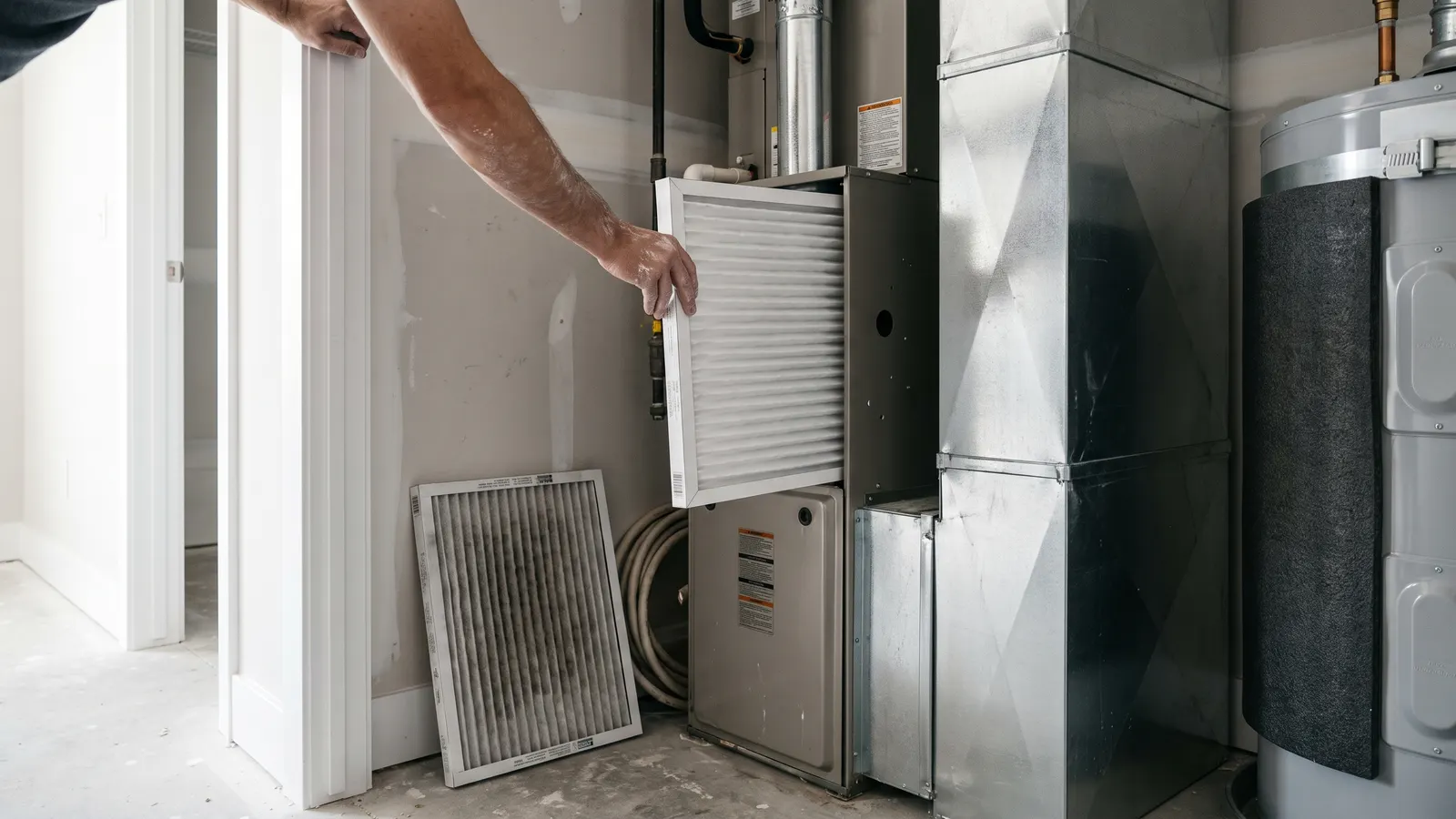
The filter. Check it every month this year, not every three. Drywall dust and sawdust from construction end up in the return, and a filter that goes gray in three weeks in month one is normal. It should settle to a longer interval by summer; if it does not, a return duct leak in the attic or crawlspace is pulling in unconditioned air, and that is a builder item. The filter guide covers sizes and MERV ratings.
The detectors. New alarms are usually hardwired and interconnected, and often combination smoke and CO units near bedrooms. Test them in month one and write down the manufacture date on each, because those dates decide when they are replaced and nobody remembers them otherwise. The detector guide has the intervals from the NFPA and CDC.
Water, in all its forms. The paper towel under each trap, the first-rain walk outside, the condensate drain in the first cooling season, the bath fans, and the first freeze. Water is what turns a small new-build defect into a large claim, and every one of these tasks is a chance to catch it early. The gutter guide and the freeze guide are the two exterior halves; the drain guide is the interior one.
The HVAC service. Two visits, spring and fall, from the first year. The equipment is under manufacturer warranty, and those warranties commonly expect documented annual service. The invoice from each visit is part of the warranty file. What a tune-up should include is the checklist to ask for.
What should you log, and where?
Log every completed task with its date, what you found, and a photo if anything looked wrong. In the first year the log has two readers: you, next year, checking whether the filter interval has settled, and the builder, in month eleven, when the consolidated list needs dates. A claim without dates is a story; a claim with dates is a record.
In Property Station the Complete button on each task takes the date, the cost, and a note, and keeps them in the task's history; the Documents page takes the invoices; the systems pages take the model, serial, and warranty dates. Why that single record matters is the longer argument.
A claim without dates is a story. A claim with dates is a record.
What should you do next?
Set up the month-one tasks this week: the filter check, the alarm test, the shutoff labels, and the paper towels. Then add the seasonal packs from the Seasonal Checklist for the two seasons ahead and adjust the dates. Put "month 11 inspection" on the calendar now, a month before the workmanship window closes, so it does not arrive as a surprise.