On this page
Test every smoke alarm and carbon monoxide detector in the house once a month by pressing the test button, replace the batteries at least once a year (or when one chirps), replace smoke alarms 10 years after their manufacture date, and replace CO detectors on the manufacturer's schedule or every 5 years. Those are the NFPA and CDC intervals, and they are not the kind of advice that has an "it depends".
Alarms fail quietly. A dead battery, a unit past its sensor life, or an alarm somebody pulled down during a cooking incident and never put back all look exactly like a working alarm until the night they are needed. The monthly test is the only way to know.
Where do alarms belong?
Smoke alarms belong inside every bedroom, outside each sleeping area, and on every level including the basement, interconnected where possible and at least 10 feet from the stove; carbon monoxide detectors belong near every sleeping area in any home with a fuel-burning appliance, a fireplace, or an attached garage. Those are the NFPA and CDC placements, and a new home built to recent code usually has them.
The NFPA's smoke alarm guidance says to install smoke alarms inside every sleeping room, outside each separate sleeping area, and on every level of the home including the basement; that interconnected alarms (when one sounds, they all sound) are best; that alarms should be on the ceiling or high on a wall and at least 10 feet from the stove; and that only qualified electricians should install hardwired alarms.
The CDC's carbon monoxide guidance says to install battery-operated or battery back-up CO detectors near every sleeping area, to check the batteries when you change the clocks each spring and fall, to replace the detector following the manufacturer's instructions or every 5 years, and, if the detector sounds, to leave the home immediately and call 911.
New-construction homes built to recent codes usually have hardwired, interconnected smoke alarms with battery backup, and often combination smoke/CO units near bedrooms. Walk the house once and make a list: which rooms, which type (smoke, CO, or combination), hardwired or battery, and the manufacture date on the back of each. That list is the maintenance plan.
What do you need?
A step stool, replacement batteries of the right type for each alarm (9-volt or AA; sealed ten-year units have none), a vacuum with a brush attachment or a can of compressed air, and a marker for writing dates on the units. Earplugs help; the test is loud on purpose.
- A step stool or short ladder
- Replacement batteries of the right type for each alarm (many use 9-volt; some use AA; sealed 10-year units have no replaceable battery)
- Earplugs, if you have sensitive ears; the test is loud by design
- A vacuum with a brush attachment or a can of compressed air
- A marker
What are the steps of the monthly test?
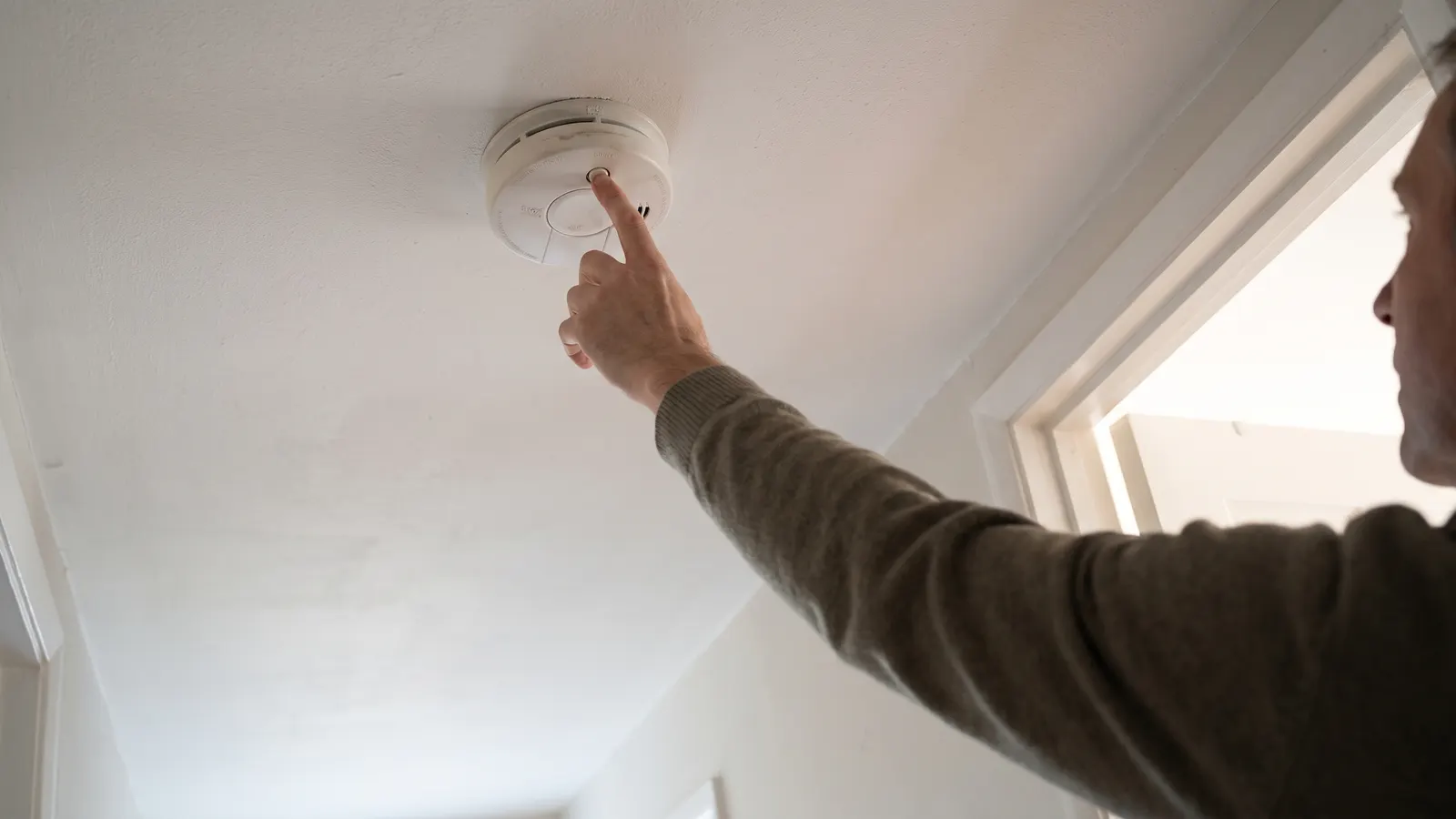
Each month, warn the household, press and hold the test button on every smoke alarm until it sounds (on an interconnected system, all of them should sound), test each CO detector the same way, and replace or investigate any unit that stays silent, sounds weak, or is slow to respond. Ninety seconds per floor.
- Tell everyone in the house you are testing, so nobody evacuates.
- Press and hold the test button on each alarm until it sounds. Done when: you hear the loud beep-beep-beep. On an interconnected system, every alarm in the house should sound when one is tested; if only one does, the interconnect is not working.
- Test each CO detector the same way. A combination unit will have one button for both.
- Note any alarm that does not sound, sounds weakly, or takes several seconds to respond. Replace its battery and test again. If it still fails, replace the unit.
What are the steps of the yearly service?
Once a year, on the same day, replace the batteries in every battery-powered alarm and the backup batteries in every hardwired one, vacuum the dust out of each unit's vents, check the manufacture date on the back and replace any smoke alarm past 10 years or CO detector past 5 or its stated life, and confirm every alarm is still where it belongs, especially near the kitchen.
- Replace the batteries in every battery-powered alarm and the backup battery in every hardwired alarm, on the same day each year (many people use the fall clock change, which is also the CDC's cue for CO batteries). Sealed 10-year alarms skip this step.
- Vacuum or blow the dust out of each alarm's vents. Dust causes false alarms and slows response.
- Check the manufacture date on the back of each unit. Replace any smoke alarm past 10 years and any CO detector past its stated life or 5 years. Write the replacement date on the new unit's mounting plate.
- Confirm each alarm is still where it belongs and none has been removed. Kitchens are where alarms disappear; if the kitchen-adjacent alarm keeps going off during cooking, move it to at least 10 feet from the stove or replace it with a model that has a hush button, but do not remove it.
What do the sounds mean?
Continuous loud beeping from a smoke alarm means fire: get out and call 911. Continuous beeping from a CO detector means carbon monoxide: leave at once and call from outside. A single chirp every 30 to 60 seconds means a low battery. Chirping that continues after a new battery means the unit has reached the end of its life and needs replacing.
| Sound | Meaning | Action |
|---|---|---|
| Continuous loud beeping (three beeps, pause, repeat) | Smoke or fire | Get out, call 911, stay out |
| Continuous loud beeping from a CO unit (often four beeps, pause) | Carbon monoxide | Leave immediately, call 911 from outside |
| One chirp every 30 to 60 seconds | Low battery | Replace the battery |
| Chirping that continues after a new battery | End of life | Replace the unit |
Do not silence a CO alarm and go back to bed. CO has no smell; the alarm is the only warning. Leave, then call.
When should you stop and call a pro?
Hardwired alarms are an electrician's job to replace if the wiring or the mounting base needs changing; a like-for-like swap onto an existing base is usually a homeowner task, with the breaker off. If an interconnected system will not interconnect, if an alarm keeps sounding with no smoke and no dust, or if a CO alarm has ever sounded, call a professional: an electrician for the alarm, and for the CO, the gas utility or an HVAC technician to find the source before anyone sleeps in the house again. The annual HVAC service exists partly to prevent that call.
What should you record?
Each alarm's location, type, power source, and manufacture date, plus the date of every battery change, test failure, and replacement. The manufacture dates are what make the 10-year and 5-year replacements happen; nobody remembers them otherwise. Set the monthly test as a recurring task with the yearly battery change and the replacement years on their own reminders.
Common questions
What does a single chirp every minute mean?
A low battery, according to the NFPA. Replace the battery. If the chirping continues after a new battery, the alarm has reached the end of its life and the whole unit needs replacing.
Do I need a carbon monoxide detector if my house is all electric?
If there is an attached garage, a fireplace, a gas grill used near an open door, or a generator anywhere near the house, yes. CO comes from anything that burns fuel, and an attached garage is enough. The CDC's guidance to install detectors near every sleeping area applies to any home with a fuel source.
How do I find the manufacture date?
It is printed on the back of the alarm. Twist the alarm off its mounting plate and look for a date. Smoke alarms are replaced 10 years after that date, CO alarms per the manufacturer's stated life or every 5 years.
What should you do next?
Alarms tell you a fire has started. A fire extinguisher is the other half of the plan for the small fires that can be stopped, and it has its own monthly check that takes even less time. If the house has a fireplace or a wood stove, the yearly chimney inspection belongs on the same list, and every house should have a radon test on record at least once.