On this page
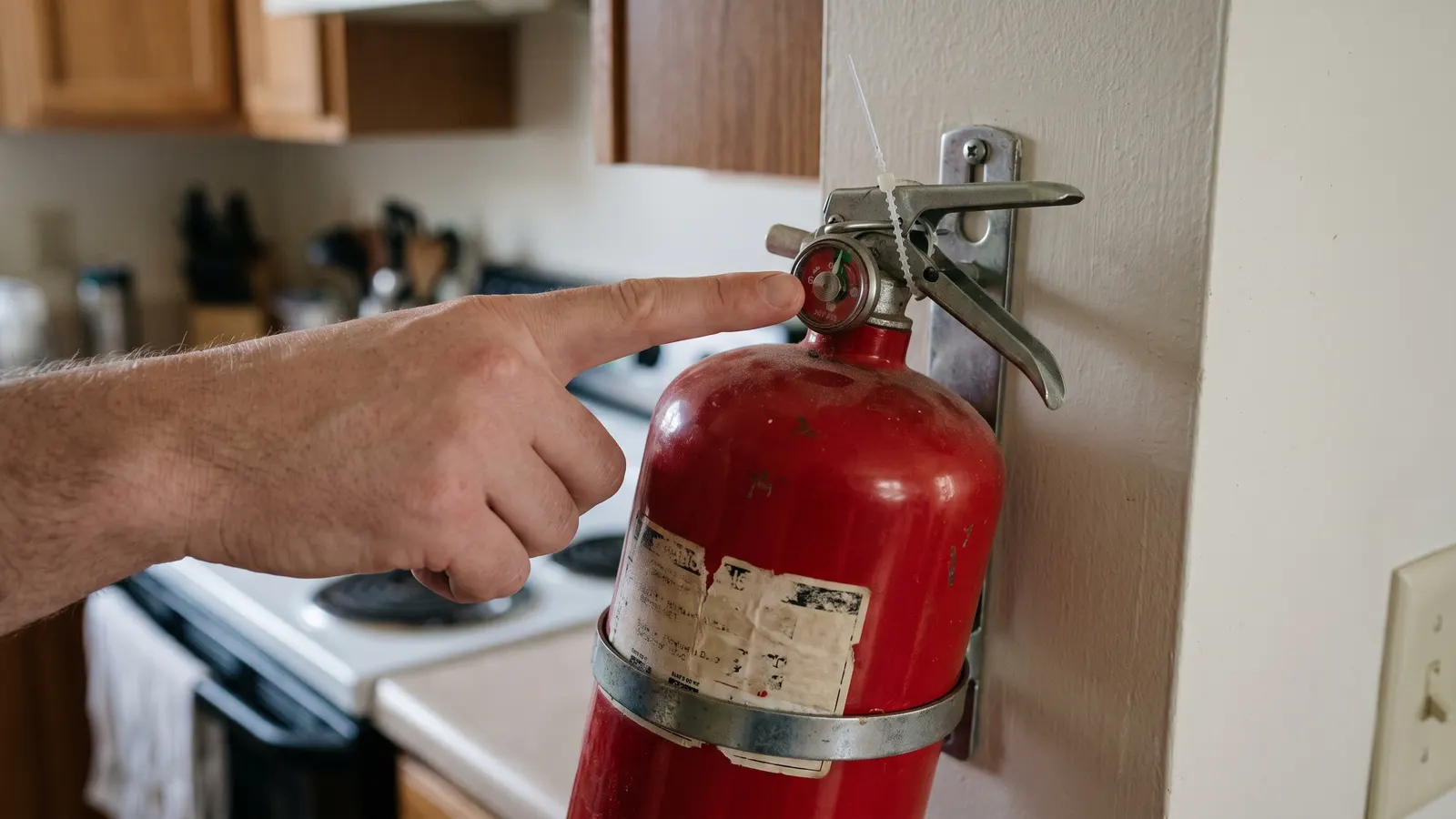
Check each fire extinguisher once a month: the gauge needle is in the green, the pin and tamper seal are in place, the nozzle is clear, the body is not dented or rusted, and nothing is blocking the path to it. That is the U.S. Fire Administration's inspection list, and it takes about a minute per extinguisher.
The other half of extinguisher readiness is knowing when not to use one. An extinguisher handles a small fire contained to one object, a pan or a wastebasket, while the room is still clear enough to breathe and the exit is behind you. Anything bigger is a 911 call from outside.
Which extinguisher do you need, and where does it go?
A home needs multipurpose A-B-C extinguishers, the largest you can comfortably lift, mounted on their brackets in the kitchen near the exit and away from the stove, on every level near the stairs or an exit, in the garage or workshop, and near a fireplace or wood stove. The U.S. Fire Administration's guidance is the basis for both the type and the placement.
The U.S. Fire Administration's page on choosing and using fire extinguishers says multipurpose extinguishers labeled "A-B-C" can be used on most types of home fires, recommends the largest extinguisher the user can safely operate, and says to use one only when others have been alerted, someone has called the fire department, the fire is small and contained to a single object, you are safe from the smoke, and you have a clear escape route.
| Location | Why |
|---|---|
| Kitchen, mounted near the exit and away from the stove | Most home fires start here; you need to reach it without reaching through the fire |
| Every level of the house, near the stairs or exit | So one is always close, and you fight with your back to the way out |
| Garage or workshop | Fuel, solvents, and tools |
| Near a fireplace or wood stove | Embers and creosote |
Mount them on the bracket that came with them, at a height an adult can lift from, visible, and not inside a cabinet where a guest could not find them.
What do you need?
Nothing but the extinguisher's own label, read once so you know its class, its size, and whether it is disposable or rechargeable, and a marker or tag for the inspection date. The monthly check uses your eyes; there is no tool, no test discharge, and no need to take anything apart.
- The extinguisher's label, read once, so you know its class, its size, and whether it is disposable or rechargeable
- A marker or a tag to note the inspection date
- Nothing else; there is no tool for this
What are the steps of the monthly check?
Each month, for each extinguisher, confirm the gauge needle is in the green, the pull pin and tamper seal are intact, the nozzle and hose are clear and uncracked, the body is free of dents and rust, nothing blocks access to it, and, if the label says so, give it a few shakes. Write the date on the tag. About a minute per unit.
- Look at the pressure gauge. The needle should be in the green zone. Red on either side means low or over-pressurized; either way the unit is replaced or serviced. Done when: green.
- Check that the pull pin is in place and the tamper seal (a plastic tie through the pin) is unbroken. A broken seal means someone discharged it, even briefly; a partially discharged extinguisher can lose all its pressure within days.
- Look at the nozzle and hose for cracks, clogs, or anything stuck in the opening.
- Look at the body for dents, rust, or corrosion, especially at the bottom where it sits on a shelf.
- Confirm it is accessible: nothing stacked in front of it, nothing hanging over it.
- If the label says to, shake or invert the extinguisher a few times to keep the dry chemical from packing (many dry-chemical models call for this monthly).
- Note the date on the tag. Done when: every extinguisher in the house has today's date.
What are the steps of the yearly review?
Once a year, read each label for its service or replacement date and act on it (disposable units are replaced by the date or when the gauge drops, rechargeable ones are serviced by a fire equipment company), confirm everyone in the house knows where each extinguisher is and what PASS means, and practice the grip, aim, squeeze, and sweep without pulling the pin.
- Read the label for the manufacturer's service or replacement date. Disposable units are replaced when they reach it or when the gauge drops; rechargeable units are serviced or pressure-tested by a fire equipment company on the schedule the label gives.
- Confirm everyone in the house knows where each extinguisher is and what PASS means.
- Practice the motion, without pulling the pin: grip, aim low, squeeze, sweep.
How do you use a fire extinguisher (PASS)?
Use a fire extinguisher only when the fire is small and contained to one object, others are out or alerted, someone is calling 911, the smoke is not overwhelming, and the exit is behind you. Then PASS: pull the pin, aim low at the base of the fire, squeeze the lever slowly, and sweep from side to side. If the fire does not go out within seconds, drop the extinguisher and leave.
- Pull the pin, holding the extinguisher with the nozzle pointed away from you.
- Aim low, at the base of the fire, not the flames.
- Squeeze the lever slowly and evenly.
- Sweep the nozzle from side to side across the base until the fire is out.
Watch the area afterward for reignition. If the fire does not go out within seconds, or grows, or the room fills with smoke, drop the extinguisher and leave. Close the door behind you.
For a grease fire in a pan, the first move is the lid: slide it over the pan and turn off the burner. Never carry a burning pan and never put water on it.
When should you stop and call a pro?
The extinguisher check itself needs no pro. Servicing, recharging, and pressure testing a rechargeable unit is done by a fire equipment company. If an extinguisher was used at all, even for a second, take it for service or replace it. And any fire that is not out within the first sweep, or that you cannot see all of, is the fire department's job; you call from outside.
What should you record?
Each extinguisher's location, class, size, purchase or manufacture date, and whether it is disposable or rechargeable, plus the date of each monthly check and any service. Put the monthly check on the same reminder as the detector test; together they are a five-minute walk through the house. The maintenance schedule can hold both as one recurring task.
Common questions
Which fire extinguisher should I buy for the house?
A multipurpose extinguisher labeled A-B-C, which the U.S. Fire Administration says can be used on most types of home fires. Buy the largest one you can comfortably lift and operate; a small one empties in seconds.
Where should extinguishers go?
One on every level, near an exit so you fight the fire with your back to the way out, and one in the kitchen mounted away from the stove so you can reach it without going through the flames. The garage is the next spot if you have one.
Do fire extinguishers expire?
They lose pressure and their contents can settle or degrade. Check the label for a service or replacement date; disposable models are replaced when the gauge drops or by the date, and rechargeable ones are serviced by a fire equipment company. When in doubt, replace it.
What should you do next?
Buy the extinguishers the house is missing this week, starting with the kitchen. Then walk the house with the detector checklist and make one list of every alarm and extinguisher, with its date. That list is the safety plan. If you have an automatic garage door, its monthly reverse test belongs on the same list.