On this page
Check your HVAC filter every month and change it at least every three months. That is the interval ENERGY STAR gives, and it is the right default for almost every house: a 1-inch filter in a home with pets or nearby construction will need changing on the short end, a thick media filter in a clean house can run longer. The manual for your equipment is the tie-breaker.
A dirty filter is not mostly an air-quality problem. It is an airflow problem. The blower has to pull harder through a clogged filter, the coil gets less air across it, and the system runs longer to reach the thermostat setting. Over a season that is a higher bill; over years it is a shorter life for the blower motor and the compressor.
How often should you change the filter?
Check the filter every month and change it at least every three months, sooner if it looks gray. That is the ENERGY STAR baseline. Pets, allergies, construction dust, and heavy-use seasons shorten the interval; a thick media filter in a clean house stretches it. Your equipment's manual sets the final answer, and the light test (can you see light through the pleats?) beats any calendar.
ENERGY STAR's page on heating and cooling efficiently says to check the filter every month, especially in heavy-use months, change it if it looks dirty, and change it at least every three months regardless.
Two things move the interval for your house:
| Situation | Check | Change |
|---|---|---|
| 1-inch pleated filter, no pets, mild season | Monthly | Every 2 to 3 months |
| 1-inch filter, pets, allergies, or dusty area | Monthly | Monthly or when gray |
| 4-inch or 5-inch media filter in a cabinet | Every 2 months | When the manual says, often twice a year |
| System running hard (heat wave, deep cold) | Every 2 to 3 weeks | When gray |
"When gray" is the real test. Hold the filter up to a light. If you cannot see light through most of the pleats, it is done, whatever the calendar says.
What do you need?
You need three things: a filter in the exact size printed on the current filter's frame, a MERV rating your system is built to handle, and a marker to date the new filter. The size matters more than the brand; a filter that is close lets air bypass around the edges, and a rating higher than the system is designed for restricts airflow as much as a dirty filter does.
- The right size. The dimensions are printed on the frame of the current filter (for example 16 x 25 x 1). Buy that exact size; a filter that is close will let air bypass it around the edges.
- A MERV rating your system can handle. MERV (Minimum Efficiency Reporting Value) is the scale that reports how well a filter captures particles between 0.3 and 10 microns.
The EPA's page on MERV ratings says the higher the rating, the better the filter traps specific particle sizes, and suggests at least MERV 13, or as high as your system fan and filter slot can accommodate. It also says to consult an HVAC technician about the highest efficiency filter that will work for your system.
Stay with the rating the system shipped with unless the manual or your technician clears a higher one. A MERV 13 in a slot designed for a MERV 8 can restrict airflow enough to cause the same problems as a clogged filter. Ask the question at the annual tune-up; it takes the technician thirty seconds to answer.
- A permanent marker to write the install date on the frame.
What are the steps?
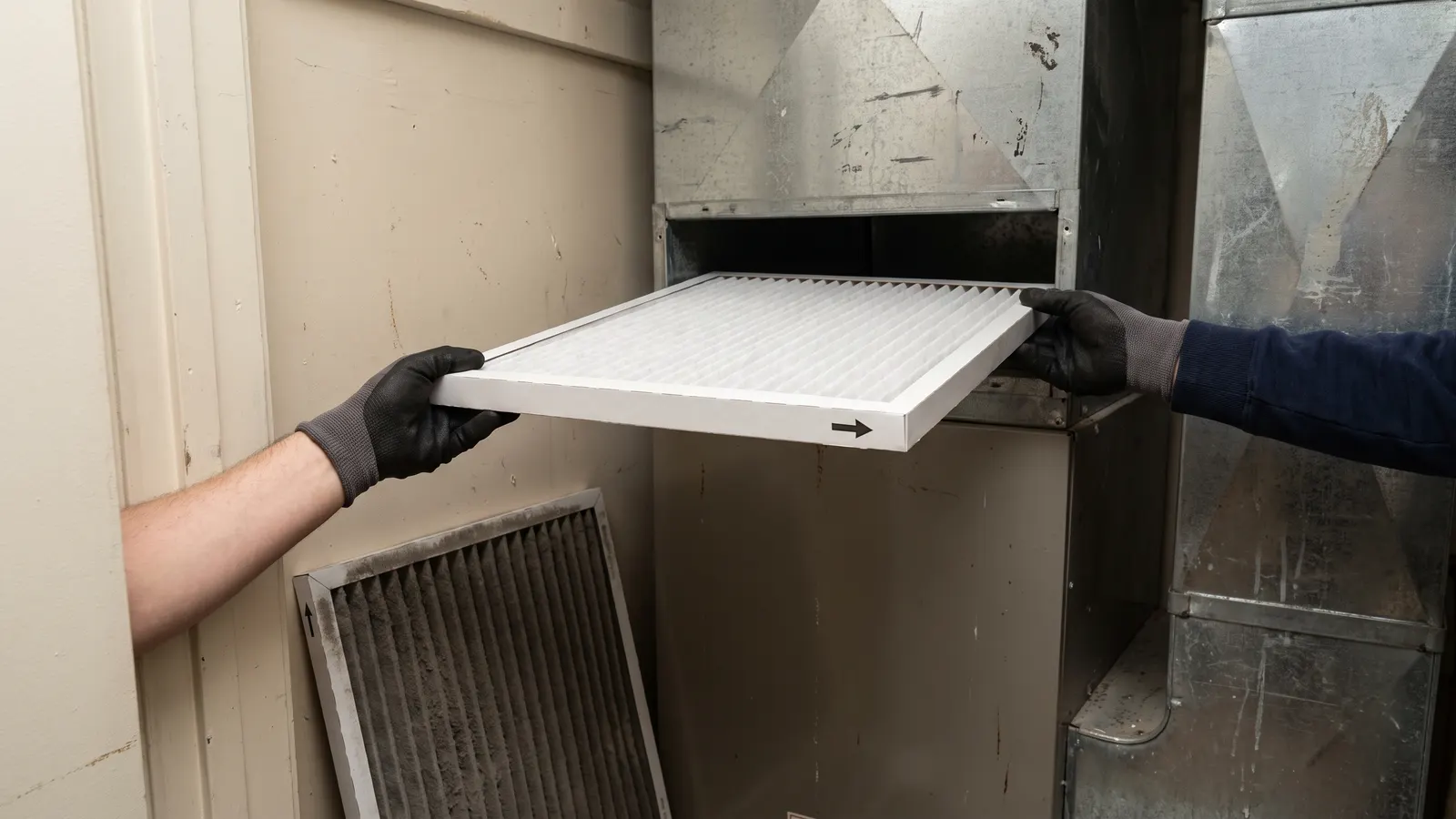
The swap takes about five minutes: turn the system off, find the filter slot, note which way the arrow on the old filter points, pull it, slide the new one in with the arrow facing the same direction, write the date on the frame, close the slot, and turn the system back on. The arrow is the only step people get wrong, so look before you pull.
- Turn the system off at the thermostat. ENERGY STAR's filter-change instructions say to shut off the furnace, A/C, and fan first so the blower is not pulling air while the slot is open.
- Find the filter. It sits where the return air enters the equipment: a slot on the side or bottom of the furnace or air handler, behind a door, or in a return grille in a ceiling or wall.
- Look at the arrow on the old filter's frame before you remove it. It points in the direction of airflow, toward the blower. Note which way it faces.
- Pull the old filter out. Bag it if it is dusty; there is no reason to shake it over the floor.
- Slide the new filter in with the arrow pointing the same way, toward the furnace or blower. It should fit snugly with no gap at the edges.
- Write today's date on the frame.
- Close the door or grille. If the slot has no cover and you can see the edge of the filter, a strip of tape or a magnetic cover keeps unfiltered air from slipping past.
- Turn the system back on. Done when: air is moving at the registers, nothing rattles, and the date is on the frame.
The arrow question is the one people get wrong. Air moves from the rooms, through the return, through the filter, and into the blower. The arrow points the way the air goes:
- Return grilleAir comes back from the rooms
- FilterThe arrow on the frame points this way, toward the blower
- Blower and coilThe equipment the filter protects
- Supply registersFiltered air goes back out to the rooms
When should you stop and call a pro?
Changing a filter is safe for anyone. Call a technician instead if the filter slot is inside the equipment cabinet and you cannot reach it without removing panels that hide wiring or the burner, if the old filter is wet (that points to a condensate or coil problem), or if the new filter turns gray in a week or two (that points to a duct leak pulling in attic or crawlspace air, which is a job for someone with a duct tester).
What should you record?
Note the filter size, the MERV rating, and the date each time. If you keep the record in the same place as the rest of the house, the pattern tells you things: a filter that used to last three months and now lasts six weeks is a sign that something changed in the ducts, the house, or the equipment. Set the task to repeat so the next check is not a memory exercise; put it on a recurring schedule and the reminder comes back on its own.
Common questions
Can I run the system without a filter for a day?
Do not. An unfiltered blower pulls dust straight onto the evaporator coil and into the ducts, which is far harder to clean than swapping a filter. Buy the filter first, then remove the old one.
Which way does the arrow go?
The arrow on the filter frame points in the direction the air moves, which is toward the furnace or blower and away from the return duct. If you are unsure, look at the old filter before you pull it out.
Is a higher MERV always better?
Only if your system can move air through it. A dense filter in a system built for a thin one starves the blower. Check the manual or ask the technician at the next tune-up before going above what the equipment shipped with.
What should you do next?
Buy a year's supply in the right size so the swap never waits on a store trip. Then read what an annual tune-up should include, because a clean filter and a serviced system are two halves of the same job. If you have been wondering whether the ducts themselves need cleaning, the answer is usually no, and the EPA explains when it is yes.