On this page
Care for a heat pump in winter by holding one temperature instead of setting back, keeping the outdoor unit clear of snow, ice, and drifted leaves, letting the defrost cycle finish without interfering, and cleaning or changing the filter when it looks dirty. Reserve the emergency heat setting for a real failure. A heat pump works hardest in the coldest weeks of the year, and the outdoor unit is the part that needs a look after every storm.
An air-source heat pump moves heat from the outdoor air into the house rather than making heat from fuel, and moves it the other way in summer. The outdoor unit is not an air conditioner sitting idle in January; it is the machine doing the heating.
Why does a heat pump need different winter care?
A heat pump needs different winter care because it heats by pulling heat out of cold outdoor air, so anything that slows air across the outdoor coil, or forces a recovery from a deep setback, pushes the work onto the electric backup strips. ENERGY STAR's page on air-source heat pumps says a heat pump can deliver up to three times more heat energy than the electrical energy it consumes, and that certified cold-climate units are tested down to 5 F and keep working below that, with backup heat most efficient at the lowest temperatures.
How often should you check it?
Look at the outdoor unit after every snowfall and ice storm, and once a week during a cold snap; check the filter monthly; and book the heating check-up in the fall before contractors get busy. ENERGY STAR's heat pump page says filters should be cleaned when visibly dirty or when the filter light comes on, and the Department of Energy's home energy checklist says to make sure a furnace or heat pump receives professional maintenance each year.
- FallBook the heating check-up, clean the outdoor unit, set the thermostat to heat at one temperature
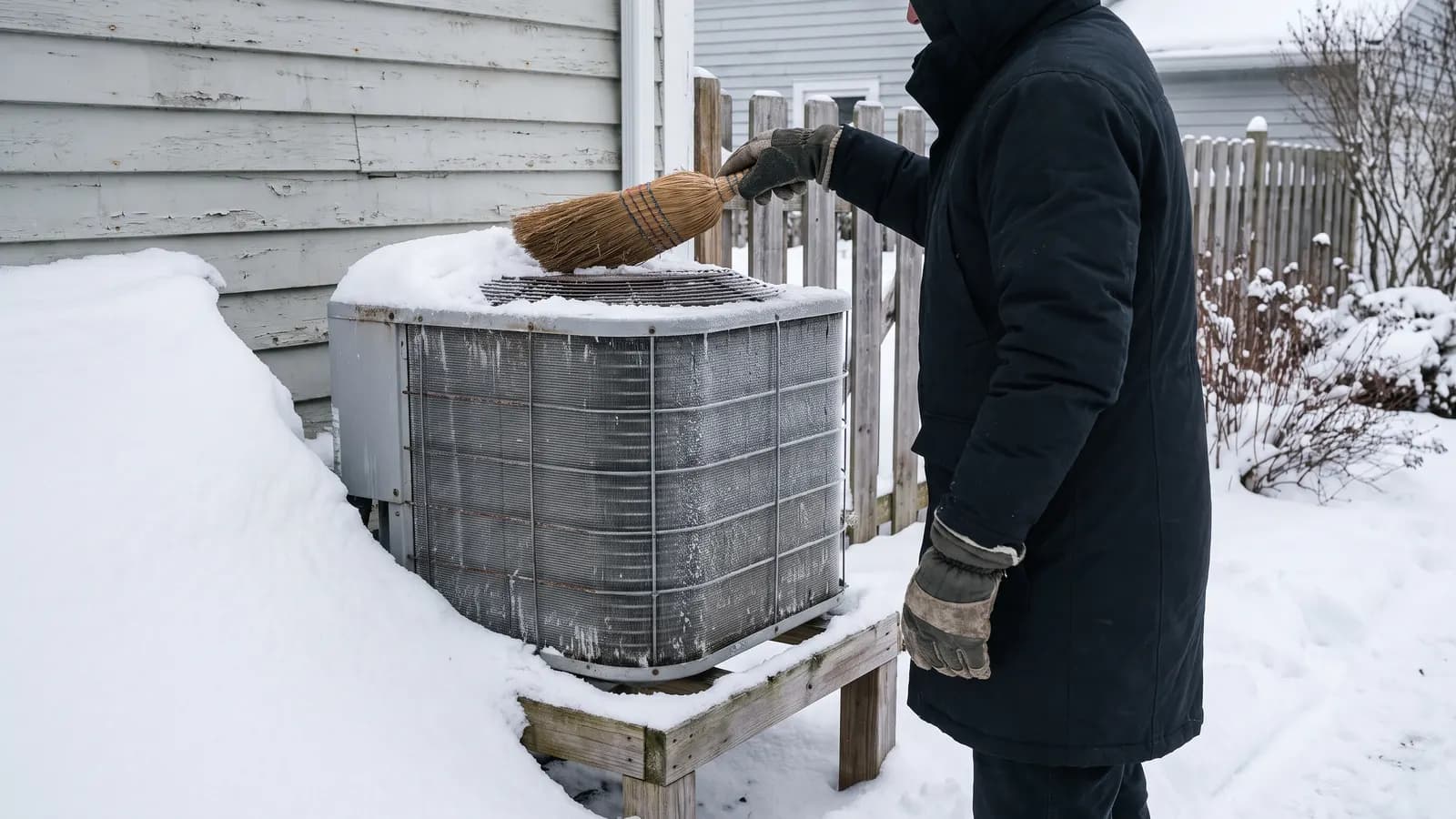
- After each snowBrush the unit clear on every side and check the ground under it for ice
- Cold snapWatch a defrost cycle and note how often the aux heat indicator comes on
- MonthlyLook at the filter
- SpringSwitch the mode to cool and clean the unit again
What do you need?
You need a broom or gloved hands for snow, a flashlight, a spare filter or the cleanable filter's instructions, and the thermostat manual, which tells you what the aux or emergency heat indicator looks like on your model. A small level checks the pad. No tools go near the coil; a shovel or an ice scraper bends the fins and can puncture the coil.
- A broom and work gloves
- A flashlight
- A spare filter in the right size, or the manual's cleaning instructions for a washable one
- The thermostat manual, to identify the aux and emergency heat indicators
- A small level for the pad
What are the steps?
Set the thermostat to heat at one temperature, set the fan to auto, clear the outdoor unit and the ground around it, check the filter, watch one defrost cycle to learn what normal looks like, and note how the aux heat behaves in a cold snap. Then write down what you saw so next winter has a baseline.
- Set the thermostat mode to heat, not auto, and one comfortable temperature. ENERGY STAR's heat pump page says to use heat or cool rather than auto to avoid mode switching on unseasonable days, and to pick a comfortable temperature and leave it there. A thermostat schedule with setbacks is for furnaces, not for this system.
- Set the fan to auto, or the lowest speed that spreads the air enough.
- Brush snow off the top and every side of the outdoor unit with the broom or your hands. Clear drifts back so air can pass through the fins. Done when: you can see fins on every side and the fan grille on top.
- Look under and around the unit for ice from defrost water. A unit sitting on the ground with ice building beneath it needs a riser; note it for the technician. Fix any gutter or roof edge that drips onto the unit.
- Check the filter. Clean or replace it if it looks dirty. Write the date on the frame.
- Watch one defrost cycle on a cold, damp day: the outdoor fan stops, steam rises off the coil, the indoor air runs cool or the backup heat comes on, then the unit resumes a few minutes later. Done when: the coil is clear of frost after the cycle ends.
- During the next cold snap, notice the aux heat indicator on the thermostat. Aux during a deep freeze or right after someone raised the set point is normal. Aux on constantly in mild weather is not.
- Confirm every supply register is open and nothing is stacked against the returns. A heat pump moves a lot of air at a mild temperature, so a blocked return makes it feel weak.
- Set the level on the outdoor unit. A pad that has tilted enough to strain the copper lines goes on the list for the technician.
When should you stop and call a pro?
Call an HVAC technician if the outdoor unit is encased in ice that a defrost cycle does not clear, if the aux or emergency heat indicator stays on in mild weather, if the unit runs constantly without reaching the set point, if it grinds or buzzes loudly, or if the breaker trips. Refrigerant, the reversing valve, and the compressor are licensed work. A new home's heat pump that struggles through its first winter may be sized wrong; ENERGY STAR says the contractor should size it with Manual J, so ask the builder while the warranty is open.
The fall check-up is where the technician tests the defrost control and the backup heat; read what the tune-up should include before you book it. If you leave the house for a week in winter, hold the heat rather than shutting the system off: the American Red Cross's frozen pipes page says to leave the heat on and set no lower than 55 F, and the rest of the freeze list applies to a heat pump house like any other.
What should you record?
Record the date of each snow clearing, what the defrost cycle looked like, how often the aux heat ran in the cold snap, the filter date, and the model and serial from the outdoor unit's nameplate. A note that says "aux on most of the coldest night, house held" is the baseline that tells you next winter whether something changed. Put the after-snow check and the monthly filter look on a recurring schedule in the home record, and add the fall check-up as a yearly task so it is booked before the first cold week.
Common questions
Why is the outdoor unit steaming while the air inside blows cool?
That is the defrost cycle. Frost builds on the outdoor coil in cold, damp weather, and the unit briefly runs in reverse to melt it, which sends steam off the coil and cool air, or backup heat, inside for a few minutes. It is normal. Ice that coats the whole unit and never clears is not.
When should I use emergency heat?
Only when the heat pump has failed and a technician is on the way. The emergency heat setting runs the electric backup alone, which is the costliest way to heat the house. In ordinary cold weather the thermostat brings the backup on by itself when it is needed; you do not need to help it.
Should I turn the heat pump down at night?
No. ENERGY STAR says heat pumps do not save energy by being turned down when you are away or asleep, because the recovery leans on the backup heat. Pick a comfortable temperature and leave it there, day and night.
What should you do next?
Go outside after the next snow and look at the unit; that one habit covers most of this guide. When the season turns, clearing and cleaning the outdoor unit is the spring half of the same job.