On this page
Clear and clean the outdoor AC unit once a year in spring, and again after storms or heavy pollen: switch off the power at the disconnect and the breaker, pull leaves and grass off the fins, cut plants back to an arm's length on every side, rinse the coil gently from the inside out with a garden hose, and straighten bent fins with a fin comb. Dirt on the coil makes the system run longer to shed the same heat. The job takes under an hour.
The outdoor unit (the condenser on an air conditioner, or the outdoor half of a heat pump) holds a coil, a fan, and the compressor. Its job is to dump the heat pulled out of the house, and it can only do that if air moves freely through the fins.
Why does a dirty outdoor unit matter?
A dirty outdoor unit matters because the coil sheds heat through its fins, and anything on the fins (cottonwood fluff, grass clippings, dryer lint, a hedge) slows the air through them. The compressor then runs longer to do the same work, which shows up as a higher bill and, over years, a shorter life. ENERGY STAR's maintenance checklist lists cleaning the condenser coil among the cooling check-up tasks and says airflow problems can reduce a system's efficiency by up to 15 percent.
Garden hose
- Gentle spray, from inside the unit outward where you can reach
- Washes dirt out the way it came in
- Leaves the fins standing
- Safe for a homeowner once the power is off
Pressure washer
- Flattens aluminum fins on contact
- Drives dirt deeper into the coil
- A flattened coil is a service call
- The one tool to leave in the garage
How often should you clean it?
Clean the outdoor unit once a year in spring, before the cooling season, and look at it again after a storm, at the end of pollen or cottonwood season, and whenever you mow or trim nearby. ENERGY STAR's checklist puts the contractor's cooling check-up in spring, so have the unit clean and clear before the annual tune-up; the coil cleaning the technician does is the deeper one.
A heat pump works all year, so its outdoor unit gets a second look in fall and after every snow. ENERGY STAR's page on air-source heat pumps says a heat pump can deliver up to three times more heat energy to a home than the electrical energy it consumes, and that work depends on the same coil in January as in July. Winter care for a heat pump is its own list.
What do you need?
You need a garden hose with a spray nozzle, work gloves, a soft brush, and a fin comb, which is a plastic comb sized to the fin spacing on the coil. Pruning shears handle the plants, a shop vacuum clears the base, and a level tells you whether the pad has settled. A foaming coil cleaner is optional; follow its label and rinse well.
- A garden hose with an adjustable nozzle
- Work gloves and eye protection
- A soft brush and a shop vacuum
- A fin comb (match it to the fins per inch printed on the package)
- Pruning shears for the plants around the unit
- A small level for the pad
What are the steps?
Turn the system off at the thermostat, kill the power at the disconnect and the breaker, clear the plants and the debris, rinse the coil from the inside out, comb the fins, check the pad and the line insulation, and restore power in the reverse order. Work from the outside of the unit unless the manual shows how to lift the fan grille.
- Set the thermostat to off. Then switch off the disconnect box on the wall beside the unit (pull the block or flip the switch) and the breaker for the outdoor unit at the panel. Done when: the fan cannot start.
- Cut plants back to an arm's length on every side and remove anything leaning on or stacked against the unit. Nothing should overhang the fan on top.
- Pull debris off the outside of the fins by hand and with the soft brush, stroking along the fins rather than across them. Vacuum the base.
- If the manual shows how, remove the top grille and lift the fan aside without straining its wires, so you can rinse from inside the coil. If it does not, work from outside.
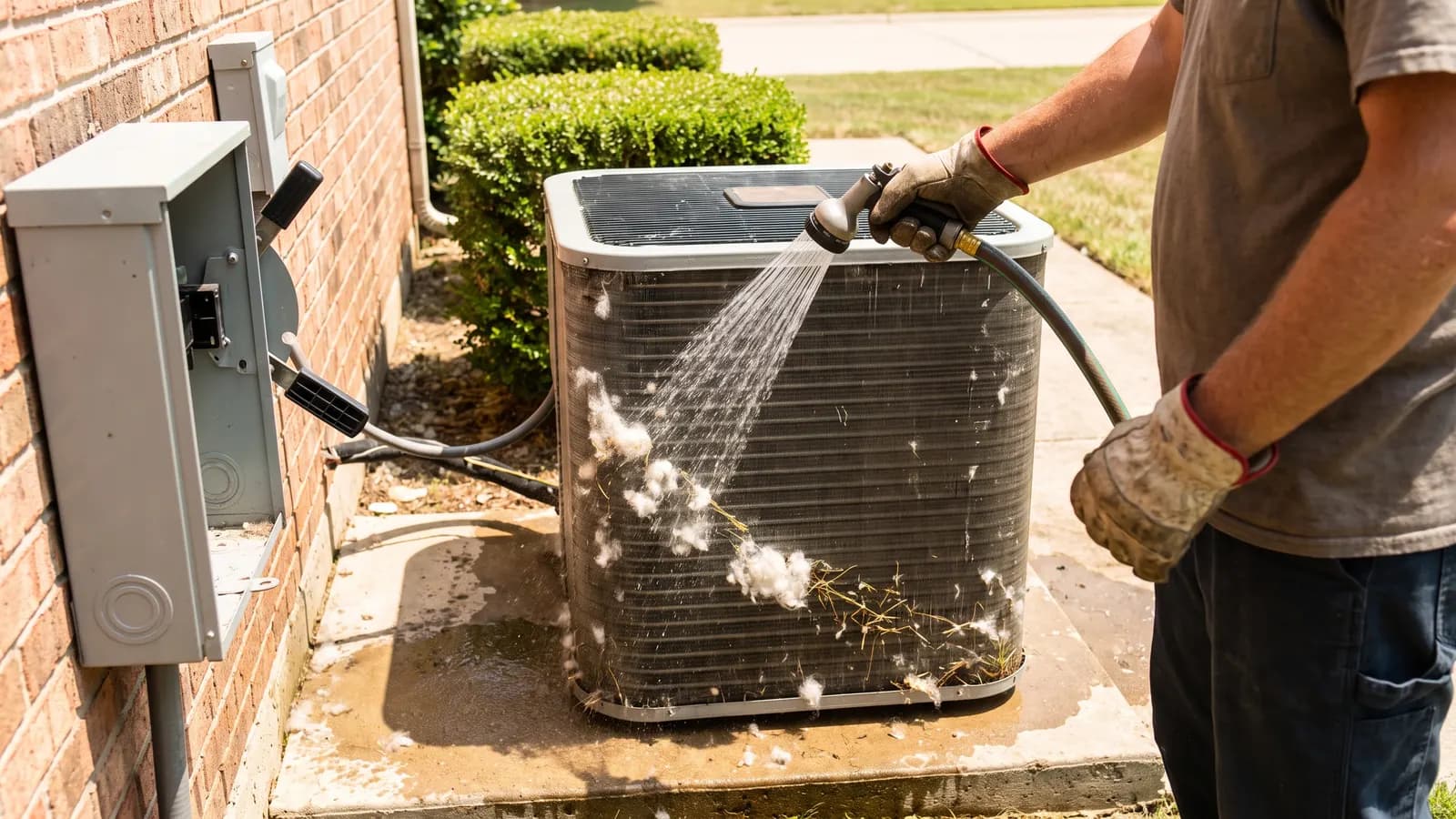
- Rinse the coil with the hose on a gentle setting, from the inside out where you can reach, or at a slight downward angle from outside. Work all the way around. Done when: the water running out at the bottom is clear.
- Comb bent fins straight with the fin comb, working in the direction of the fins. A few bent fins do not matter; a flattened patch the size of your hand does.
- Set the level on top of the unit. A pad that has tilted enough to strain the copper lines is a job for the technician; note it.
- Look at the foam insulation on the larger copper line. Torn or missing insulation is a small fix; note it for the tune-up.
- Let the coil dry, then restore the breaker, the disconnect, and the thermostat in that order. Run the system. Done when: the fan spins smoothly with no rattle and the air blowing off the top feels warm in cooling mode.
When should you stop and call a pro?
Call an HVAC technician if the fan hums but does not spin, if the unit trips its breaker, if ice forms on the copper lines in summer, if the coil has a large flattened area a comb cannot fix, or if the pad has sunk or tilted enough to pull on the line set. Refrigerant, the compressor, the fan motor, and anything behind the side panel are licensed work, not a Saturday job.
A clean coil and a house that still cools slowly points somewhere else: a dirty indoor filter, a plugged drain, or a duct leak. Check those before you book the call.
What should you record?
Record the date, what was on the coil, the condition of the pad and the line insulation, and the model and serial from the nameplate on the unit's side. If you have never written those down, reading the equipment label takes two minutes while you are standing there. In Property Station the disconnect's location belongs under Shutoffs & Key Locations, and the cleaning itself goes on a recurring schedule for the same week each spring.
Common questions
Can I use a pressure washer on the outdoor unit?
No. The aluminum fins on the coil bend under a pressure washer, and a bent fin blocks air as surely as dirt does. Use a garden hose with the nozzle on a gentle spray, from the inside of the unit outward if you can reach, and a fin comb for fins that are already flattened.
Should I cover the unit in winter?
If it is a heat pump, never; it runs all winter. For a cooling-only condenser, a board or a purpose-made top cover keeps leaves and ice out of the fan, but a full wrap traps moisture and invites rust and nesting animals. Check the manual for what the manufacturer allows.
What is the gray box on the wall next to the unit?
That box is the disconnect. It cuts power to the outdoor unit so a technician, or you, can work on it without walking to the panel. Pull the block or flip the switch, and switch off the breaker as well, before your hands go anywhere near the fan or the fins.
How much clear space does the unit need?
Enough to walk around it: roughly an arm's length on every side and nothing above the fan. The manual for your unit gives the exact clearances. They matter most on the side with the refrigerant lines and the electrical box, because that is where the technician has to work.
What should you do next?
While the power is off and the hose is out, clear the condensate drain line too; its outdoor end is usually a few feet from the unit. Then look at the shrubs you cut back and decide whether they belong there at all: keeping trees and shrubs away from the house covers the spacing that keeps this job small.