On this page
Pipes freeze where they are exposed to cold air and the water in them is not moving. Prevention is about those two things: get insulation or warm air to the exposed runs, and keep water moving through the vulnerable ones on the coldest nights. Everything below is the American Red Cross's guidance plus the details that make it work in a real house.
The reason to take it seriously is that a frozen pipe rarely fails where it froze. Ice expands and raises pressure in the whole line between the blockage and a closed faucet; the pipe splits at its weakest point, and the split does not leak until the ice thaws. That is why the flood happens the afternoon after the cold night, often while nobody is home.
Where do pipes freeze?
Pipes freeze where they meet cold moving air: outdoor hose bibs, runs through an unheated garage, crawlspace, or attic, supply lines in exterior walls under kitchen and bathroom sinks, irrigation lines and backflow preventers, and any pipe near a foundation vent or a gap that lets wind in. Interior walls in heated rooms almost never freeze. Walk the house once and list the runs that need attention:
- Outdoor hose bibs and any pipe feeding them
- Pipes in an unheated garage, crawlspace, attic, or basement
- Supply lines in exterior walls, especially under kitchen and bathroom sinks on outside walls
- Irrigation lines and backflow preventers
- Pipes near foundation vents, dryer vents, or gaps where cold air enters
The American Red Cross's page on frozen pipes says to keep the thermostat at the same temperature day and night, to leave the heat on and set no lower than 55°F when away in cold weather, to let cold water drip from a faucet served by exposed pipes, and to open kitchen and bathroom cabinet doors so warm air reaches the plumbing.
What are the steps before the first freeze?
Before the first freeze, get water out of the pipes that will be exposed and get insulation onto the ones that cannot be drained: disconnect hoses, drain and shut off outdoor faucets, drain or blow out irrigation, sleeve exposed runs with foam, seal the air leaks near pipes, and find and label the main shutoff. An afternoon in October covers all of it.
- Disconnect garden hoses and store them. A hose left attached holds water against the bib and can freeze the valve behind it. Done when: no hose is on any outdoor faucet.
- Shut off and drain outdoor faucets that have an interior shutoff valve. Close the valve inside, then open the outdoor faucet to drain the run. Leave it open. If the bib is a frost-free type with no interior valve, disconnecting the hose is the step.
- Drain the irrigation system if you have one, or have the irrigation company blow it out. A backflow preventer full of water will crack.
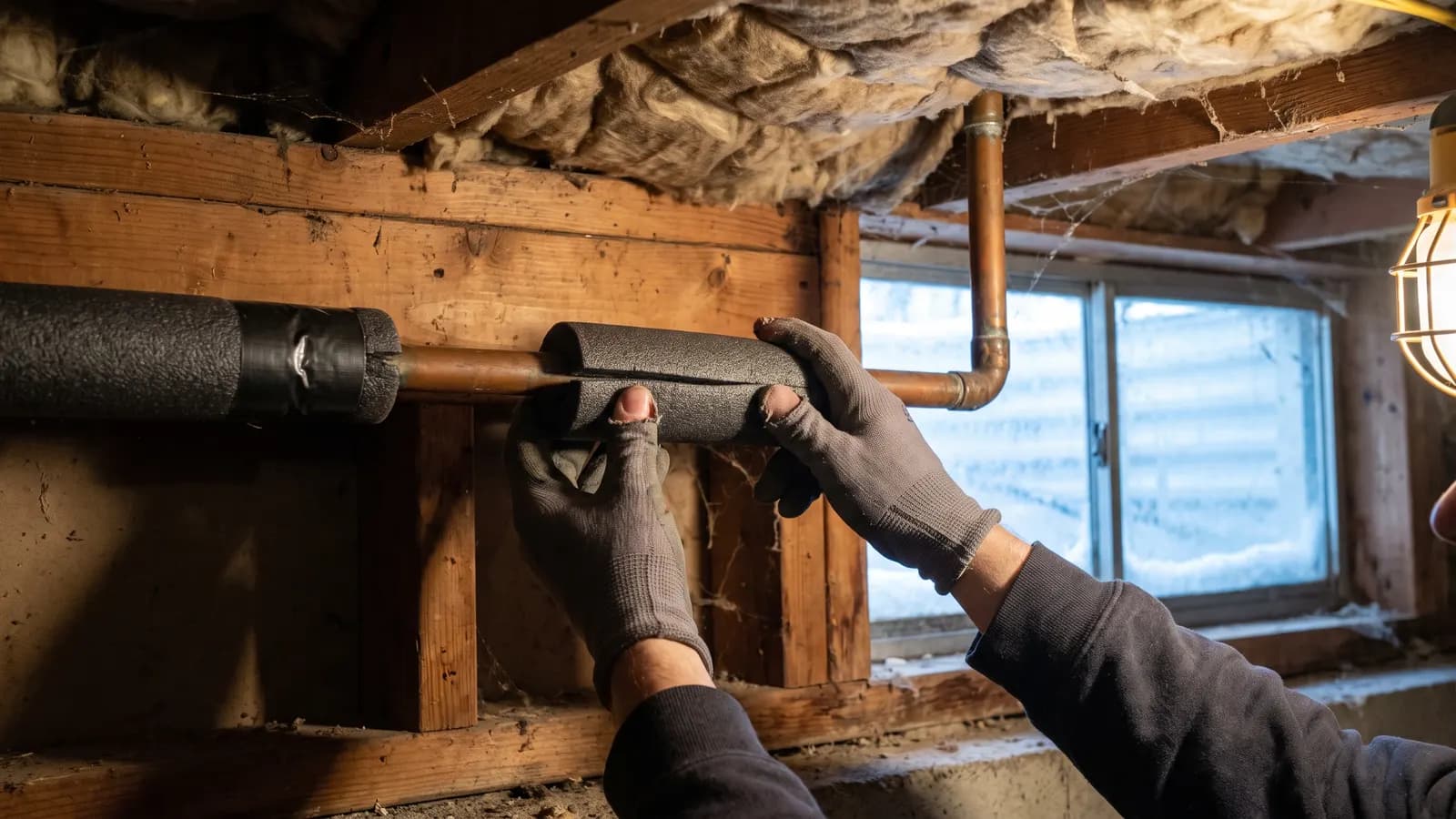
- Insulate exposed pipes with foam sleeves. Foam pipe sleeves are cheap and slit lengthwise; press them on, tape the seams, and pay attention to elbows and valves, where the sleeve wants to gap. Done when: no bare pipe is visible in unheated spaces.
- Seal the air leaks near pipes. Cold air moving over a pipe freezes it faster than still cold air. Foam or caulk gaps around pipe penetrations in the rim joist, and close foundation vents for the winter if your crawlspace design allows it.
- Find and label the main water shutoff. Everyone in the house should know where it is and how to turn it. Done when: you have turned it off and back on once, and it moves.
What are the steps on a hard-freeze night?
On a hard-freeze night the job is to keep water moving and warm air reaching the vulnerable pipes: hold the thermostat steady, open the cabinet doors under sinks on exterior walls, let a cold tap drip at the far end of each exposed run, keep the garage door closed, and, if you are away, leave the heat at 55°F or above with someone checking the house.
- Hold the thermostat steady. Do not set back the heat at night during a deep cold snap; the setback is what lets an exterior wall get cold enough.
- Open the cabinet doors under sinks on exterior walls so room air reaches the pipes.
- Let a cold-water faucet drip on the fixtures served by exposed pipes, at the far end of the run. Moving water is much harder to freeze, and an open faucet relieves the pressure that splits a pipe if ice does form.
- Keep the garage door closed if there are water lines in the garage.
- If you will be away, leave the heat on at 55°F or above and have someone check the house.
What should you do if a pipe freezes?
If a pipe freezes, keep the faucet open, find the frozen section by feel, and thaw it with gentle heat (a heating pad, a hair dryer, or hot towels) working from the faucet toward the ice, never with a flame. You will know because a faucet slows to a trickle or stops on a cold morning. Act before it thaws on its own, because the split, if there is one, leaks when the ice lets go.
- Keep the faucet open. As you thaw the pipe, water and steam need somewhere to go, and the flow helps melt the rest.
- Find the frozen section. Follow the pipe from the dead faucet toward the supply, feeling for the coldest part, usually where it passes an exterior wall or an unheated space.
- Apply gentle heat. The Red Cross lists an electric heating pad wrapped around the pipe, a hair dryer, a portable space heater kept away from anything flammable, or towels soaked in hot water. Work from the faucet end back toward the blockage.
- Never use a blowtorch, a propane or kerosene heater, a charcoal stove, or any open flame. Pipes have been set on fire this way, and the fire is worse than the flood.
- Check every other faucet in the house. If one pipe froze, others may have.
When should you stop and call a pro?
Shut off the main water valve and call a plumber if you cannot find the frozen section, if it is inside a wall you cannot reach, or if you find any water on a floor, ceiling, or wall. If a pipe has already burst, the shutoff is the first move and the plumber is the second; every minute the main is open is more water in the house. Wet electrical outlets or fixtures mean the breaker for that area goes off before anyone touches anything.
What should you record?
Note which faucets you drained, where the foam sleeves went, and the date, so next fall is a checklist instead of a rediscovery. If a pipe did freeze, record where; that spot needs insulation or rerouting before next winter, and it is the kind of fact the next owner will want. Set the fall winterizing and the spring reopening as recurring tasks in the maintenance schedule.
Common questions
How cold does it have to be for pipes to freeze?
It depends on where the pipe runs, not just the outdoor temperature. A pipe in an exterior wall or an unheated crawlspace can freeze on a night that is only a little below freezing if the wind finds it, while a pipe in a heated interior wall may never freeze. Protect the exposed ones and you have covered most of the risk.
Should I leave the heat on when I travel in winter?
Yes. The Red Cross says to leave the heat on and set the thermostat no lower than 55°F. The cost of heating an empty house for a week is small next to the cost of a burst pipe that runs for a week.
What should you do next?
While the hoses are put away, clear the gutters and check where the downspouts discharge; ice dams and foundation water are the other two winter problems that start outside. If your region also gets tropical storms, the seasonal prep post lays out both lists. And if the water heater lives in the same cold garage or basement, flush it while you are there.