On this page
Flush a tank water heater to clear the sediment that settles on the bottom, where it sits between the heat source and the water. The Department of Energy's guidance is to drain a quart from the tank every three months; a full flush once a year is the schedule many owners keep instead. Either is far better than the most common schedule, which is never.
Sediment is minerals from the water that drop out when it is heated. On a gas heater the layer insulates the burner from the water, so the tank runs longer and the steel under the sediment gets hotter than it was designed for. On an electric heater it buries the lower element. The popping and rumbling you hear from an old tank is water boiling under the sediment layer.
How often should you flush a water heater?
Flush a tank water heater once a year in most homes, or drain a quart every three months if the water is hard. The Department of Energy's guidance is the quarterly quart; a yearly full flush is the common substitute where water is soft or treated. A tank that has never been flushed gets one careful full flush and then joins the schedule. Tankless heaters need a different descaling procedure.
The Department of Energy's Energy Saver guide says to drain a quart of water from the tank every three months to remove sediment, to set the temperature to 120°F, and that most storage water heaters last 10 to 15 years.
| Water | Schedule |
|---|---|
| Soft or treated water | Full flush once a year |
| Hard water, no softener | A quart every three months plus a full flush once a year |
| Tank has never been flushed and is more than a few years old | One careful full flush, then the schedule above |
Tankless heaters are a different task (a descaling flush with a pump and vinegar or a descaler) and are outside this guide.
What do you need?
A garden hose, a screwdriver, a bucket, and gloves. The hose must reach a drain, a utility sink, or the outdoors from the valve at the bottom of the tank, and its far end must sit lower than the tank so the water can run out by gravity. Nothing here is specialized; the only thing to buy is a hose if the one you have is too short.
- A garden hose long enough to reach a floor drain, a utility sink, or outdoors, and a place to discharge that is lower than the bottom of the tank.
- A flathead screwdriver if the drain valve has a slotted stem instead of a handle.
- A bucket, if you are doing the quart version.
- Gloves. The water is hot.
What are the steps?
Turn off the heat source, let the water cool, close the cold inlet, open a hot tap upstairs, attach the hose to the drain valve, drain until the water runs clear, close the valve, refill until the tap runs steadily, and only then restore the heat. Follow the manual for your heater first. The PNNL Building America flush guide is the source for the sequence below; where your manual differs, the manual wins.
- Turn the heat source off. Gas: turn the gas control knob to the pilot or vacation setting (or off, per the manual). Electric: switch off the breaker for the heater at the panel. Done when: the burner is not lit or the breaker is off. Never drain an electric tank with the power on; a dry element burns out in seconds.
- Let the water cool if you can wait. An hour or two after shutting off the heat makes the whole job safer. If you cannot wait, treat every drop as scalding.
- Close the cold water inlet valve on the pipe coming into the top of the tank.
- Open a hot water tap somewhere in the house, ideally upstairs. This lets air into the system so the tank can drain.
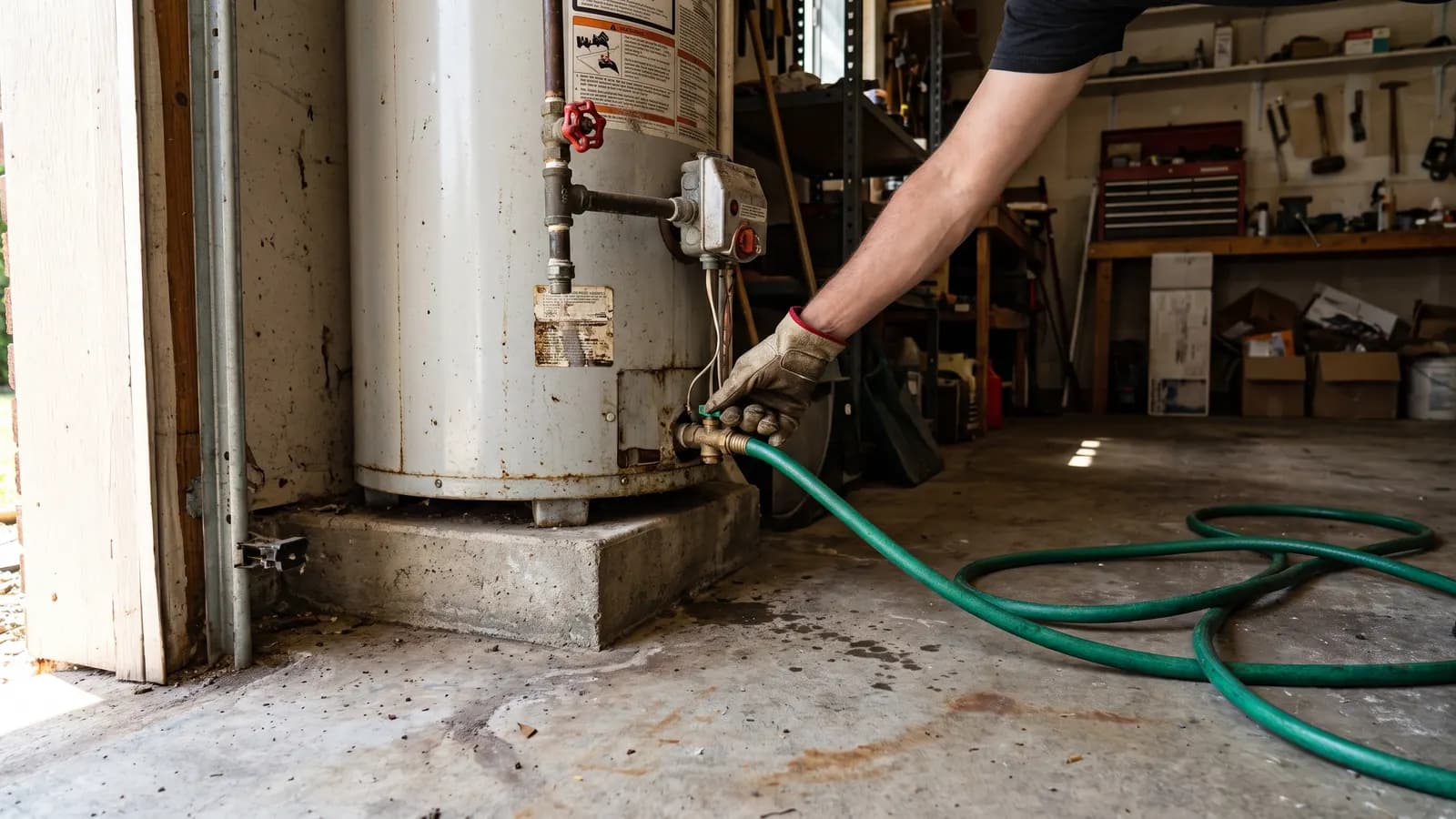
- Attach the hose to the drain valve near the bottom of the tank. Run the other end to the drain or outside, keeping it lower than the tank the whole way.
- Open the drain valve. Water will flow; it is hot and may be discolored. Let it run.
- After twenty minutes or so, or once the flow slows, open the cold inlet valve for about ten seconds to stir up the remaining sediment, then let it drain. Repeat until the water runs clear.
- Close the drain valve. Open the cold inlet and let the tank refill with the hot tap still open. The tap will sputter as air leaves the tank; when it runs steadily, the tank is full. Done when: a steady stream at the hot tap.
- Only now restore the heat. Gas: turn the control back to its setting and relight the pilot if the manual calls for it. Electric: switch the breaker back on. Done when: the burner lights or the tank starts to hum.
- Disconnect the hose over the drain and check the drain valve for drips over the next hour.
For the quart version: skip the shutoff, put a bucket under the drain valve, open it until you have about a quart, and close it. That is the whole task.
When should you stop and call a pro?
Stop if you smell gas at any point; leave the house and call the gas utility. Stop if water is leaking from the tank body (not the valve) once the sediment is out, because that tank is finished. Stop if the temperature and pressure relief valve (the lever valve near the top with a pipe running down the side) drips or will not reseat after you test it; that valve is a safety device and replacing it is plumber's work. Testing the relief valve has its own guide. Do not remove or cap the TPR discharge pipe.
While the tank is cool, this is also the time a plumber would check the anode rod, the sacrificial metal rod inside the tank that corrodes so the steel does not. Checking it means breaking loose a large hex fitting on top of the tank, which usually takes a breaker bar and sometimes an impact wrench; leave it to a pro unless you are set up for it.
What should you record?
Date, whether it was a full flush or a quart, how discolored the water was, and how long it took to run clear. Sediment that takes longer each year is a sign of hard water worth treating. Note the tank's install date and model from the label so the 10 to 15 year window is not a guess. Put the next flush on a recurring reminder; the maintenance schedule handles it.
Common questions
How often should I flush the water heater?
The Department of Energy's guidance is a quart every three months; many owners do one full flush a year instead, which is a reasonable schedule in areas with softer water. Hard water calls for the more frequent version. Your manual wins.
What if the drain valve will not close or keeps dripping afterward?
A plastic drain valve that has never been opened often will not seal again once sediment gets into the seat. Open and close it a few times to clear it. If it still drips, cap it with a garden hose cap as a stopgap and have a plumber replace the valve.
Should I flush a heater that has never been flushed?
On an old tank with years of sediment, a first flush can loosen enough scale to clog the drain valve or expose a leak that the sediment was plugging. Flush it, but do it on a day you could get a plumber if you needed one, and go slowly.
What should you do next?
While you are in the utility room, look at the pipes around the heater for signs of freezing risk; protecting exposed pipes in cold weather is the other plumbing task with a season attached. And if the hot water has been slow to reach the tap, the problem is more often the drains and aerators than the heater; keeping drains clear covers the fixtures.