On this page
Clean gutters at least twice a year: once after the leaves are down in late fall, and once in spring before the heavy rain. Add a third cleaning if the house sits under pines or a heavy canopy, and check after any big storm. The test that matters is whether water runs freely out of the downspouts in rain; if it sheets over the gutter edge instead, the gutter is full, whatever the calendar says.
A clogged gutter fails in two directions. Water spilling over the front soaks the ground at the foundation and finds its way into basements and crawlspaces. Water backing up behind the gutter soaks the fascia board it is mounted to, rots it, and in cold climates freezes into ice dams that push water up under the shingles.
How often should you clean gutters?
Clean gutters at least twice a year, after leaf drop and before spring rain, and more often under pines, heavy canopy, or a new roof shedding grit. Gutter guards stretch the interval to about once a year but do not remove it. The reliable signal is rain: water sheeting over the front edge means the gutter is full, whatever the schedule says.
| Situation | Clean | Also check |
|---|---|---|
| Few trees, open lot | Twice a year (late fall, spring) | After major storms |
| Deciduous trees over the roof | Late fall after leaf drop, again in early winter, and spring | Monthly during leaf drop |
| Pines or heavy year-round canopy | Every three to four months | Downspout outlets monthly |
| Gutter guards installed | Once a year | Whenever water sheets over in rain |
| New construction, first year | Spring and fall | After the first heavy rain, for shingle grit and construction debris |
New roofs shed a surprising amount of shingle grit in the first year, and new-construction gutters often hold sawdust, nails, and packaging from the build. The first spring cleaning on a new house is usually the dirtiest one it will ever have.
What do you need?
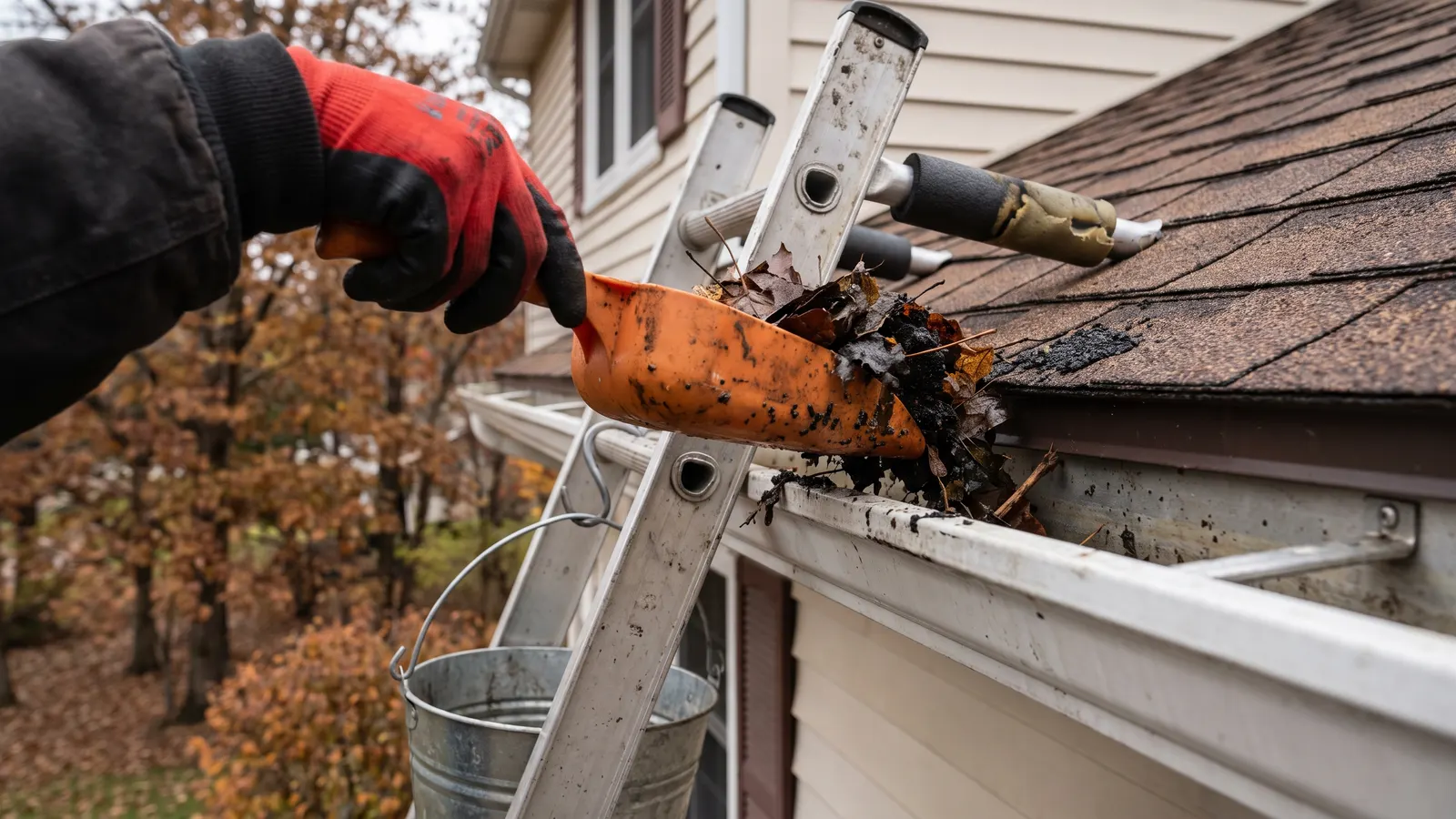
An extension ladder with a standoff so it rests on the wall or roof and never on the gutter, a helper to foot it, gloves, safety glasses, grippy shoes, a gutter scoop, a bucket with a hook or a tarp below, a garden hose with a spray nozzle, and a plumber's snake or a downspout brush for a stubborn clog. The ladder and the helper are the safety equipment; everything else is convenience.
- A sturdy extension ladder with a standoff or stabilizer so the ladder rests on the roof or wall, not on the gutter
- A helper to foot the ladder
- Work gloves, safety glasses, and shoes with grip
- A gutter scoop or a small plastic trowel
- A bucket with a hook, or a tarp on the ground
- A garden hose with a spray nozzle
- A plumber's snake or a downspout brush for a stubborn clog
What are the steps?
Set the ladder safely, work from it rather than reaching, scoop the debris toward the downspout, clear the downspout outlet, flush the run with the hose and watch the flow, clear any clog from the bottom of the downspout upward, check that each extension carries water away from the foundation, and look at the hangers, seams, and fascia while you are up there. Move the ladder often; never lean out.
- Set the ladder on firm, level ground with the base one foot out for every four feet of height. Have your helper foot it. Done when: the ladder does not move when you push it side to side from the second rung.
- Work from the ladder, not the roof, and keep your hips between the rails. Move the ladder rather than reaching. Every gutter fall we hear about involves reaching.
- Start near a downspout and scoop the debris into the bucket, working away from the outlet. Clear the leaves and the wet compacted layer underneath; that layer is what holds water.
- Check the downspout outlet. Pull out the wad of debris that collects on the strainer or in the drop. If a strainer is missing, add one; it keeps the downspout clear at the cost of an easier-to-see clog.
- Flush the gutter with the hose from the far end toward the downspout. Watch the flow: water should move freely to the outlet and out the bottom of the downspout. Standing water means the gutter has lost its pitch, usually from a loosened hanger.
- Clear a clogged downspout from the bottom up with the hose on full, then from the top with a snake or a downspout brush. If it will not clear, disconnect the lower elbow and clear it by hand. Done when: water from the top runs out the bottom at full flow.
- Check the downspout extensions. Each one should discharge several feet from the foundation onto ground that slopes away, or into a drain line. Reattach any that have been kicked off by the mower.
- Look along the gutter for loose hangers, separated seams, and sagging sections. Tighten hangers, and note anything that needs sealant or a new bracket.
- Look at the fascia behind the gutter for dark stains, soft wood, or peeling paint, which are signs of water getting behind the gutter.
When should you stop and call a pro?
Call a gutter or roofing company if the gutters are on a second story you cannot reach safely from a ladder on firm ground, if the roof pitch or the ground makes a stable ladder placement impossible, if you find rotted fascia (the gutter needs to come down to fix it), or if the gutters pool water after cleaning and need re-pitching. Never lean the ladder against the gutter itself; it bends the gutter and the ladder can slide. Do not work on a wet or windy day, and never near power lines coming into the house.
What should you record?
Note the date, how full the gutters were, which downspouts were clogged, and any fascia damage or loose hangers you saw. Two clogs in the same downspout is a tree or a missing strainer; the log shows the pattern. Put the fall and spring cleanings on a recurring schedule so the reminder arrives with the season.
Common questions
Do gutter guards mean I never have to clean gutters?
They reduce the frequency, not the need. Fine debris, shingle grit, and seed pods still collect on top of and behind most guards, and the downspout outlets still clog. Check guarded gutters once a year and clean them when water sheets over the edge in rain.
How far from the house should a downspout discharge?
Far enough that the water does not soak the soil next to the foundation. In practice that means an extension of several feet onto ground that slopes away from the house, or a connection to a drain line that carries it further. Splash blocks alone rarely move water far enough.
What should you do next?
While the ladder is out, do the annual roof check from the same position: the gutter line is where most roof problems first show. And if the siding under the gutters has green or black streaks from years of overflow, washing the exterior is the next weekend's job.