On this page
Wash the exterior of a house with low pressure, a wide nozzle, a detergent that does the work, and a rinse from the bottom up and then the top down. Once a year is enough for most homes. The mistakes that damage siding, windows, and trim all come from the same cause: using pressure to do what soap and time should do.
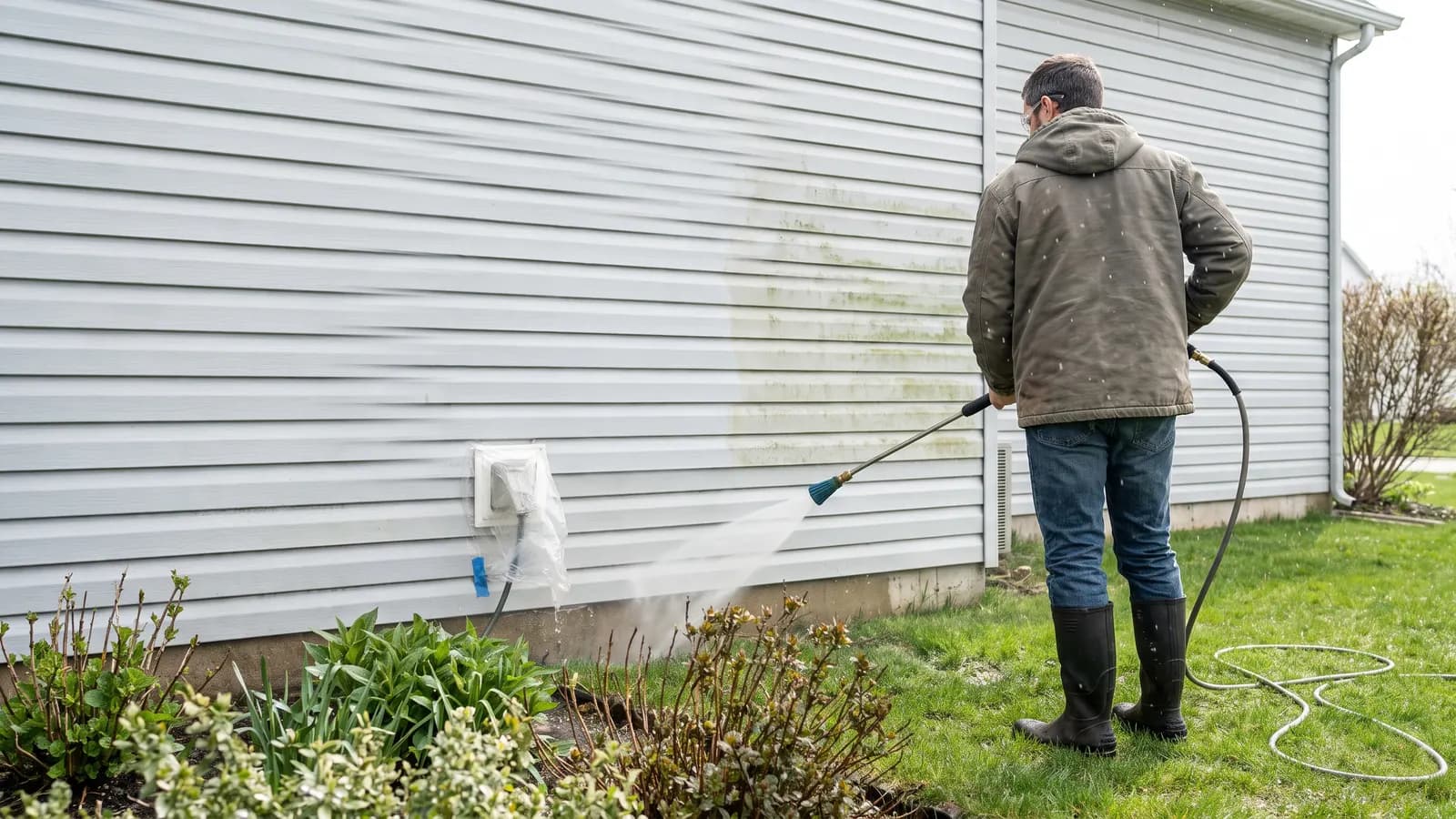
A pressure washer at full force will strip paint, gouge wood, crack vinyl, force water behind siding and into wall cavities, and blow the seal on a window. It will also drive water under shingles and into soffit vents. Used gently, the same machine takes a season of pollen, algae, and grime off in an afternoon.
What should you wash, and what should you avoid?
Wash siding, brick, stucco, concrete, and decks with detergent and low pressure from a distance; hand-wash windows, doors, fixtures, and outlets; and never pressure wash the roof, soffit vents, the electrical service entrance, or the AC condenser. The table below gives the approach for each surface and the one thing that damages it.
| Surface | Approach | Never |
|---|---|---|
| Vinyl or fiber-cement siding | Detergent, dwell, rinse with a 25° or 40° nozzle from a distance | Spray upward into the lap joints |
| Painted wood siding or trim | Detergent, soft brush, gentle rinse | Use a narrow nozzle; it strips paint |
| Brick and stucco | Low pressure only; mortar and stucco are softer than they look | Spray mortar joints up close |
| Concrete driveway and walks | Higher pressure is fine; a surface cleaner attachment leaves no stripes | Aim at expansion joint sealant |
| Wood deck | Detergent, then the widest nozzle at a distance, with the grain | Get close; it raises the grain and leaves wand marks |
| Windows, doors, light fixtures, outlets | Hand wash or a garden hose | Pressure wash; the seals fail and water enters |
| Roof | Do not pressure wash | Anything |
| Soffit vents, dryer vents, electrical service entrance, AC condenser | Cover and avoid | Spray directly |
What do you need?
A pressure washer with a detergent injector (or a hose-end sprayer for the soap and the washer only for rinsing), a black soap nozzle plus a 40° nozzle for siding and a 25° nozzle for concrete, a house-wash detergent and a deck cleaner, plastic sheeting and tape to cover fixtures, outlets, and the condenser, eye protection, gloves, closed shoes, and a long-handled soft brush.
- A pressure washer with a detergent injector, or a garden-hose-end sprayer for the soap and the washer for the rinse only
- Nozzles: a black soap nozzle, a 40° (white) nozzle for siding, a 25° (green) nozzle for concrete
- A house-wash detergent made for siding (many contain a mildew remover); deck cleaner for decks
- Plastic sheeting or tarps for plants, light fixtures, outlets, and the AC condenser
- Safety glasses, closed shoes, and gloves
- A long-handled soft brush for stubborn spots
What are the steps?
Close every window and door and cover everything electrical, clean the gutters first, test the nozzle on a hidden spot, apply detergent from the bottom up and let it dwell without drying, brush any growth, rinse from the top down with the wide nozzle angled slightly downward, do the concrete last, uncover and rinse the plants, and check the whole house in raking light for missed spots. Never spray upward into siding laps.
- Walk the house and close every window and door. Cover outdoor outlets, light fixtures, the electric meter, the AC condenser, and any vents with plastic and tape. Wet down plants near the house and cover the tender ones. Done when: nothing electrical is exposed and the plants are protected.
- Clean the gutters first if they are full; the overflow stains you are about to remove will come right back. Gutter cleaning and the house wash are one weekend's job.
- Test the washer on an inconspicuous spot with the nozzle you plan to use, from the distance you plan to use, to see how the surface reacts.
- Apply detergent from the bottom up in sections you can rinse before it dries, about a wall at a time. Bottom up prevents clean streaks running through dirty areas. Let it dwell for the time on the label, usually a few minutes; do not let it dry on the surface.
- Scrub anything with visible growth with the soft brush while the detergent is on it.
- Rinse from the top down with the wide nozzle, holding the wand a few feet from the surface and angled slightly downward so water runs off the siding, never up under the laps. Keep the wand moving. Done when: the rinse water runs clear and no soap film is left.
- Do the concrete last, with the 25° nozzle or a surface cleaner, so its dirty runoff does not land on clean siding.
- Remove the coverings, uncover the plants, and rinse the plants again to clear any detergent that reached them.
- Look at the whole house in raking light for streaks and missed spots, and rinse them.
When should you stop and call a pro?
Hire a soft-wash company for anything above the first story, for roofs (always), for stucco or historic masonry, and for painted wood that is already peeling, where washing will strip it and the real job is repainting. Do not use a pressure washer from a ladder: the recoil from the wand is enough to push you off. Never point the wand at a person or a pet, and keep the spray away from your own feet; the stream injures skin at close range.
If a gas pressure washer is involved, run it outdoors only, well away from open windows and doors; the exhaust is carbon monoxide.
What should you record?
The date, the detergent used, and any spots that would not come clean or any damage you found (soft wood, loose siding, failed caulk). Those are next weekend's repairs and worth photos. Put the annual wash on the schedule for the same month next year.
Common questions
Can I pressure wash the roof?
No. High pressure strips the granules off asphalt shingles and forces water under them, and on tile or metal it can crack or dent the surface. Roof algae and moss are treated with a low-pressure cleaner applied by a roofing or soft-wash company, or left alone if they are only cosmetic.
How often should I wash the house?
Once a year for most houses, in spring after pollen season or in fall before the wet months. Shaded north sides and areas under trees may need it twice. If green or black growth is visible, it is time, whatever the calendar says.
What should you do next?
A clean exterior makes the annual roof check easier: staining, lifted edges, and cracked caulk stand out against clean siding. Look for them the same day, from the ground, with the binoculars.