On this page
Get the HVAC ready for winter with four moves before the first cold night: book the pre-season heating check with a contractor, put in a new filter and write the date on it, run the system on a mild day so a problem shows up in October rather than January, and set the thermostat for the equipment you have (a setback for a furnace, a steady temperature for a heat pump). Then clear three feet around the equipment and test the alarms, because winter is when everything burns with the windows shut.
This is the heating chapter of the fall home maintenance checklist. The tasks below split into the ones a technician does and the ones you do, and both belong on the calendar.
What does a pre-season heating check cover?
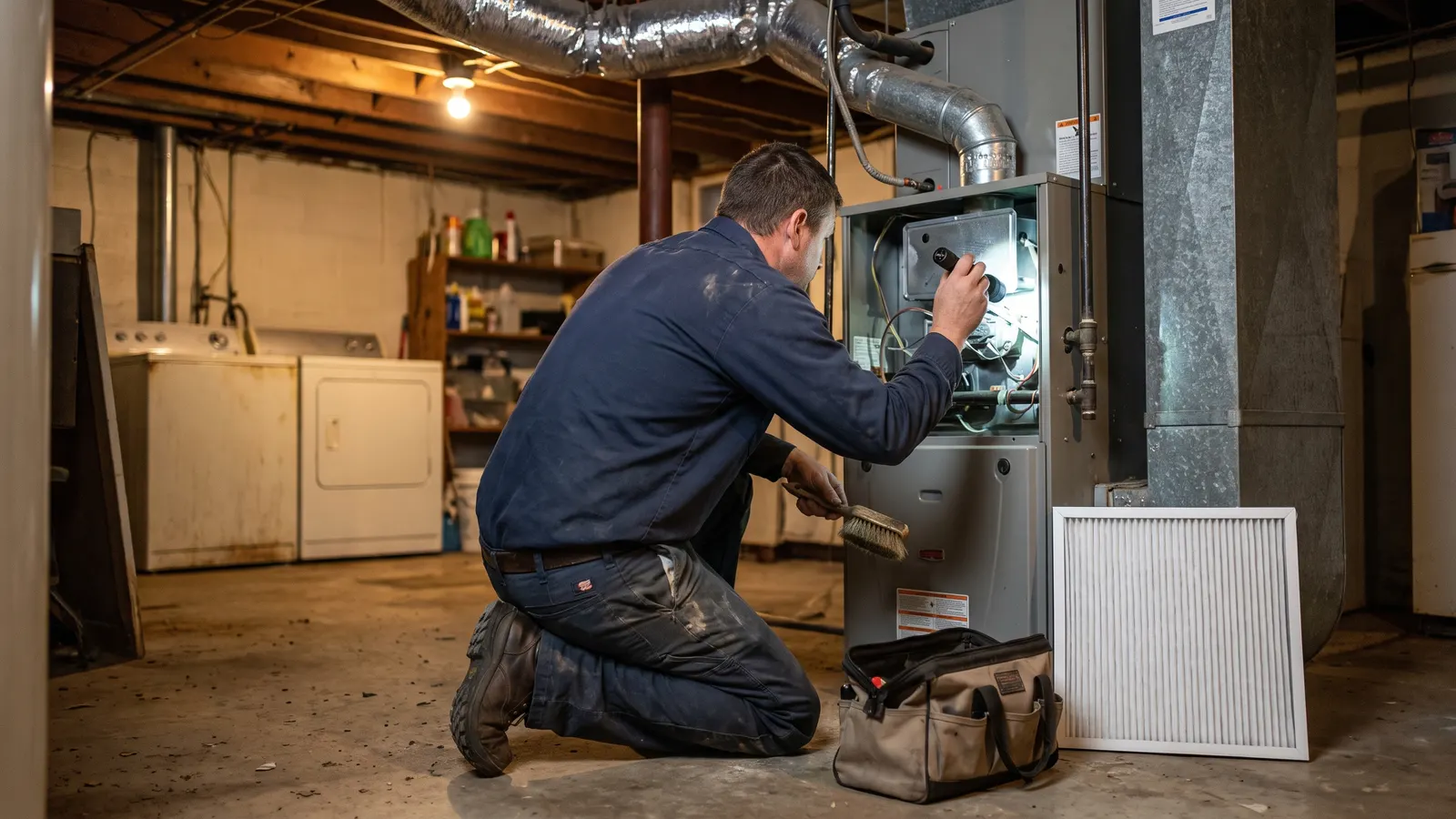
A pre-season heating check is a contractor's visit that inspects the parts you cannot see and adjusts the ones that drift. ENERGY STAR's maintenance checklist says the annual check should tighten electrical connections, lubricate moving parts, inspect the condensate drain, and, for heating, check the gas or oil connections, the gas pressure, the burner combustion, and the heat exchanger, because a dirty burner or a cracked heat exchanger causes improper burner operation. It says to do it in the fall, before the contractors get busy.
The CDC's carbon monoxide prevention guidance is to have the heating system, the water heater, and any other gas, oil, or coal burning appliance serviced by a qualified technician every year. For fuel-burning equipment, the annual visit is a safety check first and an efficiency check second.
The annual HVAC tune-up guide explains what to ask for, what the technician should leave in writing, and what to record. If the house has a fireplace or a wood stove, the chimney gets its own annual inspection, and chimney and fireplace safety covers it. Book both in September; the point of the fall date is that the crew shows up before the cold does.
What can you do yourself before the first cold night?
Before the first cold night, do the homeowner's part: a new filter, a clear path around the equipment, open registers and returns, a look at the vent pipes, a thermostat check, and a test run on a mild day. None of it needs a tool beyond a screwdriver, and all of it catches the failures that turn into a no-heat call on the coldest night of the year.
- Replace the filter and write the date on the frame. ENERGY STAR says to check it every month during heavy use months and to change it at a minimum every three months; the filter guide covers sizes, ratings, and airflow direction.
- Clear three feet around the furnace, air handler, and water heater. Boxes, paint, and laundry migrate toward the utility closet over summer.
- Open every supply register and return, and pull furniture and rugs off them. Leave them open; the system was sized with all of them open.
- Look at the vent pipes on a gas furnace or water heater for rust, gaps, or sagging, and at the PVC intake and exhaust on a condensing furnace for blockages outside. Do not disassemble anything; note what you see for the technician.
- Check the thermostat: fresh batteries if it takes them, and the mode switched to heat.
- Run the heat on a mild day for fifteen minutes. Listen for new noises, smell for anything beyond the first-run dust smell, and feel for warm air at the farthest register. Done when: every room gets warm air and the system cycles off on its own.
- Walk the ductwork you can see in the attic, crawlspace, or basement for disconnected runs or crushed flex duct; sealing and insulating ductwork is the follow-up if you find them.
Inspecting the furnace before heating season is the step-by-step for the equipment itself, including the point at which you stop and call.
What is different for a heat pump?
A heat pump is different because it heats by moving heat from outdoor air, it runs longer and gentler than a furnace, and it has an outdoor unit that needs to breathe in winter. ENERGY STAR's heat pump page says not to set the thermostat back when you are away or asleep, to set it to heat rather than auto so it does not switch modes on an unseasonable day, to use the auto fan setting, and to clean the filter when it is visibly dirty or the filter light says so.
Furnace
- Blasts hot air in short cycles, then rests
- A night setback on a programmable thermostat saves energy
- Annual check: burner, heat exchanger, gas connections, venting
- Outdoor work: keep the intake and exhaust clear
Heat pump
- Runs longer at a lower supply temperature; that is normal
- Pick a comfortable temperature and leave it there
- Annual check: refrigerant, coils, defrost cycle, backup heat
- Outdoor work: keep the unit clear of snow, leaves, and ice for airflow
ENERGY STAR also notes that certified cold climate units are tested down to 5 F and keep working below that, but a back-up heat source is most efficient at lower temperatures. Know which backup your system has (electric strips, a gas furnace in a dual-fuel setup) and confirm in fall that it works. Heat pump care in winter covers the outdoor unit, the defrost cycle, and what steam off the coil means.
How should you set the thermostat for winter?
Set the thermostat for the equipment and the weather, not for a number you read somewhere. With a furnace, the DOE's home energy checklist says a programmable thermostat that sets back automatically at night saves energy; with a heat pump, ENERGY STAR says to hold one temperature. On a hard-freeze night, the Red Cross rule overrides both: keep the thermostat at the same temperature day and night so the pipes in exterior walls stay above freezing.
That last rule is the one people miss. A setback that is fine in November can be the reason a kitchen supply line freezes in January, because the coldest hours of the night are the ones the thermostat was told to ignore. Freeze warning: what to do tonight is the short list for those nights, and setting a thermostat schedule covers the everyday program. When the house is empty in winter, the Red Cross says heat on and no lower than 55 F.
Which safety checks go with the heating season?
The heating season's safety checks are clearance, alarms, and the gas rule. The NFPA's heating tip sheet says to keep anything that can burn at least three feet from the furnace, fireplace, wood stove, or space heater, to test smoke alarms at least once a month, and never to use the oven to heat the home. Ready.gov's winter page repeats the oven rule and adds the carbon monoxide detectors with battery backups.
Test the smoke and CO detectors at the start of the season and monthly after that. If a portable heater will be part of the plan, space heater safety has the placement and cord rules, and the winter maintenance checklist keeps the monthly loop going once the season starts.
What should you record?
Record the tune-up date and what the technician found, the filter size and each change date, the thermostat program, and any noise or smell you noticed on the test run, all on the system's page in the home record. The record is what turns next year's visit from a cold start into a conversation: the technician can see last year's readings, and you can see whether the same part is failing twice.
In Property Station, the heating check is a task on the Maintenance page with Frequency (months) set to 12 and a reminder before the due date; the filter change is a second task at the interval your house needs; and the invoice goes on the Documents page as a Receipt. The features page shows where the system's page lives.
Common questions
When should you book the heating tune-up?
Early fall, before the first cold night. ENERGY STAR's maintenance checklist says to check the heating system in the fall because contractors get busy once winter comes. A September appointment is easy to get; a December one, after a no-heat call, is not.
How often should the filter be changed in winter?
Check it monthly. ENERGY STAR says to check the filter every month, especially during heavy use months like winter, to change it if it looks dirty, and to change it at a minimum every three months. A house with pets, a new build still shedding construction dust, or a system that runs all day will need it sooner.
Should a heat pump be set back at night?
No. ENERGY STAR says heat pumps do not save energy by turning down when you are away or asleep, and that the best use is to pick a comfortable temperature and leave it there. Set the thermostat to heat rather than auto in winter so it does not switch modes on a mild afternoon.
Does skipping the tune-up affect the warranty?
Check the warranty document; it is the only source. Some equipment warranties ask for proof of annual professional service, and a builder warranty on a new home may say something similar. Keeping the invoice from each visit in the home record is the cheap way to be sure.
What should you do next?
Call for the tune-up today, change the filter this weekend, and run the heat on the next mild afternoon. Then set the two recurring tasks so next fall starts with a reminder instead of a cold house.