On this page
Prepare for an earthquake by securing what can fall, learning what to shut off, stocking what you would need for several days, and copying the documents off-site. Ready.gov's list is to secure heavy items like bookcases, refrigerators, water heaters, and televisions, to store heavy and breakable objects on low shelves, to keep a supply kit, to consider structural improvements, and to consider earthquake insurance because a standard homeowner's policy does not cover the damage. The house part is a weekend; the paperwork part is an evening.
Earthquake country is also wildfire country and, along parts of the coast, storm country, and the documents step below is the same one that the tornado post and the hurricane checklist ask for. Do it once.
What should you secure inside the house?
Secure anything tall, heavy, or hung that could fall on a person or block a door: bookcases, dressers, the refrigerator, the television, mirrors and framed art over beds, and the water heater. Ready.gov's earthquake page says to secure those items and to store heavy and breakable objects on low shelves; the CPSC's Anchor It campaign says anchoring all furniture with drawers, doors, and shelves to the wall prevents tip-over injuries and deaths, earthquake or not.
- Find the studUse a stud finder behind the furniture and mark it; drywall alone will not hold
- Bracket the wallDrive the wall bracket from the anchoring kit into the stud
- Bracket the furnitureMove the piece close to the wall and attach the second bracket to its frame or to the TV
- Connect and tightenJoin the strap to both brackets and pull it snug
- Tug testPull on the straps; CPSC says to confirm everything is secure before you walk away
The CPSC's list of what you need is short: a furniture or TV anchoring kit, a drill and bit, a screwdriver, and a stud finder. Anchoring furniture and TVs is the step-by-step, including the wall types that need a different anchor. Start in the bedrooms, because that is where people are when a quake hits at night, and work outward.
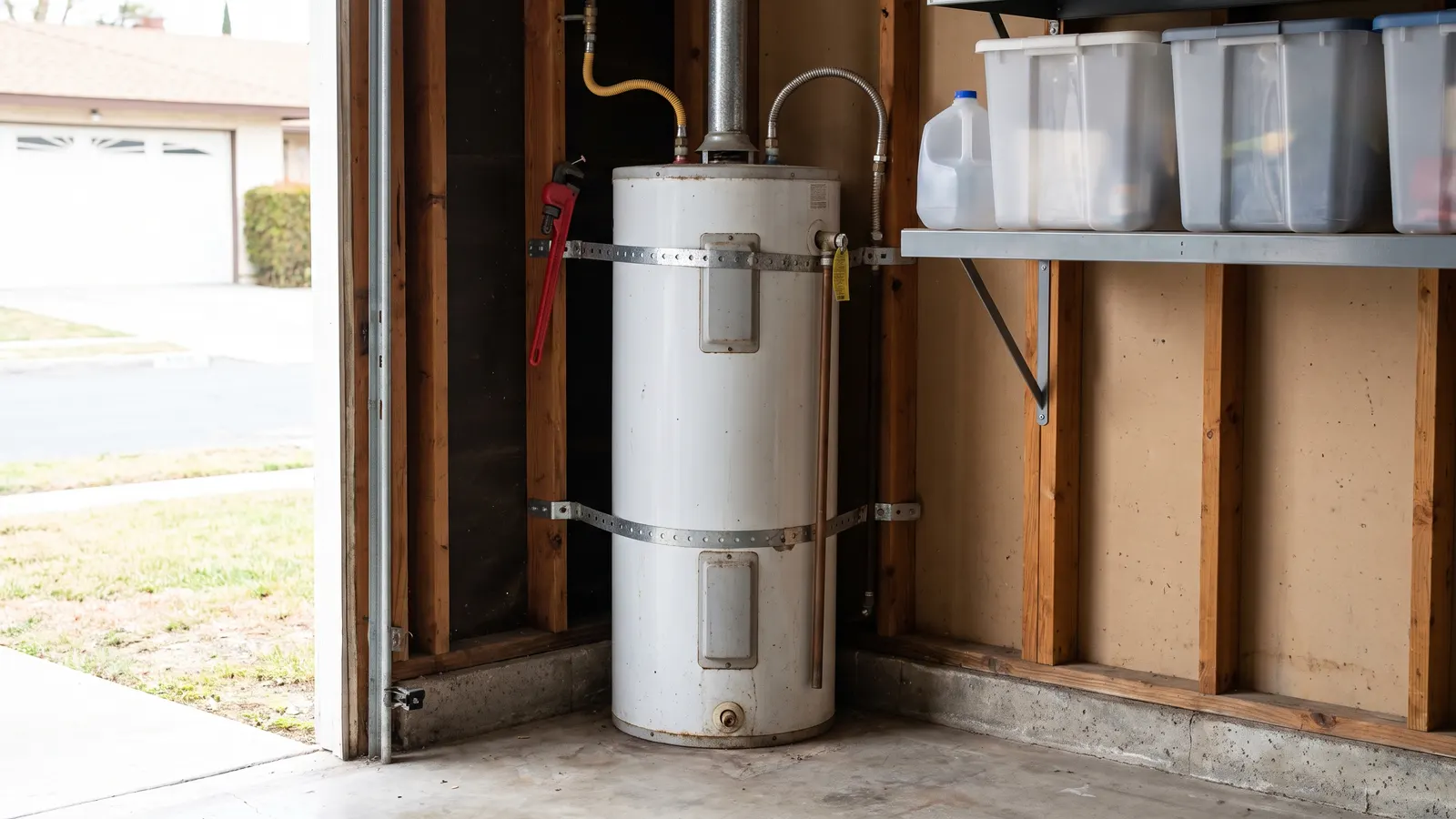
In the houses we see, the water heater is the item most often left unstrapped, especially after a replacement, when the old straps come off and the installer does not put new ones on. A tank that tips can tear its gas line and its water connections at the same time. Where seismic straps are required, the PNNL water heater blanket guide describes one strap in the top third of the tank and one in the bottom third. Check yours, and ask the installer to show you the straps the next time the tank is replaced.
Where are the shutoffs, and when do you use them?
The shutoffs that matter after a quake are gas, water, and the electrical main, and the time to find them is now, in daylight, with a wrench that fits. Ready.gov's after-the-quake instructions are to expect aftershocks, to leave a damaged building, and to watch for leaking gas and water lines and downed power lines. Knowing which valve is which turns that watch into an action.
Walk the house with the five shutoffs every owner should know and put a wrench where the gas meter is. The rule for gas is the NFPA's: if you smell it, do not light anything, leave immediately, and call the fire department or the gas company from outside. We recommend shutting the gas off only if you smell it or hear it, because in our experience getting it turned back on means waiting for the utility. Water is different: if a line has broken, shutting the main water valve stops the flooding, and there is no waiting to turn it back on.
What should the kit and the plan include?
The kit should cover several days without water, power, or a way out of the neighborhood, and the plan should cover the minute of shaking and the hour after. Ready.gov's earthquake page says the supply kit needs several days of food and water, a flashlight, a fire extinguisher, and a whistle; during shaking, Drop, Cover, and Hold On, stay inside, and avoid doorways; afterward, expect aftershocks and leave a damaged building.
Earthquake kit and plan
- Water at one gallon per person per day for several days, per Ready.gov's kit page
- A several-day supply of non-perishable food and a manual can opener
- Flashlights and batteries, a whistle, and a first aid kit
- A fire extinguisher that everyone can find and that you have checked this year
- Sturdy shoes by every bed, because broken glass is the first hazard after the shaking
- A wrench or pliers at the gas meter and the water main
- A battery or hand crank radio, phone chargers, and a backup battery
- An out-of-area contact everyone in the family will call or text
- A practiced Drop, Cover, and Hold On drill, twice a year
Building a home emergency kit covers the full list and the yearly check. A second, smaller kit in the car matters more in earthquake country than most places, because Ready.gov's advice to keep one there assumes you might be stranded, and roads and bridges are what an earthquake closes.
What about insurance and documents?
Insurance and documents are the part of earthquake prep that decides what happens in the months after, and both are done at a desk. Ready.gov says to consider an earthquake insurance policy because a standard homeowner's policy does not cover earthquake damage; the Insurance Information Institute says the same, that a standard policy will not pay for damage caused by a flood, earthquake, or routine wear and tear. Read your policy, ask your agent what an earthquake policy costs and what its deductible is, and decide on purpose rather than by default.
Then copy the documents: the policy, the deed and mortgage, identification, the home inventory with photos, and the contacts for the insurer, the utilities, and the builder if the house is new. Ready.gov's financial preparedness page says to store important documents in a safety deposit box, on an external drive, or in the cloud so they are easy to reach during a disaster. The inventory is the piece most people lack; how to build a home inventory room by room takes an afternoon and pays for itself at the first claim.
In Property Station the policy is an Insurance document on the Documents page, the inventory photos sit beside it, and the Shutoffs & Key Locations page holds where the gas meter and water main are; the features page shows how the record is organized.
What structural questions should you ask?
The structural questions depend on the age of the house, and the answers come from an engineer or a contractor who does seismic work, not from an article. Ready.gov's phrase is to consider structural improvements. For an older house, the usual questions are whether the frame is bolted to the foundation, whether a raised foundation's short walls are braced, and whether the chimney is reinforced. For a new build, the question is what seismic design the plans include, and the answer belongs in the record with the plans.
Ask the builder, before closing, which seismic provisions the house was built to and where the water heater straps and the gas shutoff are, and keep the plans and the selection sheets with the home record. Keeping your selection sheets and plans explains why the plans matter later; after an earthquake, they are what an engineer and an adjuster both ask for first.
What should you do after the shaking stops?
After the shaking stops, check for injuries, put on shoes, and check the house for gas smell, water leaks, and damage before you do anything else. Ready.gov says to expect aftershocks, to leave a damaged building, and to watch for leaking gas and water lines and downed power lines. If the power is out, the food, medicine, and generator rules are the same as in any outage, and the winter storm and outage post has Ready.gov's numbers for the refrigerator and freezer and the CPSC's rules for generators.
Photograph the damage before cleanup, note the time, and report to the insurer with the policy number from the record. Then write down what moved and what held: the bookcase that stayed put and the cabinet that emptied itself tell you what to anchor before the next one.
Common questions
Does homeowners insurance cover earthquake damage?
Ready.gov says a standard homeowner's policy does not cover earthquake damage and suggests considering a separate earthquake policy, and the Insurance Information Institute says the same about standard policies. Read your own policy and ask your agent what an earthquake policy would cost and what its deductible would be.
Should you stand in a doorway during an earthquake?
No. Ready.gov's instruction is Drop, Cover, and Hold On, to stay inside, and to avoid doorways. Get under a sturdy table or desk if one is near, cover your head and neck, and hold on until the shaking stops.
What should be anchored first?
The things that can fall on a bed or block an exit. Ready.gov names bookcases, refrigerators, water heaters, televisions, and objects that hang on walls. Start in the bedrooms, then the water heater, then the living room television and the tall kitchen furniture.
How much water should the kit hold?
Ready.gov's kit page says one gallon per person per day for several days, for drinking and sanitation, plus a several-day supply of non-perishable food. Store it where you can reach it if part of the house is unsafe, and re-think the kit every year.
What should you do next?
This weekend, anchor the bedroom furniture and check the water heater straps. This week, find the gas and water shutoffs, put a wrench at each, and photograph the house for the inventory. Then call the agent about earthquake coverage and decide.