On this page
Prepare for tornadoes by settling four things before the season: where in the house everyone goes, how the warning will reach you at night, what is already in that spot when you get there, and where the documents are if the house is not standing afterward. Ready.gov's guidance covers the first three. The fourth is the part a home record does, and it is the part most families discover they skipped.
Tornado country overlaps hurricane country and freeze country, and the pre-season lists differ. The regional storm and freeze guide sorts out which seasons your house has; this post is the tornado piece, and it is short because the right answers are few.
Where should you shelter during a tornado?
Shelter in a safe room built to FEMA criteria or a storm shelter built to the ICC 500 standard if you have one, and otherwise in a small, interior, windowless room or basement on the lowest level of a sturdy building. That is Ready.gov's tornado page, and it adds the instruction for the moment itself: go to the safe location immediately and cover your head or neck with your arms. Decide the room now and practice going there.
Built shelter
- A safe room to FEMA criteria or a storm shelter to ICC 500
- Built and anchored to a published standard, not improvised
- Added at construction or retrofitted; for a new build, a question to ask the builder before the slab is poured
- Stocked and reachable in under a minute from the bedrooms
Best available room
- Small, interior, windowless, on the lowest level
- A basement, or a ground-floor bathroom, closet, or hallway with no exterior wall
- Practiced, so children can find it in the dark
- Stocked the same way, with helmets or pillows for heads
In the houses we see, the chosen room is often the master closet on the second floor or a bathroom with a window, because that is where people ended up last time. Walk the house once with Ready.gov's description in hand and pick the room that actually matches it, even if it is the coat closet under the stairs.
How will you know a tornado is coming?
You will know a tornado is coming if you have set up more than one way to be warned, because the one you rely on will be the one that fails at night. Ready.gov says to sign up for the community warning system and to keep a NOAA Weather Radio, and describes the signs: a rotating, funnel-shaped cloud, an approaching cloud of debris, or a loud roar like a freight train. The warning system is for the nights you are asleep; the signs are for the afternoons you are outside.
Put the weather radio in the bedroom, not the kitchen, with the tone alert on. Enable the wireless emergency alerts on every phone in the house and make sure they are not silenced overnight. If your area has outdoor sirens, learn what they sound like, and do not count on hearing one through a closed house in a storm.
What should be in the shelter spot before the season?
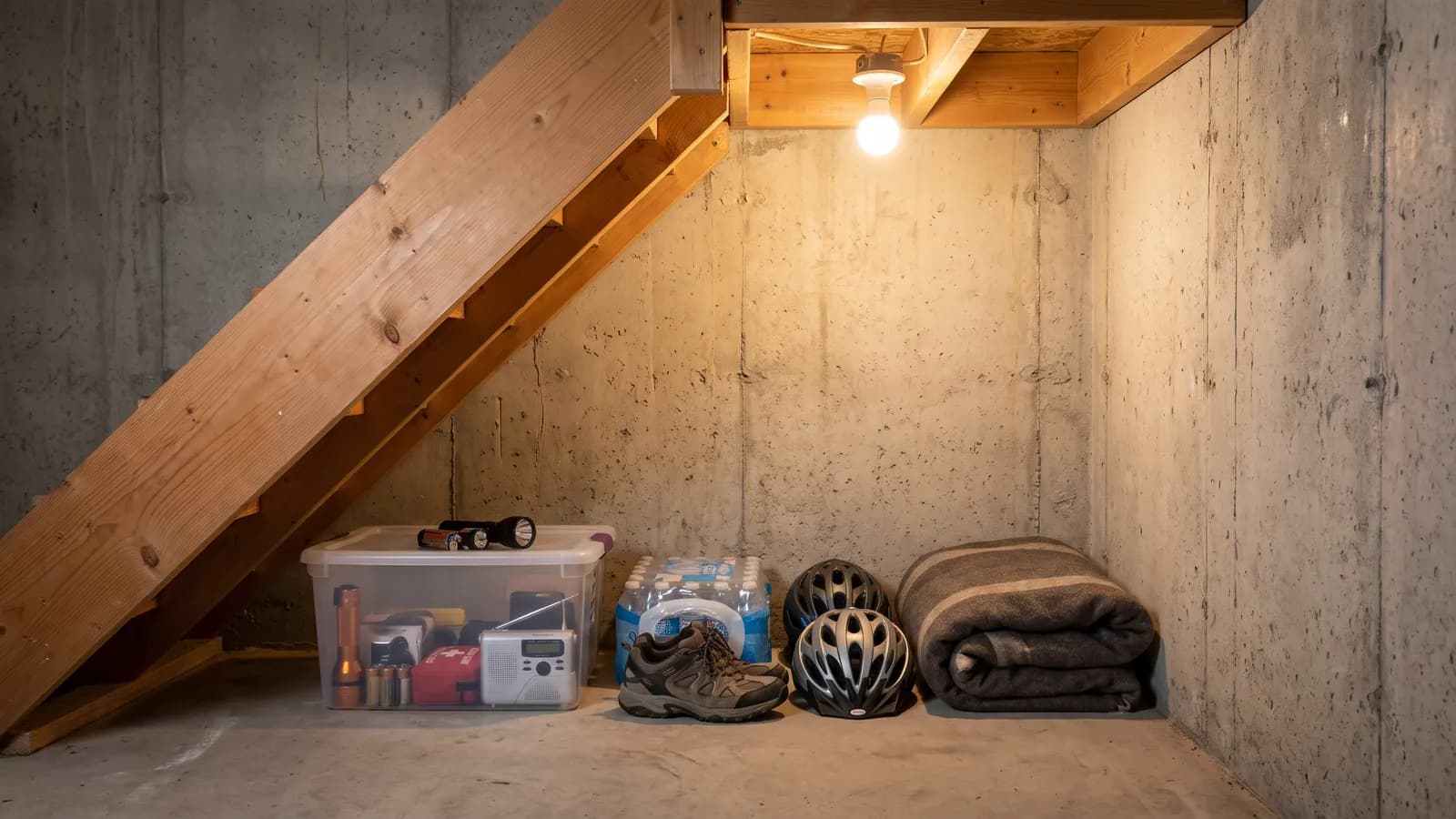
The shelter spot should hold what you would want if you had to stay there for an hour and then walk out into debris. Ready.gov's kit page is the list: water at one gallon per person per day for several days, a several-day supply of food, a battery or hand crank radio, flashlight, first aid kit, extra batteries, whistle, dust mask, a wrench or pliers to turn off utilities, and a cell phone with chargers and a backup battery.
In the shelter spot
- Water and a few days of food, checked and rotated once a year
- Flashlight and batteries, or a headlamp for everyone
- Whistle to signal for help
- Thick-soled shoes, long pants, and work gloves, one set per person
- Helmets or pillows for heads; a blanket
- First aid kit and any daily medication
- Battery or hand crank radio with a NOAA Weather Radio band
- Phone charger and a backup battery
- Wrench or pliers for the gas and water shutoffs
- A printed card with insurance, utility, and family phone numbers
Building a home emergency kit covers the full kit and where to keep the copy for the car. Ready.gov's instruction to re-think the kit every year and replace expired items is easiest to obey if the annual check is a dated task; tie it to the start of the local season.
What paperwork does a tornado test?
A tornado tests whether you can prove what you owned and what covered it, from somewhere other than the house. That means the insurance policy and declarations page, a room-by-room inventory with photos, the deed and mortgage documents, identification, and the phone numbers for the insurer, the agent, the utilities, and, for a new build, the builder. Ready.gov's financial preparedness page says to store important documents in a safety deposit box, on an external drive, or in the cloud so they are easy to reach during a disaster.
Photograph every room from two corners, open the closets and cabinets, and photograph each appliance and system with its label. How to build a home inventory room by room is the method. The same documents step serves a hurricane, an earthquake, and a fire, which is why the earthquake post and the hurricane checklist both point back to it; do it once and every season is covered.
In Property Station the policy is an Insurance document on the Documents page, the photos are stored alongside it, and the Shutoffs & Key Locations page holds where the gas and water shutoffs are, all of it reachable from a phone standing in a driveway (the features page lists what else the record holds).
What should you do after the tornado passes?
After the tornado, stay in the shelter until the warning has expired, then move carefully: Ready.gov says to stay clear of fallen power lines and broken utility lines and to wear thick-soled shoes, long pants, and work gloves during cleanup. If you smell gas, leave the building and call the gas company or the fire department from outside. Photograph everything before you touch it; the claim starts with those pictures.
The house record does two jobs in the days after. First, it answers the adjuster: what was in the house, what it cost, what the policy number is. How to document damage for an insurance claim is the sequence. Second, it holds the shutoffs and the outage plan: where the main water valve is if a line broke, and how long the refrigerator and freezer hold when the power is out, which the winter storm and outage post covers with Ready.gov's numbers. The five shutoffs every owner should know is the walk to do before the season, not after.
Common questions
Is a bathroom or a closet a safe place?
It can be, if it matches Ready.gov's description, a small, interior, windowless room on the lowest level of a sturdy building. An interior bathroom or closet on the ground floor with no window and no exterior wall is the usual best available room in a house without a basement or a built shelter.
Do you need a weather radio if you have a phone?
Ready.gov says to sign up for the community warning system and to keep a NOAA Weather Radio, and its hurricane page says to have several ways to receive alerts. A phone that is off, out of signal, or on silent at 2 a.m. is one way that failed; a weather radio with a tone alert is the second way.
What should you wear for cleanup after a tornado?
Ready.gov says thick-soled shoes, long pants, and work gloves, and to stay clear of fallen power lines and broken utility lines. Debris fields hide nails, glass, and live wires. Photograph the damage before you move anything, for the claim.
Does homeowners insurance cover tornado damage?
Read your policy; it is the only source. The NAIC describes homeowners insurance as paying when the house is damaged or destroyed by fire, weather, theft, or other disasters, but the deductible and any wind-specific terms are in your own document. Keep a copy where you can reach it without going home.
What should you do next?
Tonight, pick the room and put a flashlight, shoes, and a whistle in it. This week, set up the second warning path and photograph the house for the inventory. Before the season, stock the room and put the yearly kit check on the calendar.