On this page
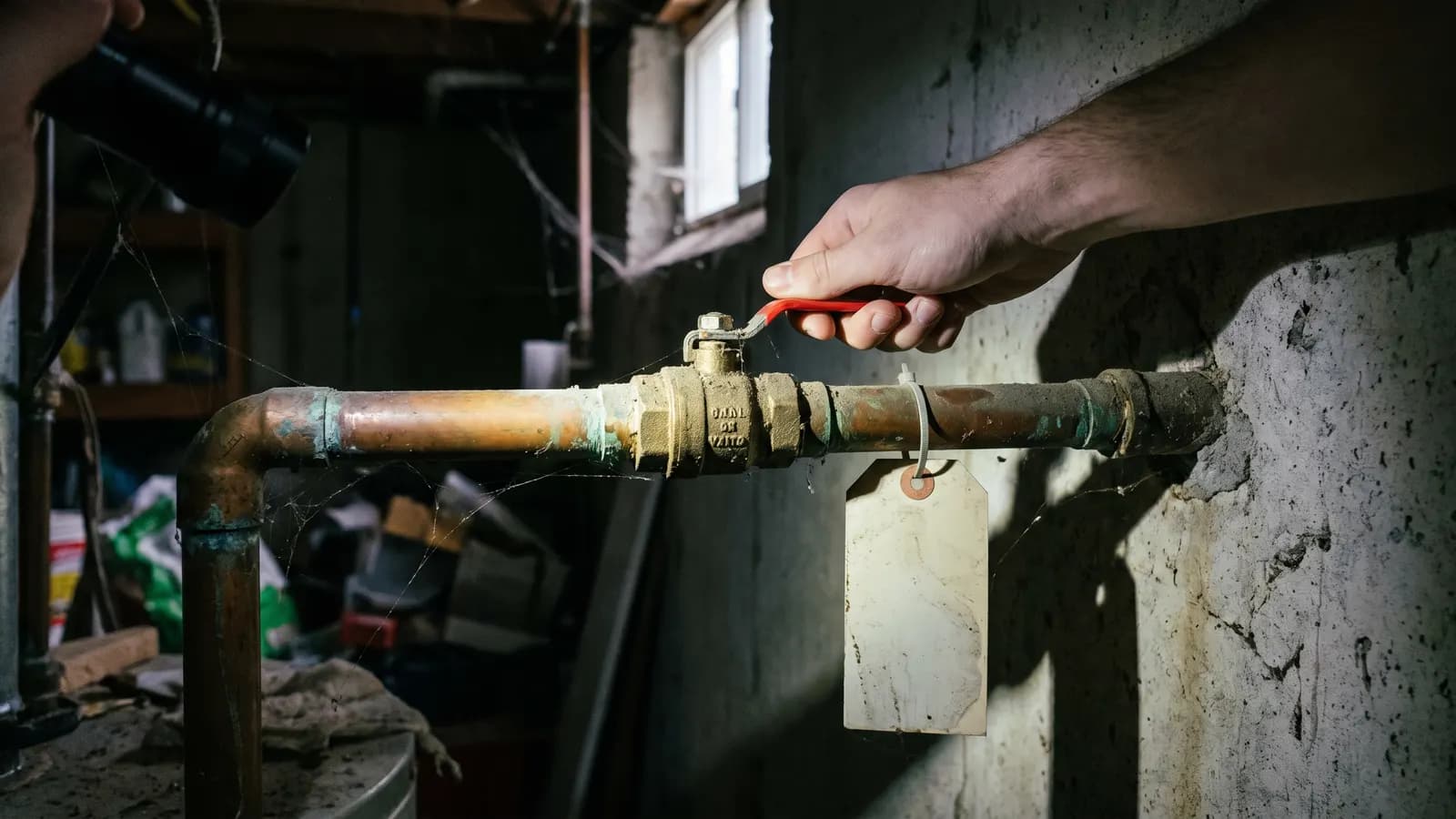
Find the main water shutoff before you need it. It is the one valve that stops every drop of water entering the house, and it sits where the supply line first comes through the wall or floor: on the street-facing wall of a basement or crawl space, in the garage or a utility closet on a slab, or in a ground box near the meter in warm climates. To close a ball valve, turn the lever a quarter turn so it sits across the pipe; to close a gate valve, turn the wheel clockwise until it stops.
Why does the main shutoff matter?
The main shutoff matters because every other fix for a water emergency starts after the water is off. A burst pipe, a split washing machine hose, or a failed water heater tank keeps running until someone closes this valve. Knowing where the main is turns a flood into a mop-up, and it is the first step in what to do when a pipe bursts. Test it once a year: a valve that has not moved in years can seize, and one you find stuck during a flood is worse than none.
Ready.gov's emergency kit list includes "a wrench or pliers to turn off utilities", and its flood guidance says to turn off the electricity if it is safe to do so and never to touch electrical equipment while standing in water.
Where is the main water shutoff?
The main water shutoff is on the supply pipe within a few feet of where it enters the house, before the first branch, often next to the water meter. Cold-climate homes bring the line in through the basement or crawl space wall facing the street; slab homes put it in the garage or a utility closet; warm-climate homes often mount it outside near the front hose bib.
| House type | Where to look first |
|---|---|
| Basement | The street-facing wall, low, where the pipe comes through the foundation |
| Crawl space | Just inside the access hatch, sometimes with a handle extended into a closet above |
| Slab foundation | Garage wall, laundry closet, or the mechanical room |
| Warm climate | An in-ground box near the meter, or the exterior wall near the front hose bib |
| Private well or condo | After the pressure tank, or inside the unit near the water heater |
What do you need?
You need a flashlight, a tag and a marker, and a phone to photograph the valve and its surroundings. Most ball and gate valves turn by hand; keep an adjustable wrench or pliers nearby for a stiff gate valve wheel.
- A flashlight or headlamp; the valve is usually in the darkest corner of the house
- A weatherproof tag and a permanent marker
- An adjustable wrench or pliers, and penetrating oil for a stem that has not moved in years
What are the steps?
Trace the supply line to its first valve, identify whether it is a ball or gate type, open a cold tap so you can see the result, close the valve, confirm the tap stops, reopen it, check for drips at the stem, and tag it. The test takes a few minutes; the tag and the photos make the valve findable by anyone in the dark.
- Find where the water enters. Start at the meter or the wall facing the street and follow the largest cold pipe. Done when: you find a valve on that pipe before it branches.
- Identify the valve type. A lever handle is a ball valve and moves a quarter turn; a round wheel is a gate valve and turns several full rotations.
- Open a cold tap on the lowest floor and let it run; it shows you when the water is off.
- Close the valve. Ball valve: turn the lever until it sits across the pipe. Gate valve: turn the wheel clockwise until it stops, firmly but without forcing.
- Watch the open tap. Done when: the flow drops to a trickle and stops. If it keeps running at full strength, you have closed a branch valve, not the main.
- Reopen the valve. Ball valve: lever back in line with the pipe. Gate valve: counterclockwise until it stops, then back a quarter turn so it does not jam.
- Check the stem for drips. A slow weep often stops with a slight tightening of the packing nut; a steady drip is a plumber call.
- Tag the valve with "MAIN WATER" and the closing direction, and photograph it from the doorway. Done when: a stranger could find it with the tag alone.
- Walk every adult in the house to it. Then find the other shutoffs: the stops under each sink, the washing machine valves, and the interior valves for outdoor faucets.
When should you stop and call a pro?
Stop and call a plumber if the valve will not turn with firm hand pressure, if the stem drips after you operate it and tightening the packing nut does not stop it, if the valve closes but water keeps flowing (a gate valve wedge that no longer seats), or if there is no valve at all between the meter and the first branch. If the valve is in a flooded basement with the power on, do not wade to it; call the utility to cut the power first.
What should you record?
Record the valve's location, type, closing direction, the date you tested it, and whether it turned freely, with photos of the valve and the route from the nearest door. In Property Station, the Shutoffs & Key Locations page under My Home holds this list, and the yearly test goes on the Maintenance page as a recurring task with Frequency (months) set to 12; the home record is where the next owner finds it too.
Common questions
What if the main shutoff will not turn?
Stop. A gate valve that has sat for years can shear its stem if you force it, and a broken stem means no shutoff at all until a plumber replaces it. Try penetrating oil and gentle pressure; if it still will not move, book the replacement now.
Which way is off on a ball valve?
A ball valve is closed when the lever sits across the pipe, at a right angle to it, and open when the lever runs along the pipe. It only moves a quarter turn.
Can I use the valve at the street?
The curb stop at the street often belongs to the water utility, and some utilities forbid customers from operating it. Call the utility's emergency line; many will send someone out.
What should you do next?
Find the valve now and tag it this week. Then take the next step in the same room: the water meter leak test uses the meter you just located, and in a cold climate, preventing frozen pipes starts with knowing which valve to close.