On this page
When the clocks change, do six things in one hour: press the test button on every smoke and carbon monoxide alarm, replace the batteries in the ones that take them, check the manufacture date on each alarm and replace any past its life, change the HVAC filter, look at the fire extinguisher's gauge, and run the family's escape drill. The CDC ties the CO detector battery check to the clock change explicitly; the rest fit the same hour because they are all twice-a-year jobs that nobody schedules.
The two dates fall in useful places. The November change comes right before heating season, and the March change comes right before cooling season, so each one is also the moment to start the seasonal list: the fall checklist in November and the spring work in March.
What should you do at the clock change?
At the clock change, work through the alarms first, then the filter, the extinguisher, and the drill, and write the dates down as you go. Every item below has a source that says how often to do it, and every one of them is easy to forget for a year, which is exactly what the clock change fixes.
The clock-change hour
- Press the test button on every smoke alarm and CO alarm in the house
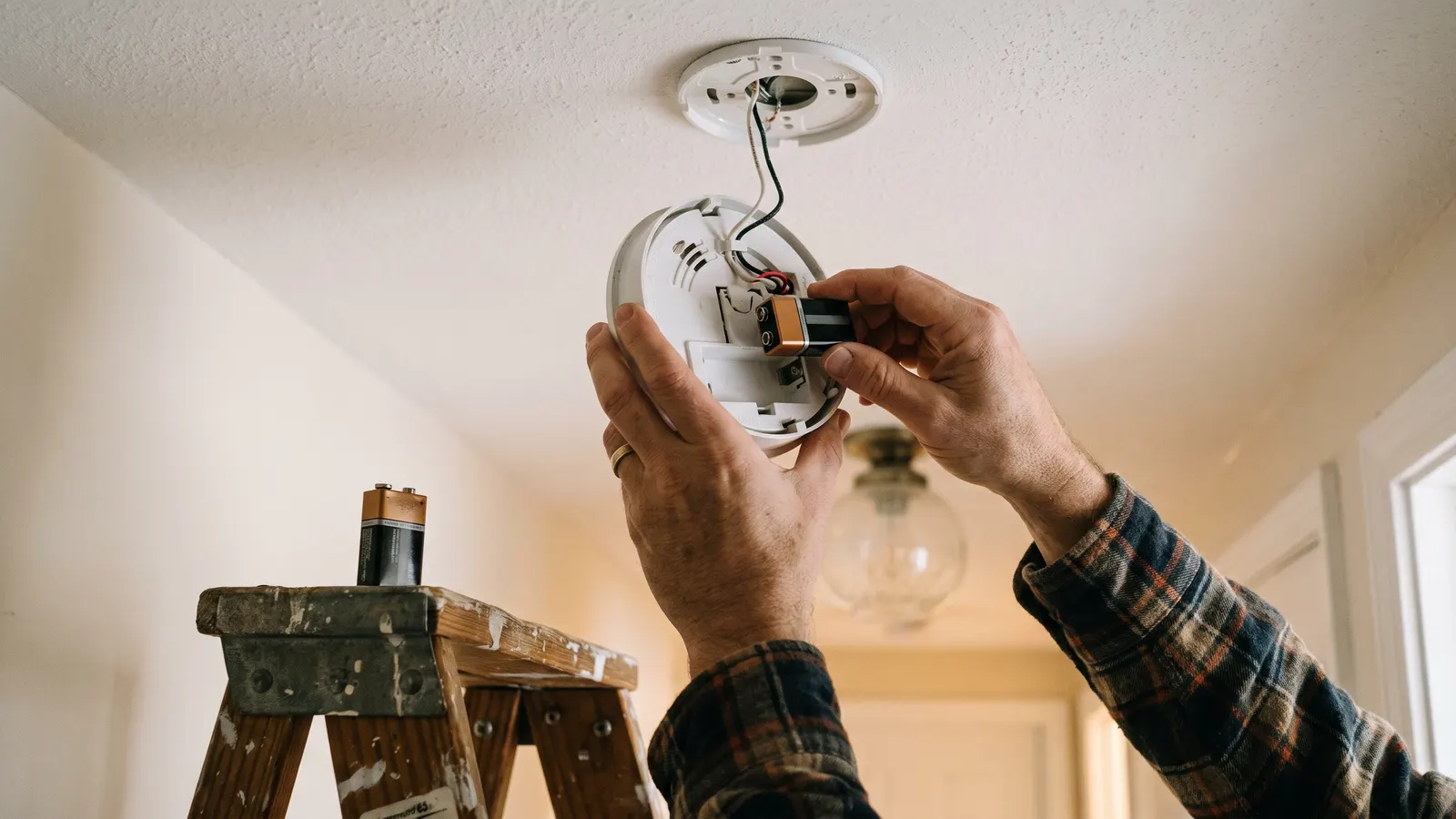
- Replace the batteries in every alarm that takes a replaceable battery
- Take each alarm down and read the manufacture date; replace any smoke alarm past 10 years and any CO alarm past its label
- Change the HVAC filter and write the date on the frame
- Check the fire extinguisher: gauge in the green, pin in place, nozzle clear, nothing stacked in front of it
- Run the escape drill, starting it by pressing an alarm's test button
- Press TEST and RESET on the GFCI outlets in the kitchen, bathrooms, garage, and outdoors
- Look at the calendar for the season ahead and start that list
The detector test guide covers where alarms belong and what the different chirps mean. The filter guide covers sizes, ratings, and which way the arrow points. Neither takes more than fifteen minutes.
Why tie it to the clock change?
Tie the checks to the clock change because it is a date the whole country already observes, it arrives twice a year, and the CDC's carbon monoxide page already says to check CO detector batteries when you change the clocks each spring and fall. A monthly test is the standard; in practice it slips, and a twice-a-year anchor is the floor that keeps a dead alarm from staying dead for a year.
Ready.gov's home fires page says a fire can become life-threatening in just two minutes, to replace smoke alarm batteries twice a year unless you are using 10-year lithium batteries, to replace the entire smoke alarm every 10 years or as the manufacturer directs, and to practice the home fire escape plan twice each year. Twice a year is the clock change, both times.
The other reason is the calendar. A house has two seasons that ask for a walk-through, the start of heating and the start of cooling, and the clock changes land a few weeks before each. Doing the alarms and the filter on the same morning you think about the furnace or the air conditioner puts the safety items at the front of the seasonal list instead of the end.
Which alarms need new batteries and which need replacing?
Alarms come in three kinds, and each has its own rule for batteries and for the end of its life. The NFPA's smoke alarm page says to test every smoke alarm at least once a month, that a single chirp every 30 or 60 seconds means a low battery, and to replace all smoke alarms 10 years after the manufacture date. The U.S. Fire Administration adds the battery schedule: 9-volt batteries at least once a year, and the backup battery in a hardwired alarm once a year.
| Alarm | At the clock change | Replace the whole unit |
|---|---|---|
| Battery smoke alarm (9-volt or AA) | Test; new battery at least once a year, twice per Ready.gov | 10 years after the manufacture date (NFPA) |
| Hardwired smoke alarm with backup battery | Test; new backup battery once a year (USFA) | 10 years after the manufacture date |
| Sealed 10-year smoke alarm | Test only; no battery to change | When it reaches the age on its label |
| Carbon monoxide alarm | Test; check or replace the battery each clock change (CDC) | Per the manufacturer, or every 5 years (CDC) |
The date check is the step that gets skipped, because it means taking the alarm off the ceiling. Do it once, write the manufacture date on tape on the front, and every clock change after that is a glance. If an alarm has no date, or the label is unreadable, treat it as expired.
What else fits in the same hour?
The same hour has room for the filter, the extinguisher, the GFCI outlets, and the drill, because each is a five-minute check that has a source behind it. ENERGY STAR says to check the filter every month and change it at a minimum every three months, so the clock change is a filter day by definition. The USFA's extinguisher page says to check for easy access, the recommended pressure on the gauge, undamaged parts, and cleanliness.
March: before cooling season
- Alarms, batteries, dates, filter, extinguisher, drill
- Start the spring list: the outdoor AC unit, the condensate drain, the gutters after winter
- Move the CO alarm check to the top; a furnace that ran all winter has had its season
November: before heating season
- Alarms, batteries, dates, filter, extinguisher, drill
- Start the fall list: the heating check, the outdoor faucets, the three-foot clearance walk
- Read the space heater and holiday rules before they matter
The GFCI test is the ESFI's monthly routine (press RESET, plug in a nightlight, press TEST, the light goes off, press RESET, it comes back), and testing GFCI outlets shows what to do when one fails. The drill follows the home fire escape plan: two ways out of every room, a meeting place out front, and the alarm's test button as the starting gun. In November, the same morning is the right time to read holiday decorating safety and the winter checklist before the lights and the space heaters come out.
How do you make it stick?
Make it stick by putting the clock-change hour on a schedule with a reminder, rather than trusting the clock itself to remind you. The clock change is a good anchor because it is public, but the house does not know what day it is; a task with a due date and a reminder a week ahead is what gets the batteries bought before the morning they are needed.
In Property Station, the whole hour is one task on the Maintenance page: title it for the clock change, set Frequency (months) to 6, set the Next Due Date to the Sunday the clocks change, and the default reminder arrives 7 days before. Put each alarm's manufacture date in the task's Description, so the replacement years are in front of you every time it comes due instead of on a ceiling. The features page shows the rest.
Common questions
Do 10-year sealed alarms need anything at the clock change?
Not a battery. Ready.gov says to replace smoke alarm batteries twice a year unless you are using 10-year lithium batteries. A sealed alarm still gets the monthly press of the test button, and it still gets replaced when it reaches the age on its label, which the clock change is a good day to check.
How do you find the manufacture date on an alarm?
It is printed on the back or the side of the unit, so you have to take it off its bracket to read it. The NFPA says to replace all smoke alarms 10 years after the manufacture date. Write the date on a piece of tape on the front so you never have to take it down to check again.
Should the CO detector be replaced on the same schedule as smoke alarms?
No, and this is the one people get wrong. The CDC says to replace a carbon monoxide detector following the manufacturer's instructions or every 5 years, while the NFPA's figure for smoke alarms is 10 years after the manufacture date. Check the label on each device rather than assuming they match.
What if an alarm keeps chirping after a new battery?
The NFPA says a single chirp every 30 or 60 seconds means a low battery, so first confirm the new battery is seated and fresh. If the chirp continues, check the manufacture date; an alarm past its 10 years is at the end of its life and gets replaced, not re-batteried.
What should you do next?
Buy the batteries this week, before the change, and set the six-month task now so the next one arrives with a reminder. Then take each alarm down once, read the date, and write it on the front; that is the step that makes every clock change after this one a ten-minute job.