On this page
Test every GFCI outlet and breaker in the house once a month: press Test, confirm the power goes off, press Reset, confirm it comes back. That is the schedule the Electrical Safety Foundation International recommends, and the whole house takes about ten minutes. A GFCI that fails the test is not protecting anyone from shock, and nothing about it looks different until you press the button.
A GFCI (ground fault circuit interrupter) is an outlet or breaker that measures the current going out on one wire and coming back on the other. If they differ by a few thousandths of an amp, current is leaking somewhere it should not, possibly through a person, and the device cuts power in a fraction of a second. Code has required them near water for decades: bathrooms, kitchens, garages, outdoors, basements, laundry. A newer home has them in all of those places, and often as breakers in the panel as well as outlets.
Why test GFCIs monthly?
The Electrical Safety Foundation International says GFCIs should be tested every month to ensure they are in working order, and after every major electrical storm, because voltage surges from lightning, utility switching, and normal use can damage them. A GFCI that fails the test should be checked by a licensed electrician or replaced.
The reason the interval is short is that the failure is silent. A GFCI's sensing circuit can fail while the outlet keeps delivering power. You would only find out during the shock it was supposed to prevent.
What do you need?
A nightlight or a small lamp, ten minutes, and a list of where the GFCIs are: every outlet with Test and Reset buttons and every breaker in the panel with a test button. The list is worth making once because many outlets without buttons are protected by a GFCI in another room, and the map is what saves you next time a garage outlet goes dead.
- A small plug-in lamp or nightlight
- A list of where the GFCIs are. Walk the house once: every outlet with Test and Reset buttons, and every breaker in the panel with a test button. Note which outlets have no buttons but go dead when a GFCI trips; those are protected downstream.
- Ten minutes, on the same day each month (the detector test day works well)
What are the steps?
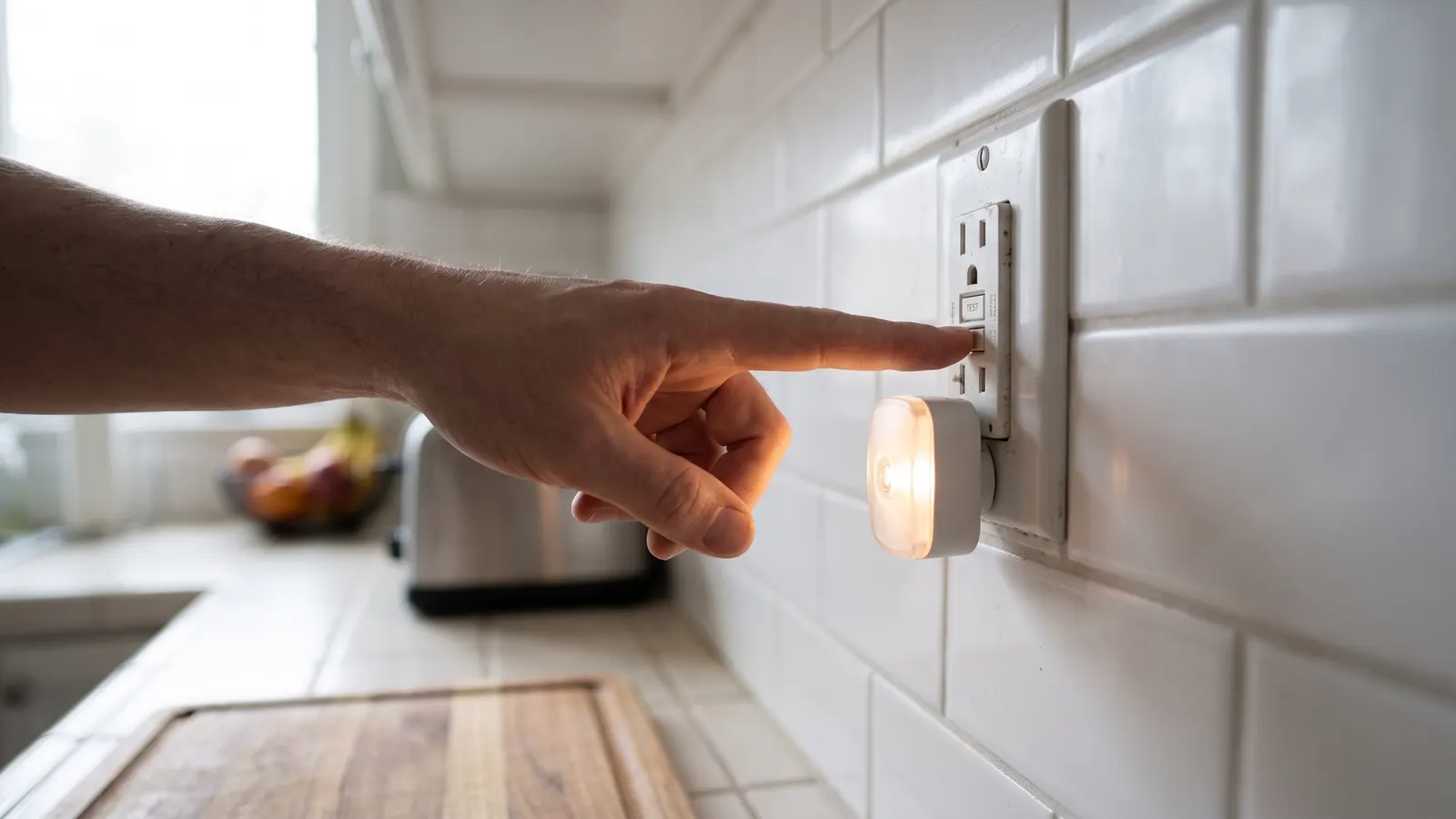
For each GFCI, press Reset, plug in the nightlight and confirm it is on, press Test and confirm the light goes out, then press Reset and confirm it comes back. A GFCI that fails either half is not protecting anyone and comes out of service until it is repaired or replaced. Breakers with a Test button get the same treatment at the panel.
- Press Reset on the GFCI to make sure it is set.
- Plug the nightlight into the outlet and confirm it is on.
- Press Test. The light should go out and, on most outlets, the Reset button pops out with a click. Done when: the light is off.
- Press Reset. The light should come back on. Done when: the light is on.
- If the light did not go out when you pressed Test, or does not come back when you press Reset, the GFCI has failed. Stop using that outlet and anything it protects. Mark it and call an electrician, or replace it if you are qualified to work in the box.
- For a GFCI breaker in the panel: press its Test button; the handle should trip to the middle or off position; switch it fully off and then on to reset.
- Check the downstream outlets once. With the GFCI tripped, the outlets it protects should be dead; with it reset, they should work. That tells you which outlets rely on which GFCI, which is worth writing down.
When should you stop and call a pro?
Call a licensed electrician if a GFCI fails the test, if one trips repeatedly with nothing plugged in, if an outlet is warm, discolored, or buzzing, if there is any sign of moisture in an outlet box, or if an outlet near water has no GFCI protection at all (an older home, or an outlet added later).
Replacing an outlet means opening a box with live conductors behind it; unless you are comfortable turning off the breaker, confirming it is off with a tester, and wiring line and load correctly, it is an electrician's job. Never bypass or remove a GFCI to stop it tripping.
In a new-construction home, a GFCI that fails in the first year is a workmanship item; report it to the builder in writing before replacing it.
What should you record?
The date, which GFCIs you tested, and any that failed. Keep the map of which outlets each GFCI protects; it saves a lot of confusion the next time a garage outlet goes dead. Set the test as a monthly recurring task alongside the smoke and CO detector test; together they are the monthly safety walk.
Common questions
Why do several outlets go dead when one GFCI trips?
One GFCI outlet can protect every outlet downstream of it on the same circuit. In many houses the GFCI in one bathroom protects the other bathrooms, the garage, and the outdoor outlets. When a dead outlet has no buttons, look for the GFCI that feeds it, often in another room, and press Reset there.
What is the difference between a GFCI and an AFCI?
A GFCI (ground fault circuit interrupter) protects people from shock by cutting power when current leaks out of the circuit, for example through a person. An AFCI (arc fault circuit interrupter) protects the house from fire by cutting power when it detects arcing in wiring. Newer homes have both, often as breakers in the panel; both have test buttons and both are tested the same way.
My GFCI trips as soon as I reset it. What now?
Unplug everything on the circuit and try again. If it holds, plug things back in one at a time to find the faulty appliance. If it still trips with nothing plugged in, there is a wiring fault or moisture in an outlet box, and that is an electrician's call.
What should you do next?
Walk the house and make the GFCI map this week. Then read how to reset a tripped breaker, because the panel is the other place a "dead outlet" problem gets solved, and the two guides together cover nearly every power-loss call an electrician gets.