On this page
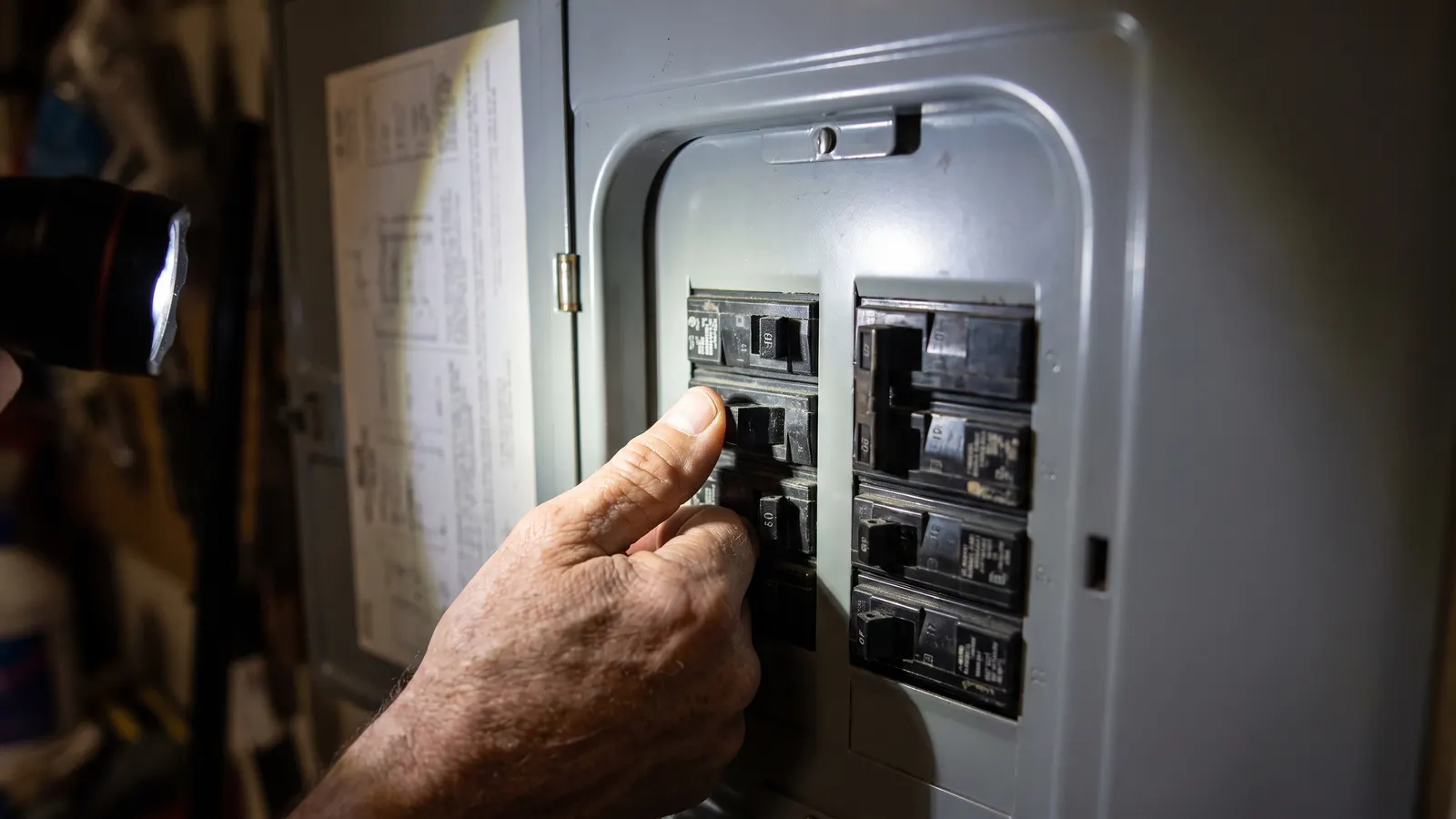
Reset a tripped breaker by finding the one whose handle sits in the middle position or is slightly off, pushing it fully to Off until it clicks, then back to On. If it holds, you are done. If it trips again right away or within minutes, do not keep resetting it: the breaker is telling you there is an overload, a short, or a fault, and the next step is finding which.
A circuit breaker is a switch that turns itself off when the current on its circuit exceeds what the wiring can safely carry, or, for GFCI and AFCI breakers, when it detects a ground fault or an arc. It protects the wiring inside the walls from overheating. The panel (the gray metal box, usually in a garage, utility room, basement, or closet) holds one breaker per circuit plus a main breaker that shuts off the whole house.
What should you check before you touch the panel?
Before you touch the panel, make sure the floor and your hands are dry, that you will only operate the breaker handles and not remove the flat metal cover behind the door, and that there is no smell of burning, no scorch mark, and no buzzing or crackling. Any of those three signs means leave the panel alone and call an electrician; smoke means leave the house and call 911.
- Stand on a dry floor with dry hands. If the floor around the panel is wet, stop; that is an electrician and possibly a plumber first.
- Only operate the handles. The outer door opens; the flat metal cover behind it (the dead front) stays screwed on. Everything behind that cover is live even when breakers are off.
- If you smell burning plastic, see scorch marks, or hear buzzing or crackling from the panel, do not reset anything. Leave the panel alone and call an electrician. If there is smoke, leave the house and call 911.
What are the steps?
Work out what lost power, open the panel door, find the handle sitting in the middle position, push it firmly to Off until it clicks, then to On. If it holds, you are done. If it trips again at once, unplug everything on that circuit and try once more; if it still trips with nothing connected, leave it off and call an electrician.
- Figure out what lost power. One room, a group of outlets, one appliance, half the house? That narrows which breaker to look for.
- Open the panel door and read the labels. A well-labeled panel says which breaker feeds which room; a new-construction panel usually is labeled, though not always accurately.
- Find the tripped breaker. A tripped handle sits between On and Off, often with a red or orange flag showing, and feels loose. Some brands trip fully to Off. If nothing looks tripped, run your thumb along each handle; the tripped one has less resistance.
- Push the handle firmly to Off. You will feel it click. This step is required on most breakers; pushing straight to On from the middle does nothing.
- Push it to On. Done when: the handle stays firmly on and the lights or outlets come back.
- If it trips again immediately, leave it off. Unplug or switch off everything on that circuit, then try once more. If it holds, plug things back in one at a time to find the item that trips it. If it trips with nothing connected, leave it off and call an electrician.
- If it holds for a while and then trips again, note what was running. A breaker that trips whenever the space heater and the vacuum run together is an overload, and the fix is moving one of them to another circuit. A breaker that trips on its own with nothing new running may be failing or may be reacting to a fault that comes and goes.
What about GFCI and AFCI breakers?
Newer homes have breakers with a Test button on the face. These trip for reasons beyond overload: a GFCI breaker trips on a ground fault (current leaking to ground, as through water), an AFCI breaker on arcing (a loose connection, a damaged cord, a failing device). Reset them the same way, Off then On. If an AFCI trips repeatedly, the cause is often a specific device or a damaged cord on that circuit; a vacuum cleaner, an old lamp, or a treadmill are common. Testing GFCI outlets explains the monthly test that applies to these breakers too.
When should you stop and call a pro?
Call an electrician if a breaker trips again with nothing plugged in, if any breaker is hot to the touch, if the panel buzzes, smells, or shows scorch marks, if a breaker will not reset (the handle will not stay on even with the circuit empty), if the main breaker trips, or if you find water anywhere near the panel. Never replace a breaker with a higher-rated one to stop it tripping; the rating matches the wire, and a larger breaker lets the wire overheat inside the wall. Never hold a breaker on. Do not remove the dead front.
A new home whose breakers trip under normal use in the first year has a wiring or load problem that belongs to the builder; document what was running and report it during the warranty period.
What should you record?
Which breaker tripped, when, and what was running. A breaker that trips twice under the same load is a pattern, and the record is what tells the electrician where to look. This is also the moment to fix the panel labels: with the breaker off, note what went dead and write it on the panel directory. Add "verify panel labels" as a one-time task in the maintenance schedule and do it on a Saturday with a helper and a lamp.
Common questions
Is it safe to open the panel door?
The outer door, yes. Behind it is the dead front, the metal panel with only the breaker handles showing through, and that is safe to touch and operate. The dead front itself is held on by screws; behind it are live bus bars. Never remove the dead front.
Why does a breaker trip when I run the microwave and the toaster together?
Overload. A kitchen circuit has a limit, and two heating appliances together can exceed it. Move one to a different circuit (a different outlet often means a different circuit in a kitchen). If the same breaker trips often under normal use, the circuit may need to be split, which is an electrician's job.
The breaker will not stay on even with everything unplugged. What is wrong?
A short circuit or a ground fault in the wiring, a fixture, or a device that is hardwired (a disposal, a fan, a water heater), or a breaker that has worn out. Leave it off and call an electrician. Do not hold the handle on or replace the breaker with a larger one.
What should you do next?
Label the panel properly once, with a helper and a lamp, so every future outage is a thirty-second fix instead of a search. Then do the monthly safety walk: GFCI outlets and smoke and CO detectors, five minutes, same day each month.