On this page
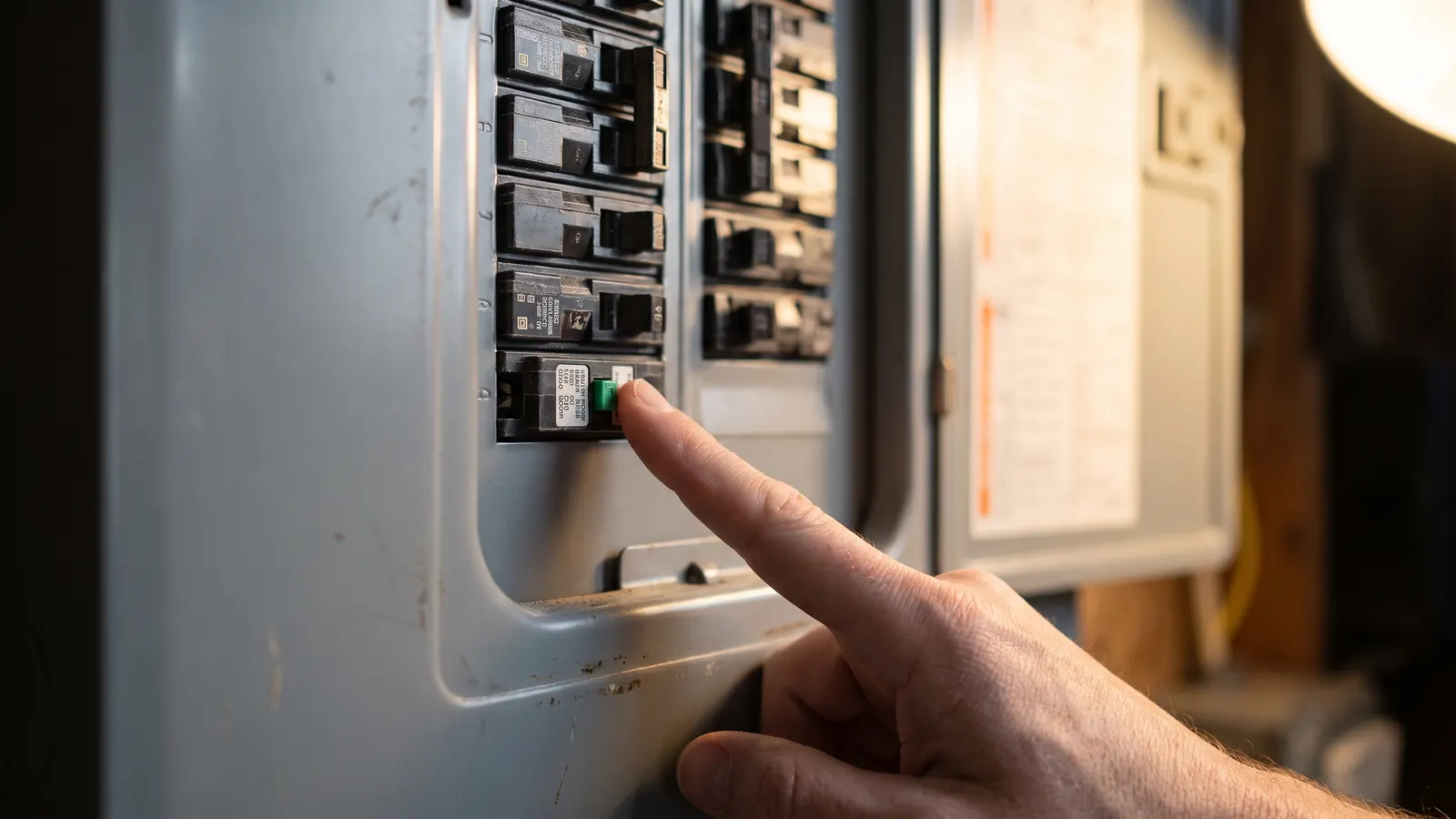
Test each AFCI breaker once a month by pressing the Test button on its face: the handle should snap to the tripped position and the circuit should go dead. Then push the handle fully Off and back On to restore power. A breaker that does not trip when tested, or that will not reset, is not protecting the circuit and needs an electrician. The whole panel takes a few minutes, and doing it on the same day as the GFCI and smoke alarm tests is the easy way to remember it.
An AFCI (arc fault circuit interrupter) is a breaker that watches the current on its circuit for the signature of an electrical arc, the small sustained spark across a damaged cord, a loose connection, or a nail through a cable, and cuts the power before the arc ignites what is around it. The Electrical Safety Foundation International describes an arc fault as a dangerous electrical problem caused by damaged, overheated, or stressed electrical wiring or devices.
Why do AFCI breakers matter?
AFCI breakers matter because the fires they prevent start inside walls, where nothing else can see them. ESFI says arc faults can occur when older wires fray or crack, when a nail or screw damages a wire behind a wall, or when outlets or circuits are overburdened. A standard breaker reacts only to a large overload or a dead short; an arc can smolder below that threshold, heating the insulation around it, and the AFCI is the only device in the panel built to notice.
ESFI's AFCI page says that since the 2008 edition, the National Electrical Code has included significantly expanded requirements for AFCI protection in all new homes, and that the CPSC estimates AFCIs could prevent more than 50 percent of the electrical fires that occur every year.
How often should you test them?
Test AFCI breakers once a month, and once after they are installed. That is the interval on the NFPA's electrical safety page: test AFCIs and GFCIs after installation and once a month thereafter. The interval is short because the failure is silent. Put the test on the same day as the GFCI test and the smoke alarm test, which are monthly as well; the three together are one lap of the house.
What do you need?
A flashlight, a list of which breakers are AFCIs, a dry floor, and a few minutes when nobody minds a bedroom or living room circuit dropping for a moment. Nothing goes behind the dead front. If the panel directory does not say which breakers are AFCI, look for a Test button on the breaker face; the breaker's own label usually says AFCI, CAFCI (combination), or dual function.
- A flashlight
- The panel directory, so you know which rooms each AFCI feeds; label the panel first if it is blank
- A few minutes with work saved and computers shut down on the circuits you will trip
- Optional: a nightlight in a room on the circuit, so a helper can confirm the power dropped
What are the steps?
Warn the household, open the panel door, find each breaker with a Test button, press it, watch the handle trip, then reset it Off and On. Confirm the circuit came back. Note any breaker that fails to trip, will not reset, or trips again on its own, and leave that one off until an electrician has looked at it.
- Save work and shut down computers on the affected circuits; the test cuts power like an outage.
- Stand on a dry floor with dry hands and open the panel door only. The metal cover behind it stays on.
- Find the first breaker with a Test button. Read its label: AFCI, CAFCI, or dual function (AFCI and GFCI in one).
- Press Test firmly. Done when: the handle snaps to the tripped or Off position, usually with a click, and the circuit goes dead.
- Reset it: push the handle fully to Off until it clicks, then to On. Done when: the handle stays on and a light or the nightlight on that circuit is back.
- Repeat for every AFCI breaker. In a newer home that can be most of the panel, since bedrooms, living rooms, hallways, and often the kitchen are on AFCI circuits.
- Note any breaker that did not trip when tested, or would not stay on afterward. Switch a breaker that failed to trip to Off and leave it there; the circuit is not protected.
- Reset clocks, and check that any GFCI outlets downstream of a dual-function breaker came back.
| Breaker | What it senses | What it protects | Test |
|---|---|---|---|
| Standard | Overload and short circuit | The wiring, from overheating | None; it trips on its own |
| GFCI | Current leaking to ground | People, from shock | Monthly, Test button |
| AFCI | The signature of an arc | The house, from fire | Monthly, Test button |
| Dual function | Ground faults and arcs | Both | Monthly, Test button |
When should you stop and call a pro?
Call a licensed electrician if a breaker does not trip when you press Test, if it will not reset, if it trips repeatedly with nothing unusual running, if it is warm to the touch, or if the panel buzzes, smells, or shows scorching. An AFCI that trips on its own is reporting a fault on the circuit: a damaged cord, a loose connection in a box, a failing device, or a nail in a cable. Finding that fault is the point of the breaker; resetting it repeatedly without looking for the cause defeats it.
In a new home, an AFCI that trips repeatedly in the first year is a workmanship item. Write down the dates and what was running, and send the builder a service request while the warranty covers it.
What should you record?
Record the date, which AFCI breakers you tested, and any that failed or tripped on their own, with what was running at the time. A breaker that fails is an electrician visit and a replacement date worth keeping with the panel's record. Set the test as a recurring task in the maintenance schedule on the same day as the GFCI and detector tests; in Property Station the Add Maintenance Task dialog takes a Frequency in months, and a frequency of one brings it back every month.
Common questions
What is the difference between an AFCI and a GFCI?
A GFCI protects people from shock by sensing current leaking to ground; an AFCI protects the house from fire by sensing the electrical signature of an arc. Many newer homes have both, sometimes combined in one dual-function breaker. Both have a Test button and both get the same monthly press.
My AFCI breaker trips when I run the vacuum. Is it broken?
Probably not. Some motors and older devices produce arcs the breaker reads as a fault. Try the vacuum on a different AFCI circuit; if it trips that one too, the vacuum is the cause. If only one breaker trips, with several different devices, have an electrician check that circuit.
Can I replace an AFCI breaker with a standard one to stop nuisance trips?
No. The AFCI is there because the circuit serves bedrooms or living areas where an arc behind a wall is most dangerous, and swapping it removes that protection and usually violates code. Find the cause of the trips instead, with an electrician if needed.
Do older homes have AFCIs?
Often not. Expanded AFCI requirements arrived with the 2008 National Electrical Code, so a home wired before then may have none. NFPA suggests asking a licensed electrician about adding AFCI protection; it can be done at the panel or with AFCI outlets at the start of a circuit.
What should you do next?
Open the panel today and count the Test buttons. If there are none and the house predates the 2008 code cycle, ask an electrician about adding AFCI protection, as NFPA suggests. If there are several, set the monthly task and press them now; the GFCI outlets take the same few minutes.