On this page
To save water at home, find and fix leaks first, then look outside at irrigation, and only then at fixtures and habits. The EPA's WaterSense program says each American uses an average of 82 gallons of water a day at home, that the average family can waste 180 gallons per week from household leaks, and that outdoor water use accounts for more than 30 percent of household use on average and as much as 60 percent in arid regions. Leaks and irrigation are where the gallons go, so they are where to start.
How do you find the leaks first?
Find leaks with the meter, then the toilets, then the fixtures, because a leak runs every hour of the day and no habit change competes with that. The EPA's Fix a Leak Week page says the average household's leaks can account for more than 9,300 gallons of water wasted every year, and that fixing easily corrected leaks can save about 10 percent on water bills. Its two tests take a couple of hours of not using water and ten minutes with food coloring.
- Meter testCheck the water meter before and after a two-hour period when no water is being used. The EPA says that if the meter changes at all, you probably have a leak. The meter guide shows how to read the dial and the low-flow indicator.
- ToiletsPut a few drops of food coloring in each tank. Color in the bowl after 10 minutes means the flapper is leaking; stopping a running toilet is usually a flapper or a fill valve.
- Faucets and showersA faucet dripping once per second can waste more than 3,000 gallons per year, and a showerhead leaking 10 drips per minute more than 500, per the EPA. A washer or a cartridge fixes most of them.
- IrrigationWalk every zone while it runs. The EPA says a leak just 1/32 of an inch in diameter can waste about 6,300 gallons per month.
- Meter againRepeat the two-hour test after the repairs. A meter that now holds still is the proof.
Leaks that the meter shows but the toilets and fixtures do not explain are in a supply line, a water heater, a softener, or underground between the meter and the house. Those go to a plumber, and the meter reading is what you hand them.
Why is irrigation the biggest outdoor cost?
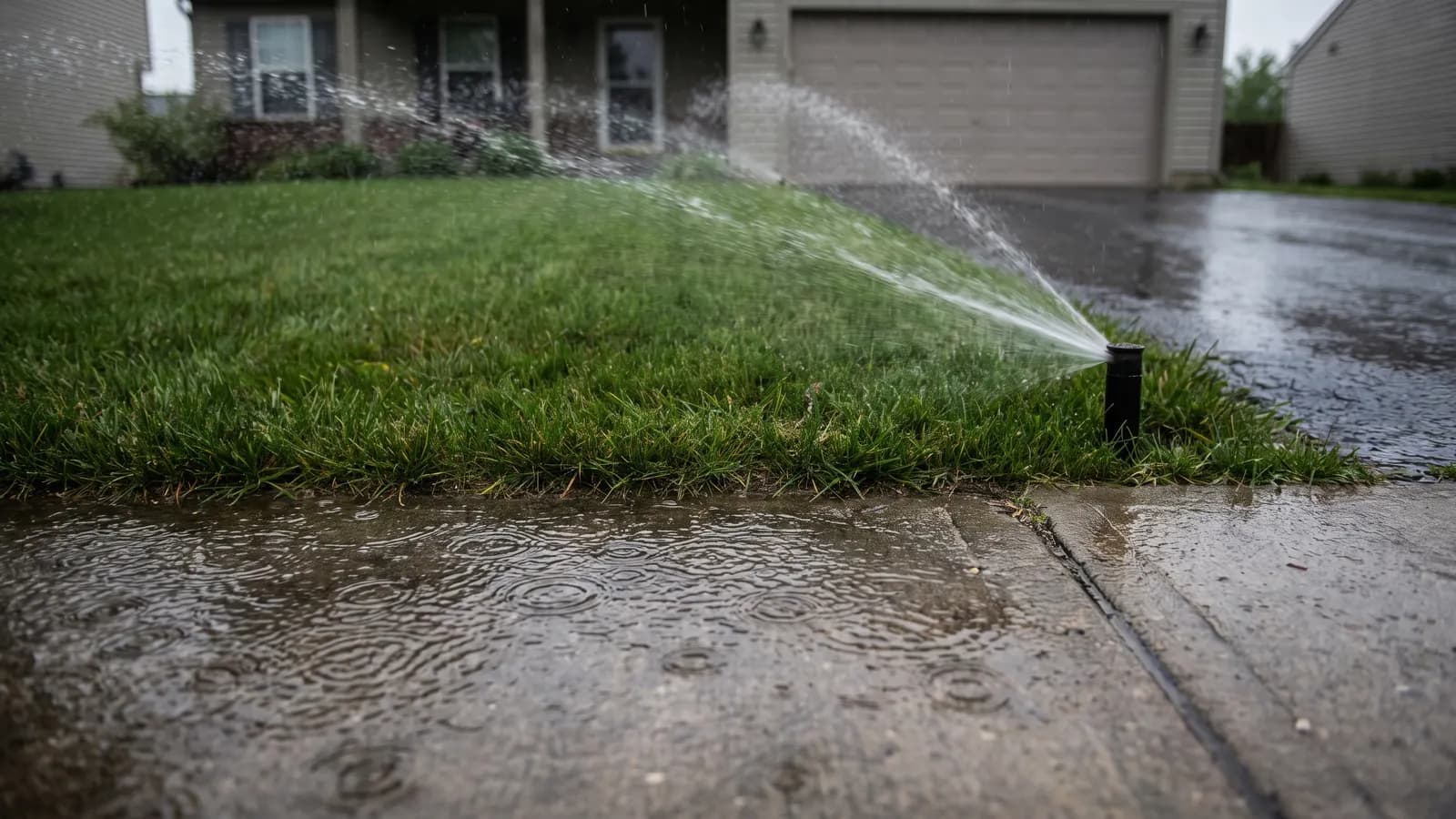
Irrigation is the biggest outdoor cost because it runs on a timer whether or not the lawn needs it, and because much of what it sprays never reaches a root. The EPA's WaterSense statistics say as much as 50 percent of outdoor water is lost to wind, evaporation, and runoff, and that an automatic irrigation system that is not properly maintained can waste up to 25,000 gallons annually. A broken head or a cracked line in one zone can run for weeks before anyone notices a wet patch.
Walk every zone once a season with the controller in manual mode, one zone at a time. Look for heads that spray the driveway, heads that do not pop up, geysers where a head is missing, and pooling that means a cracked line. Adjust the run times for the season, shut the system off during rainy weeks, and put the walk on the schedule so it happens in spring, midsummer, and before shutdown.
The spring restart and the fall shutdown bracket the season. Winterizing the irrigation keeps freeze damage from creating next year's leak, and the spring startup is when to find last winter's. Planting choices change the demand itself; landscaping that cuts energy use covers shade and ground cover that need less water than turf.
Which fixtures and habits matter?
Fixtures and habits come after leaks and irrigation because they save less per change, but two of them are close to free. The EPA says a WaterSense labeled showerhead can save the average family more than 2,700 gallons per year, and running the dishwasher only when it is full can save nearly 320 gallons annually. Hot water counts twice: every gallon saved at the shower is also a gallon the heater did not heat, which is the connection to lowering water heating costs.
| Change | Effort | What the EPA says |
|---|---|---|
| WaterSense showerhead | Minutes, hand-tight | Saves the average family more than 2,700 gallons per year |
| Run the dishwasher full | None | Saves nearly 320 gallons annually |
| Fix a dripping faucet | A washer or cartridge | A drip once per second can waste more than 3,000 gallons per year |
| Fix a running toilet | A flapper or fill valve | Food coloring in the tank finds it in 10 minutes |
| Maintain the irrigation system | A seasonal walk | An unmaintained system can waste up to 25,000 gallons annually |
Faucet aerators and showerheads also clog with scale, which lowers flow without saving anything; cleaning aerators and showerheads restores the pattern so nobody runs the tap longer to compensate.
What should you track?
Track three numbers: the monthly gallons on the bill, the meter reading before and after a two-hour idle period each season, and the date of each toilet test. The bill shows the trend, the meter test catches a new leak within a season instead of a year, and the toilet test is the cheapest check in the house. Compare a cold month to the same month last year; a jump with nothing else changed is a leak until proven otherwise.
The meter test and the irrigation walk have intervals, which makes them tasks. In Property Station each is a task on the Maintenance page with a Frequency in months and a reminder before it is due; completing it schedules the next one.
Write the meter readings in the task's completion notes. A year of readings is how you notice that the number stopped holding still.
Common questions
How do I know if my water bill is too high?
The EPA's Fix a Leak Week page suggests looking at usage in a colder month such as January or February, when nobody is watering. If a family of four exceeds 12,000 gallons per month, there could be serious leaks. Compare the same month year over year on your own bills as well.
What is the fastest way to find a leak?
Read the water meter, use no water for two hours, and read it again. The EPA says that if the meter changes at all, you probably have a leak. Then check the toilets with food coloring in the tank, since toilets are the first place to look indoors.
Are low-flow fixtures worth changing?
A WaterSense labeled showerhead can save the average family more than 2,700 gallons per year, per the EPA. Showerheads and faucet aerators are cheap and take minutes; toilets are a bigger job. Change those when a fixture fails or when you remodel, unless your water rate makes the payback obvious.
Does saving water also save energy?
Yes, for hot water. Every gallon of hot water you do not use is a gallon the heater did not have to heat, so a shorter shower or a low-flow showerhead cuts both bills. Cold-water savings, such as irrigation, cut only the water bill.
What should you do next?
Run the two-hour meter test tonight and drop food coloring in every toilet tank. If the meter moves and the toilets are clean, call a plumber with the reading. If it holds still, walk the irrigation zones this weekend and set the seasonal walk on the schedule.