On this page
Clean a faucet aerator by unscrewing it from the spout tip, separating the screen and washer, soaking the pieces in white vinegar until the mineral scale softens, brushing them clean, rinsing, and screwing the aerator back on by hand. Clean a showerhead the same way, unscrewed or with a bag of vinegar tied over it for an hour. Do it whenever the flow narrows, sputters, or sprays sideways, and about twice a year if your water is hard.
Why does a clogged aerator matter?
A clogged aerator matters because it makes a healthy plumbing system feel like a failing one. Scale and grit in the screen cut the flow, split the stream so it sprays the counter, and can make a pull-down sprayer stick. Owners respond by calling about low pressure, when the fix is a fitting the size of a coin. In a shower, blocked nozzles turn a soft spray into a few hard jets.
The pattern we see: flow drops slowly over months, so nobody notices until a guest mentions it. Hard-water houses without a softener clog fastest, and new-construction homes clog early from construction debris in the lines.
How often should you clean aerators and showerheads?
Clean aerators and showerheads whenever the flow changes and, as a routine, about twice a year in hard-water areas or once a year where water is soft or softened. Most faucets have no manufacturer interval; the faucet's care page is the tie-breaker. A house with a working water softener may go years between cleanings; a house on hard well water may need the kitchen aerator done every few months.
Hard water, no softener
White crust on the aerator within months, kitchen tap first. Clean twice a year and whenever the stream splits. Scale on the aerators means scale in the water heater too.
Soft or softened water
Little or no crust; the usual clog is grit. Clean once a year and after any plumbing work. If the aerators start crusting, the softener has stopped doing its job.
What do you need?
You need white vinegar, a small bowl, an old toothbrush, a cloth, and a plastic bag with a rubber band for a showerhead you cannot remove. A rubber jar gripper or cloth-wrapped pliers help with a tight aerator, and a stopper in the sink keeps the small parts out of the drain.
- White vinegar, a cup or two
- A small bowl, and a plastic bag with a rubber band
- An old toothbrush and a toothpick for individual nozzles
- A cloth or rubber jar gripper, and pliers as a last resort
What are the steps?
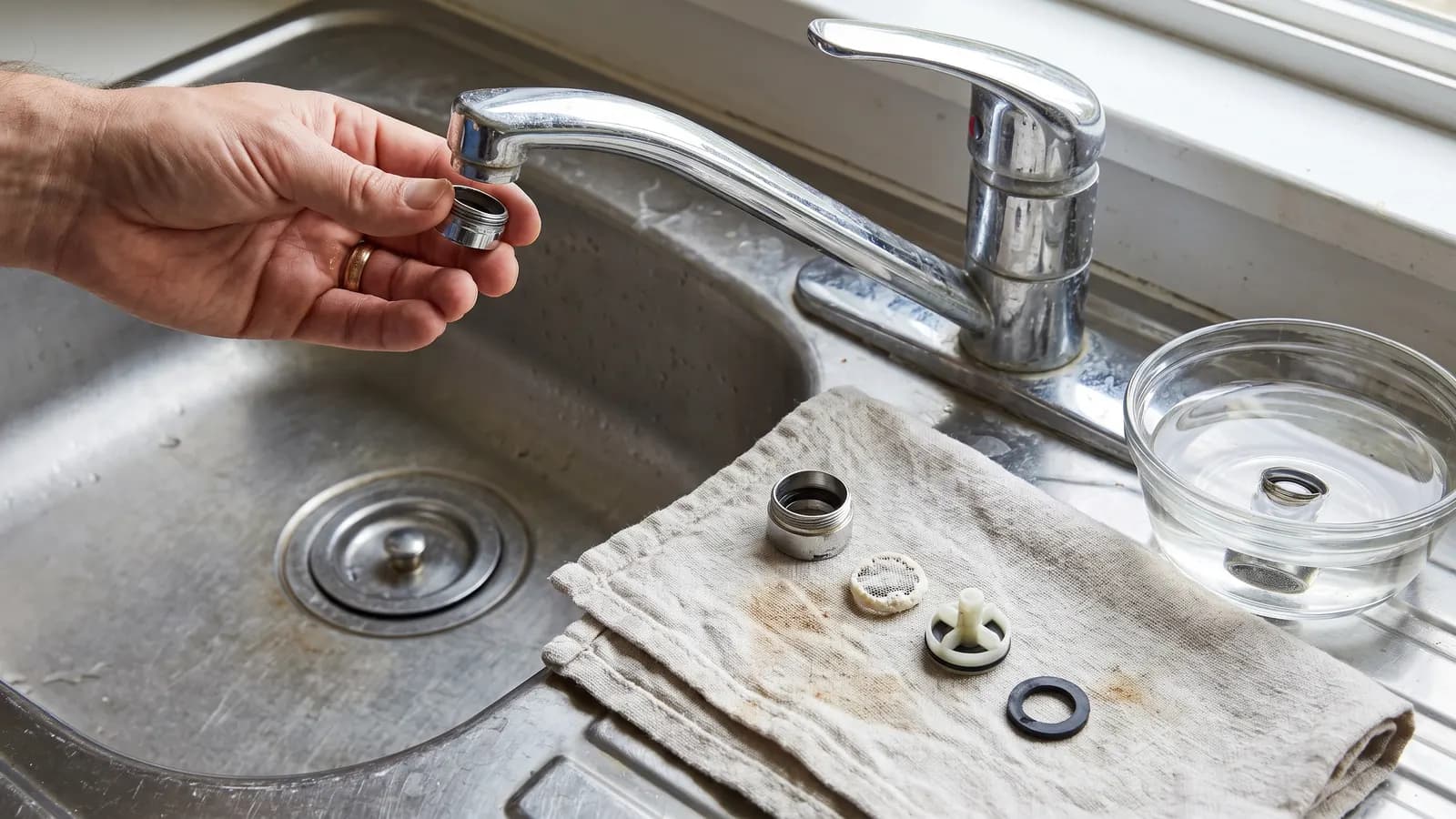
Block the drain, unscrew the aerator, lay out its parts in order, soak them in vinegar until the scale softens, brush and rinse, reassemble, and screw it back by hand until it seals. For the showerhead, either unscrew it at the arm and soak the whole head, or bag it with vinegar in place. Run each fixture afterward to flush loose scale.
- Put the stopper in the sink or lay a towel over the drain; the small parts are directly above it.
- Unscrew the aerator counterclockwise as seen from below. Fingers first, then a cloth for grip, then cloth-wrapped pliers. Done when: the spout tip is empty.
- Note the order of the parts as they come out: housing, screen, mixer, washer. Lay them out in that order or photograph them.
- Soak the parts in vinegar until the scale is soft, from a half hour for a light film to overnight for a heavy crust. Warm vinegar works faster.
- Brush the screen, poke any stubborn holes clear, and rinse everything. Replace a washer that is cracked or flattened.
- Reassemble in the same order and screw the aerator on by hand until it stops, then a small fraction more. Do not tighten with pliers; the housing cracks. Done when: the stream is full and straight with no drips at the joint.
- For the showerhead, unscrew it from the arm with a cloth-wrapped wrench, holding the arm steady so it does not turn in the wall. Soak it face down in vinegar for an hour, scrub the nozzles, rinse, and refit with fresh thread tape. If it will not come off, tie a bag of vinegar over it for an hour.
- Run the shower on hot for a minute to flush loose scale, then check for drips at the arm.
- Repeat for every faucet while the vinegar is out.
When should you stop and call a pro?
Stop and call a plumber when the aerator is clean, the supply stops are fully open, and the flow at that fixture is still weak, because the faucet cartridge or the supply line may be blocked. Call when the shower arm turns in the wall as you try to remove the head; forcing it can break the fitting behind the tile. If every fixture in the house has weak flow, the problem is upstream: test the house water pressure before replacing anything.
What should you record?
Record the date, which fixtures were cleaned, how heavy the scale was, and any aerator you replaced with its thread size. A note like "kitchen aerator heavy scale, bath aerators light" tells you which fixture to check first next time. Put the cleaning on a recurring schedule at the interval your water calls for; in Property Station it is one Maintenance task with the fixtures listed in the description, and the completion notes build the scale history the home record keeps.
Common questions
How do I remove an aerator that will not unscrew?
Wrap it in a cloth or a rubber jar gripper and turn clockwise as seen from above. If it still will not move, hang a bag of vinegar over it for an hour to loosen the scale. A recessed aerator needs the small plastic key that came with the faucet.
Is vinegar safe for all finishes?
White vinegar is safe on the aerator's brass and plastic parts and on most chrome. On oil-rubbed bronze, brushed nickel, and other coated finishes, soak only the removed part and wipe any splash at once.
Do new homes need this?
Yes, often sooner than older ones. Construction debris and pipe shavings end up in the aerators during the first months of a new build, which is why a new faucet can slow down within the first year. Clean every aerator once in the first few months, then settle into the schedule.
What should you do next?
Clean the kitchen aerator today; it is the one that clogs first. If it came out crusted, find out why: check whether the house has a softener and whether it is working, and put the water heater on its flush schedule, because the scale you saw on a screen the size of a coin is also on the bottom of the tank.