On this page
Stop a running toilet by finding which of four parts has failed: the flapper that seals the tank, the fill valve that refills it, the float that tells the fill valve when to stop, or the chain from the handle to the flapper. Put a few drops of food coloring in the tank and wait; color in the bowl means the flapper. Water pouring into the overflow tube means the float or the fill valve. Each fix is a few dollars in parts.
Why does a running toilet matter?
A running toilet matters because it wastes water continuously and the noise is the only warning you get. The EPA WaterSense Fix a Leak Week page says the average household's leaks can account for more than 9,300 gallons of water wasted every year, and that fixing easily corrected leaks can save about 10 percent on water bills. A toilet that refills on its own is the textbook easily corrected leak.
How do you tell which part has failed?
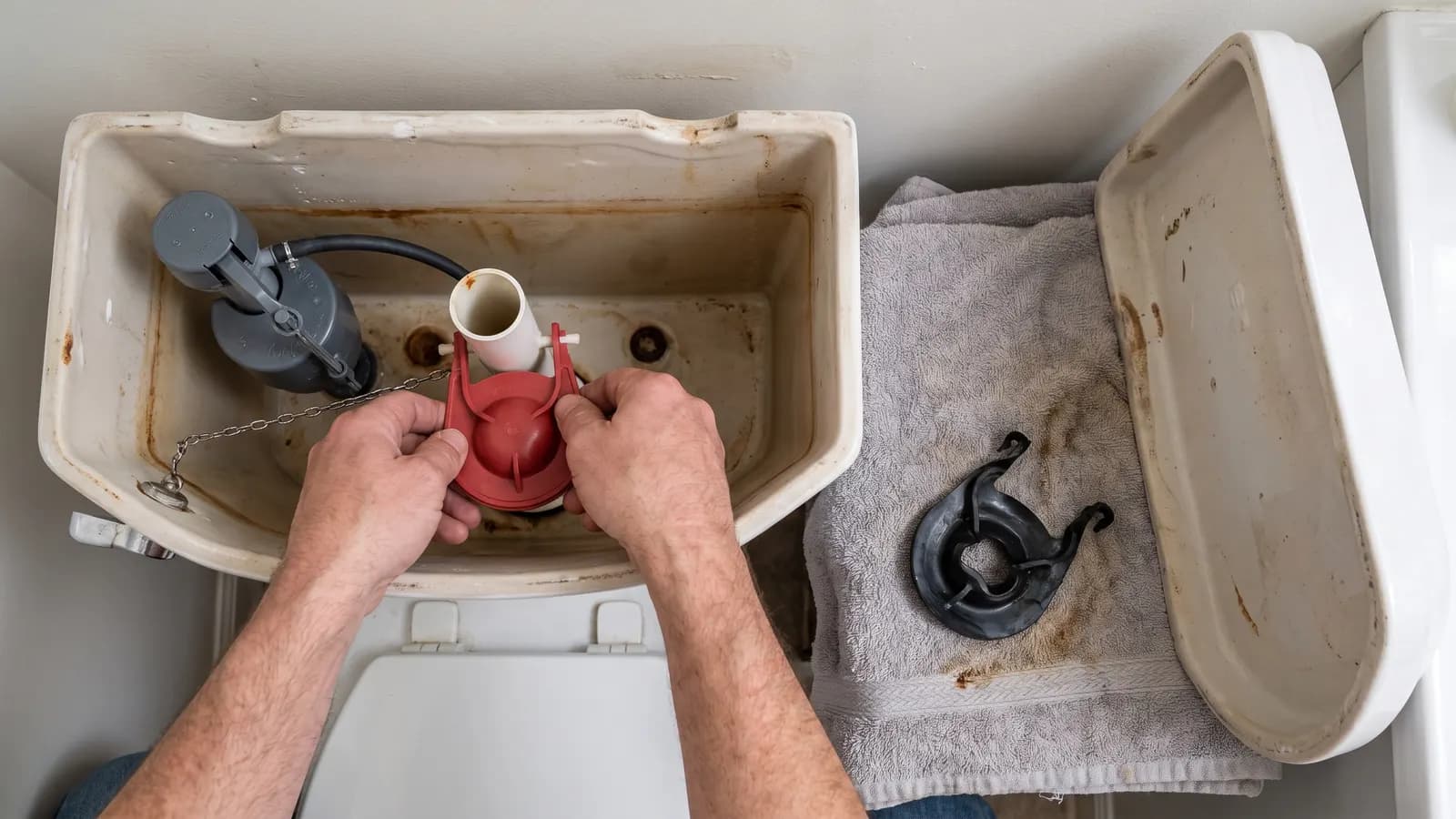
Tell the parts apart by lifting the tank lid and watching. If water is trickling over the top of the overflow tube (the open pipe in the middle of the tank), the float is set too high or the fill valve is not shutting off. If the level is below the tube but the fill valve still cycles on now and then, the flapper is leaking into the bowl, and the dye test proves it. A toilet that runs only until you jiggle the handle has a chain problem.
EPA WaterSense's Fix a Leak Week dye test: "Identify toilet leaks by placing a few drops of food coloring in the toilet tank. If any color shows up in the bowl after 10 minutes, you have a leak."
| What you see | Likely cause | Fix |
|---|---|---|
| Color in the bowl after the dye test | Flapper not sealing, or a rough seat | Replace the flapper; clean the seat |
| Water running into the overflow tube | Float too high, or fill valve not closing | Lower the float; replace the fill valve |
| Runs until the handle is jiggled | Chain too long or short | Adjust the chain |
What do you need?
You need food coloring, a sponge and a bucket, and the replacement part once you know which one failed: a flapper, a fill valve, or both. Most toilets need no tools beyond pliers and an adjustable wrench. Take the old part to the store; a poor match keeps running.
- Food coloring or a dye tablet
- A sponge, a bucket, and a towel
- Pliers and an adjustable wrench
- A flapper or fill valve matched to the toilet's model number, stamped inside the tank
What are the steps?
Run the dye test, then work from the cheapest part to the most involved: adjust the chain, adjust the float, replace the flapper, and only then replace the fill valve. The water stays on for the first three; close the stop under the tank for the last one.
- Lift the lid and set it somewhere safe; the lids crack easily.
- Run the dye test: a few drops of food coloring in the tank, then wait 10 minutes without flushing. Done when: you know whether color reached the bowl.
- Check the chain. It should have a couple of links of slack when the flapper is closed, and it must not slip under the flapper. Flush and listen.
- Check the float. Water should stop at the fill line marked on the overflow tube or the tank wall. On a cup float, turn the adjustment screw down; on a ball float, bend the arm down slightly. Done when: the fill valve shuts off with the water below the tube.
- Replace the flapper if the dye test was positive. Close the stop, flush to empty the tank, unhook the chain, pull the flapper's ears off the pegs, and wipe the seat clean; vinegar removes crust. Fit the new flapper, rehook the chain, and open the stop. Done when: a second dye test is clean.
- Replace the fill valve if the float adjustment did not stop the running. Close the stop, empty the tank, disconnect the supply line over a bucket, unscrew the retaining nut, and lift the old valve out. Fit the new one per its instructions, reconnect the supply, and clip the refill tube to the top of the overflow tube. Open the stop slowly.
- Flush several times and watch for drips at the supply connection and under the tank. Done when: the tank fills, stops, and stays quiet for a full minute.
When should you stop and call a pro?
Stop and call a plumber if the shutoff under the tank will not turn or leaks when you close it, if the tank bolts or the tank itself leak onto the floor, if the flush valve seat is so pitted that a new flapper will not seal, or if the toilet keeps running after a new flapper and fill valve. A toilet that runs and drains slowly may have a partial clog, which is a drain problem, not a tank problem.
What should you record?
Record the toilet's location, the model number from inside the tank, the part you replaced, and the date. A toilet that needs a second flapper within a year has a rough seat or in-tank cleaning tablets eating the rubber. In Property Station a yearly dye test of every toilet is one recurring task on the Maintenance page with Frequency (months) set to 12, and the parts go in the completion notes in the home record. Put it on the maintenance schedule.
Common questions
Why does the toilet run for a few seconds every so often?
That is a phantom flush: the flapper lets a little water into the bowl, the level drops, and the fill valve tops it up. A new flapper fixes it in most cases; a rough flush valve seat is the other cause.
Can I just adjust the float instead of replacing parts?
Yes, if the only problem is water pouring into the overflow tube. Lower the float so the water stops at the fill line marked on the tube. If the fill valve keeps running with the float lowered, the valve itself is worn and needs replacing.
Do I need to match the flapper to the toilet brand?
Flappers come in a few sizes and styles, and the wrong one seals badly. Take the old flapper to the store or note the model number from inside the tank. A universal flapper fits many toilets but not all.
What should you do next?
Do the dye test on every toilet in the house tonight; it costs a few drops of food coloring and ten minutes. Then read the meter, because a toilet is the most common hidden leak but not the only one; the two-hour meter test catches the rest.