On this page
Winterize the irrigation system before the first hard freeze: shut off its water supply, open the drains on the backflow preventer, and clear the water out of the underground lines, usually with a compressed-air blow-out. The shutoff and the drains are homeowner work. The blow-out is the step most people hire, and in a cold climate it is not optional; water left in the lines freezes, and what breaks is the backflow preventer, the valves, and the pipe.
This guide is for the common automatic sprinkler system: a shutoff valve inside the house or in a box near the meter, a backflow preventer above ground, a controller, and zone valves feeding underground lines. Drip systems and well-fed systems vary; the installer's instructions win.
When should you winterize the irrigation system?
After the last watering of the season and before the first night forecast well below freezing. In most cold and mixed climates that is a window of a few weeks in fall. Book the blow-out early; irrigation companies fill up the week of the first freeze warning.
What do you need?
The location of the irrigation shutoff valve and the backflow preventer, a flathead screwdriver for the test cocks, the controller's manual or its off setting, an insulated cover or a bag of insulation and a plastic bag for the backflow preventer, and either an irrigation company booked for the blow-out or a compressor with enough volume and a regulator if you are set up for it.
- The location of the irrigation shutoff valve (often in the basement, crawlspace, or a valve box near the water meter) and of the backflow preventer
- A flathead screwdriver for the test cocks on the backflow preventer
- The controller's manual or the "rain mode" or "off" setting
- Insulated covers or a bag of insulation and a plastic bag for the backflow preventer, if you leave it in place
- An irrigation company booked for the blow-out, or a compressor with enough volume and a regulator if you are set up for it
What are the steps?
Shut off the water at the irrigation valve, set the controller to off, open the backflow preventer's ball valves halfway and its test cocks to drain it, open any manual drains, blow out the lines zone by zone (or have it done), then insulate or remove the backflow preventer and leave the shutoff closed and the drains open until spring. About an hour of homeowner work plus the blow-out visit.
- Shut off the water to the irrigation system at its dedicated valve. Done when: the valve is closed and the backflow preventer's gauge or the system's pressure drops when you open a test cock.
- Set the controller to off or rain mode, not to a schedule. If the controller is unplugged for winter, note the programs first; some lose them. A controller left running with the water off will cycle the valves dry, which harms nothing but tells you nothing.
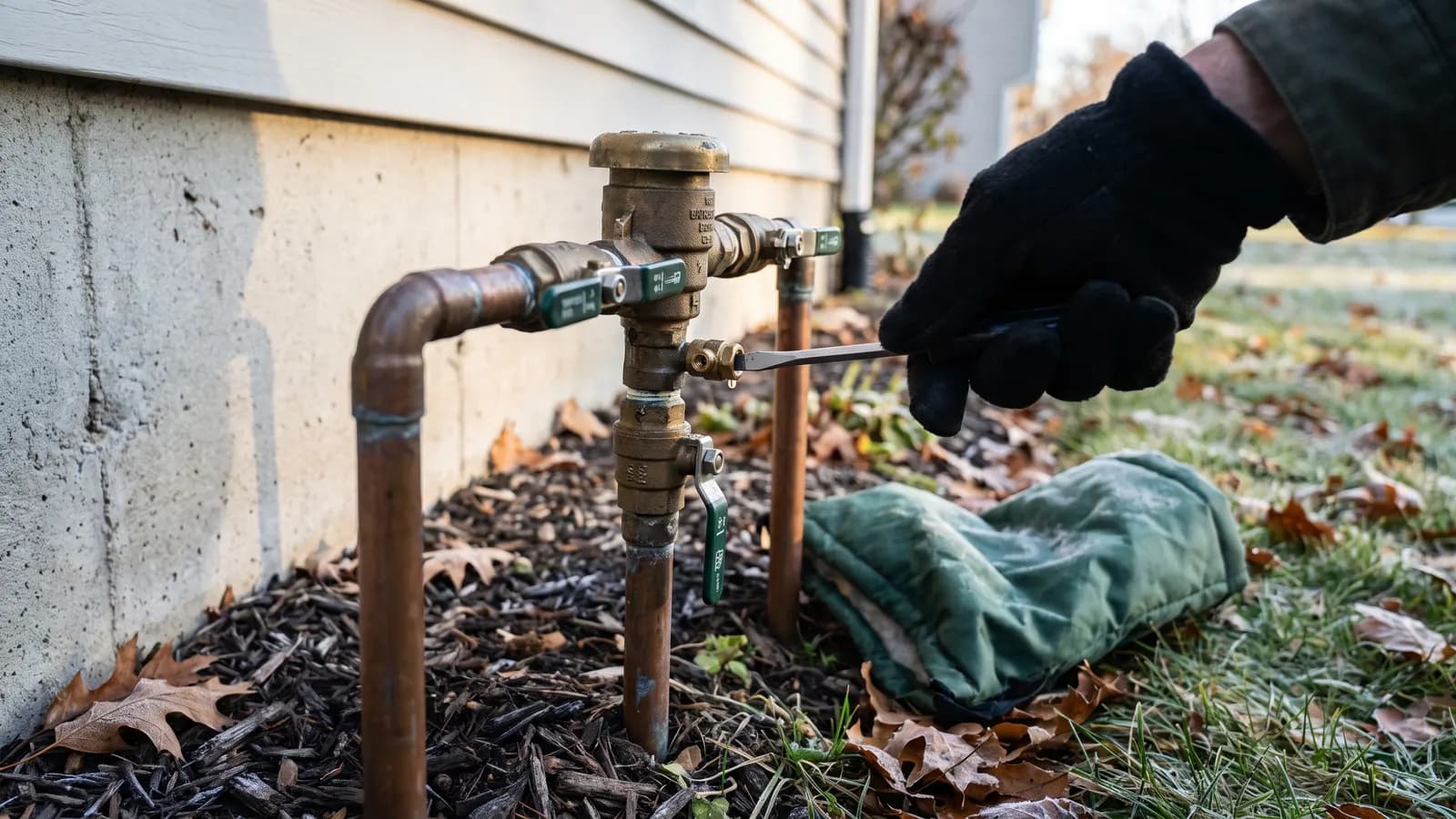
- Drain the backflow preventer. Open the two ball valves on it to a 45-degree position (halfway) and open the test cocks with the screwdriver so water can leave and air can enter. Leaving the ball valves half open prevents water from being trapped in the ball, which is what cracks it. Done when: water has stopped draining from the test cocks.
- Drain what you can by gravity. If the system has manual drain valves at the low points, open them. If it has automatic drains, the valves handle themselves once the pressure is off. Many systems have neither, which is why the blow-out exists.
- Blow out the lines, or have it done. With the compressor connected at the blow-out fitting (downstream of the backflow preventer; never blow air through the backflow preventer itself), one zone at a time is opened at the controller and air pushes the water out of the heads until they run dry mist, then the next zone. A pro brings a compressor sized for it and knows the pressure the pipe and heads can take. Done when: every zone has run dry.
- Protect the backflow preventer. Either leave it drained with the ball valves half open and wrap it in an insulated cover, or, if it has union fittings, remove it and store it indoors. Cover any exposed above-ground pipe the same way.
- Leave the shutoff closed and the drains open until spring.
How do you restart the system in spring?
Close the test cocks and the drain valves. Set the backflow preventer's ball valves fully open. Open the supply valve slowly to let the system fill without a surge. Walk each zone with the controller running: look for heads that do not pop up, heads that spray the wrong way, and wet spots that mean a cracked line. Reset the controller's programs.
When should you stop and call a pro?
Hire the blow-out unless you have the compressor and the experience. Call an irrigation company if the shutoff valve will not close, if the backflow preventer leaks from the body after draining, if you find a cracked head or a wet spot in spring (a broken line underground), or if you are not sure which valve is the irrigation supply. Backflow preventers in many jurisdictions must be tested by a certified tester on a schedule; the tag on the device or the water utility will say.
On a new home with a builder-installed system, ask the builder or the installer for the as-built zone map and the winterizing instructions before the first fall; both are easy to get in month one and hard to get in year three.
What should you record?
The date of shutoff and blow-out, who did the blow-out, the location of the shutoff valve and the backflow preventer, the controller's programs, and anything that needed repair in spring. Set the fall winterizing and the spring restart as recurring tasks, and put them on the same days as the other freeze-season jobs: protecting the house's pipes and the last gutter cleaning.
Common questions
Do I need to winterize in a mild climate?
If the ground where the pipes run never freezes, no; shutting the system off for the season and draining the backflow preventer is enough. If your area gets even a few hard freezes a winter, the backflow preventer and any above-ground pipe are at risk, and draining them is the minimum. When in doubt, ask the installer what they do for your area.
Can I blow out the lines with my own compressor?
A small shop compressor rarely moves enough air, and too much pressure damages the valves and heads. Blow-outs need the right volume at a modest pressure, one zone at a time, and it is easy to get wrong. Most homeowners hire it; it is a short visit each fall.
What is the backflow preventer and why does everyone mention it?
The brass assembly above ground near where the irrigation line leaves the house. It keeps irrigation water from siphoning back into your drinking water. It sits above ground, holds water, and is the first thing to crack in a freeze; it is also the most expensive single part of the system.
What should you do next?
Book the blow-out now if it is fall. Then walk the yard with the grading and drainage checklist: a sprinkler head that soaks the foundation every morning is a drainage problem with a timer on it.