On this page
Water must move away from the house. Walk the perimeter after a heavy rain and look for the two failures: ground that slopes toward the foundation, and downspouts that dump water at the wall. Fixing them is mostly soil and a few feet of pipe, and it prevents the wet basement, the damp crawlspace, the cracked slab, and the settling that show up years later as expensive structural problems.
Grading is the slope of the ground next to the house. Drainage is where the roof water and the surface water go once they hit the ground. Both are set when the house is built and both change: backfill settles, mulch beds build up, a patio is added, a downspout extension gets kicked off by the mower.
What are the two things to look for?
Look for ground that slopes toward the foundation, and for downspouts that dump their water at the wall. Those two account for most water problems in houses, and both are visible after a heavy rain. Then look at the details: window wells that fill, a patio that slopes toward the house, a sump or condensate line that discharges beside the wall, and mulch beds built up above the siding line.
In most houses we see with water problems, the water is coming from the roof. A single downspout can carry the rain from a large section of roof, and if it discharges at the foundation, that is a lot of water in one spot. Extending downspouts is the highest-value drainage fix there is, and the cheapest.
- Slope. Stand at each corner and look along the wall. The ground should fall away from the house. Low spots, flat spots, or beds that have built up above the surrounding grade hold water against the wall.
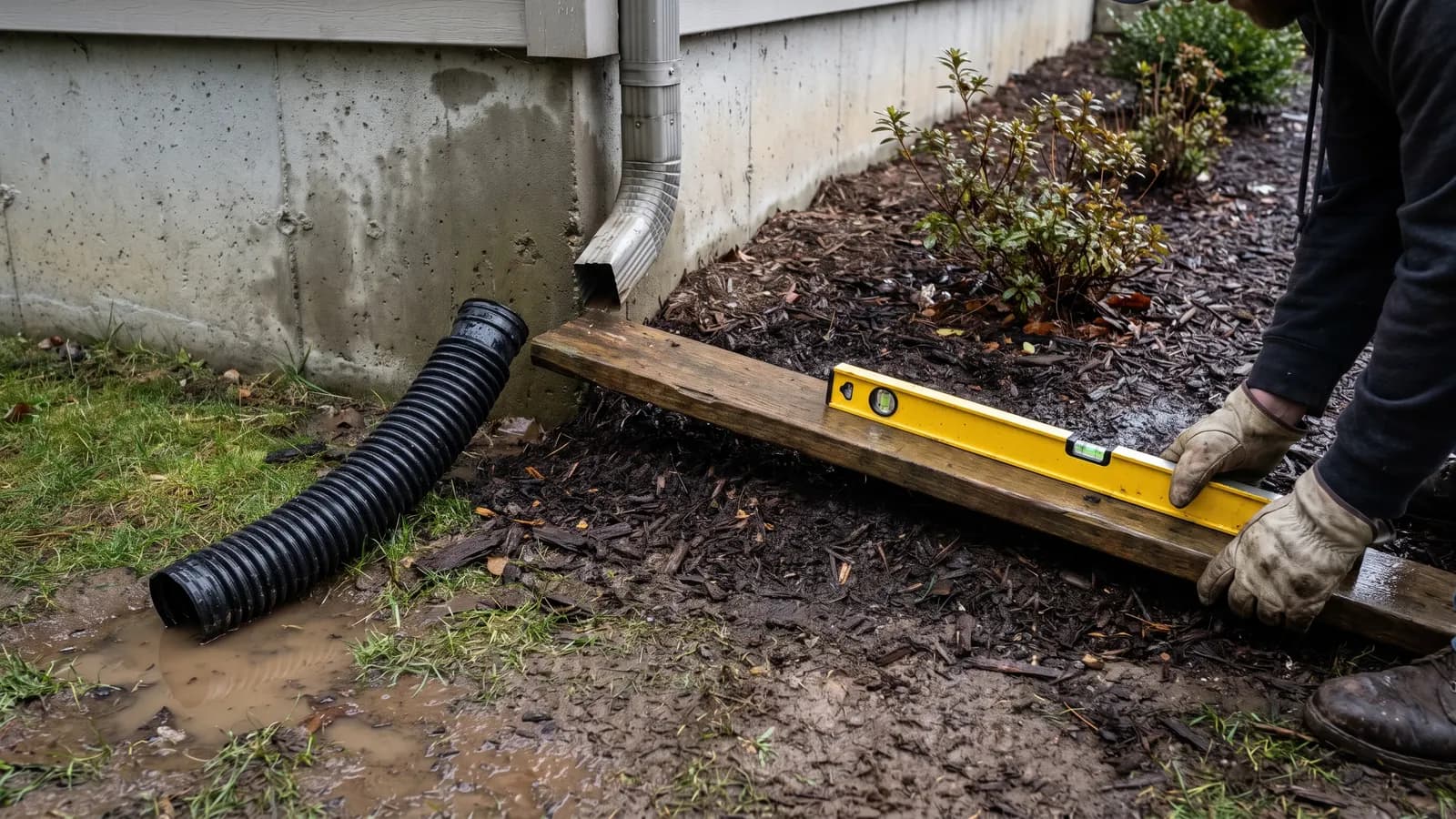
- Downspouts. Each one should discharge several feet from the foundation onto ground that slopes away, or into a buried drain line that daylights somewhere lower. A splash block at the wall is not enough for a heavy rain.
Then the details: window wells that fill, a patio or walk that slopes toward the house, a sump pump discharge that dumps next to the wall so the pump cycles the same water, an AC condensate line dripping at the foundation, and a hose bib that drips into a low spot.
What do you need?
A long straight board with a level on it (or a line level and string) to read the slope, a shovel, a rake, and a tamper, fill soil that packs rather than bagged topsoil or mulch, downspout extensions with elbows and stakes or a buried drain line with a pop-up emitter, and a camera with last year's photos to compare against.
- A long, straight board and a level (a 4-foot level on an 8-foot board reads the slope), or a line level and string
- A shovel, a rake, and a tamper
- Fill soil that compacts (clay-loam, not topsoil, not mulch)
- Downspout extensions: rigid or corrugated pipe, elbows, and stakes; or a buried drain line and a pop-up emitter
- A camera for before and after photos, and last year's photos to compare
What are the steps of the check?
After a heavy rain, or with a hose running at each corner, walk the perimeter and note where water stands or runs toward the house, read the slope with the board and level along each wall, follow every downspout to where its water ends up, look at the foundation walls and the basement or crawlspace for stains and efflorescence, check the window wells, and check that mulch sits below the siding line.
- Do it after a heavy rain, or run a hose at each corner for ten minutes and watch. Note every place water stands or runs toward the house. Done when: you have a list and photos.
- Check the slope with the board and level at several points along each wall. The far end of the board should sit lower than the end at the house.
- Follow each downspout to its end. Note where the water lands and where it goes from there.
- Look at the foundation walls and the basement or crawlspace for signs: efflorescence (white mineral deposits), damp patches, staining at the base of the wall, a musty smell, water lines on the crawlspace piers.
- Check window wells for standing water and for a drain or gravel at the bottom.
- Look at the mulch beds. Mulch piled above the siding line holds water against the wall and invites termites; it should sit a few inches below the siding.
What are the steps of the fixes?
Extend the downspouts first, because roof water is most of the problem; then regrade the low spots with packed fill sloped away from the house and kept below the siding; then route the condensate and sump discharge away and fix any dripping hose bib; then test everything again with the hose. A weekend of dirt and pipe prevents the expensive foundation problems.
- Extend the downspouts first. Attach an elbow and a length of pipe, run it out several feet or to a low area that drains away, and stake it. For a cleaner look, bury solid pipe from the downspout to a pop-up emitter in the lawn, with a slight fall the whole way. Done when: water from the downspout ends up well away from the wall and keeps going.
- Regrade the low spots. Remove mulch or sod, add fill soil in layers, tamp each layer, and shape a slope away from the house. Keep the soil below the siding and the top of the foundation and clear of any vents and weep holes. Reseed or replace mulch on top. Done when: the board and level read a fall away from the house at every point.
- Fix the small sources. Route the AC condensate and the sump discharge to the same downspout extension or to their own pipe. Fix the dripping hose bib. Add a window well cover if the well fills.
- Test with the hose. Run water at the top of the regraded area and at each downspout and confirm it moves away.
When should you stop and call a pro?
Call a drainage or foundation contractor if water enters the basement or crawlspace after the grading and downspouts are corrected, if a patio, driveway, or walkway slopes toward the house (a concrete or hardscape job), if the lot sits lower than the neighbors and water arrives from next door, if you find cracks in the foundation wider than a hairline or a wall that bows, or if the fix would involve digging near the foundation deeper than a few inches.
Exterior French drains, footing drains, and waterproofing membranes are excavation work with safety and code implications. Call before digging anywhere near buried utilities; the national "call before you dig" service is free.
On a new-construction home, grading that sloped away at closing and toward the house a year later is the backfill settling. Photograph it, compare with the closing-day photos, and report it to the builder during the warranty period; many warranty documents address grading specifically.
What should you record?
Photos of every wall from the same spots each year, the slope readings, where each downspout ends, and what you changed. The foundation photos in particular are a record you hope never to need and will be very glad to have if a structural claim ever arises. Set the post-rain walk as a twice-yearly task, and put the gutter cleaning on the same days; the gutters are where the water starts.
Common questions
How much slope should the ground have away from the house?
Enough that water visibly runs away from the foundation rather than pooling; a common rule of thumb is a drop of several inches over the first several feet, and the builder's plans or local code may state a number. What matters is the test: after a heavy rain, no water stands against the wall.
Can I just add soil against the foundation?
Yes, with limits. Use soil that packs (not bagged topsoil or mulch, which absorb water), keep it a few inches below the siding, brick ledge, or the top of the foundation so it does not touch wood or cover weep holes, and slope it away. Do not bury the foundation's damp-proofing line or block crawlspace vents.
My new house had good grading at closing and now it does not. Why?
Backfill around a new foundation settles for a year or more as the disturbed soil compacts, and the ground that sloped away in month one can slope toward the house by month twelve. This is normal, it is why the first-year check matters, and it is often a warranty item if the builder's grading plan called for a slope that no longer exists.
What should you do next?
Extend the downspouts this weekend; it is an hour and it is the fix that matters most. Then do the fall caulk walk on the same perimeter: water that cannot get in at the ground should not get in at the wall either.