On this page
Control indoor humidity by measuring it with a hygrometer in the rooms that matter, running the bathroom and kitchen fans during showers and cooking and for 20 minutes after, venting the clothes dryer outdoors, fixing the water sources (grading, downspouts, a wet crawlspace, a plugged AC drain), and only then adding a dehumidifier where the readings stay high. The target is below 60 percent relative humidity, ideally 30 to 50, and lower in winter in a cold climate. Most houses get there with fans and fixes, not machines.
Relative humidity is how much water the air holds compared with the most it could hold at that temperature. Warm air holds more, which is why the same moisture that is harmless in July condenses on a January window.
Why does indoor humidity matter?
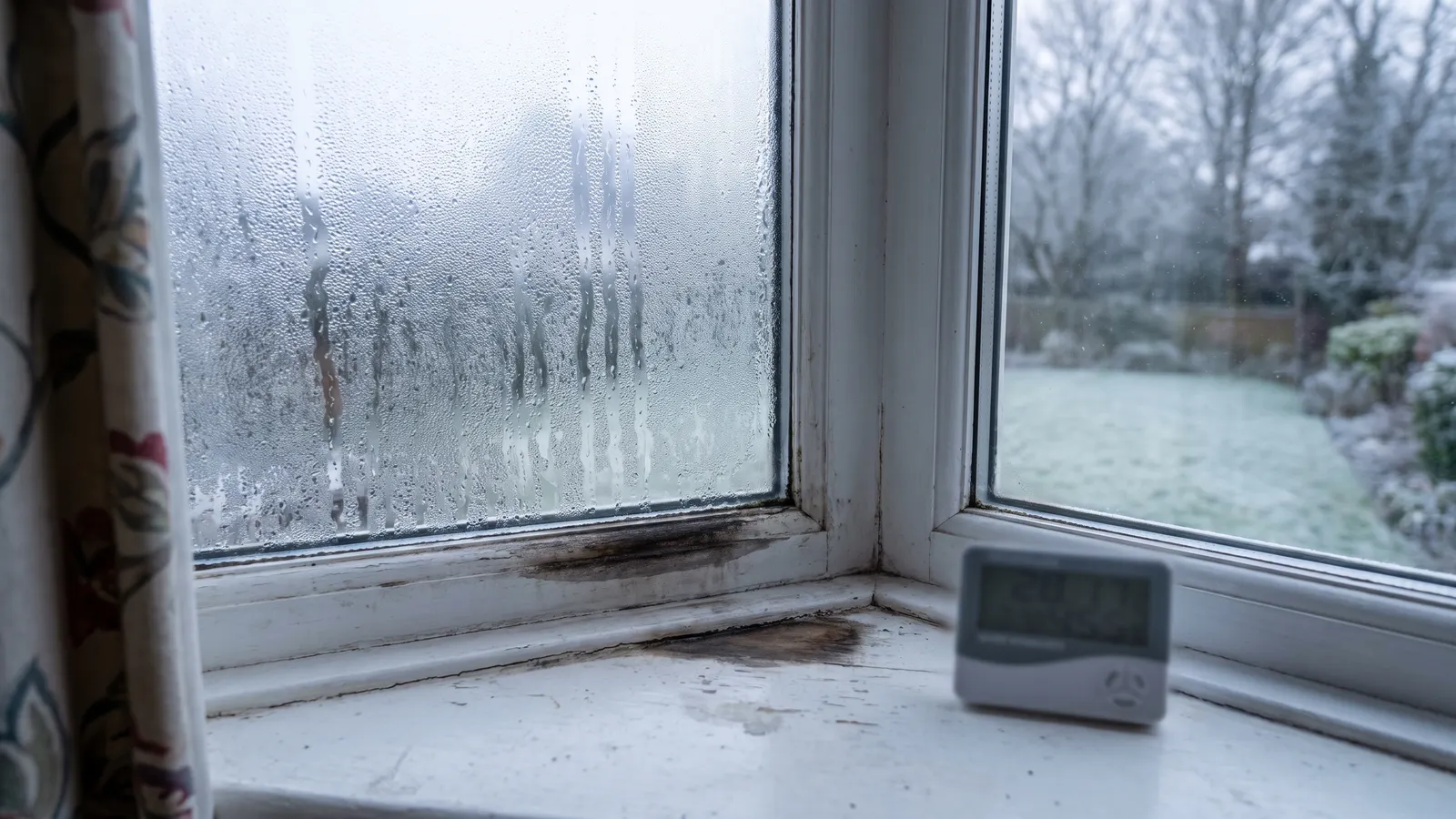
Indoor humidity matters because water in the air ends up on the coldest surface in the house, and whatever is there stays wet: window frames, the back of a closet on an outside wall, the underside of the roof deck. The EPA's mold guide says to keep indoor humidity below 60 percent, ideally between 30 and 50 percent, and that in most cases mold will not grow if wet materials are dried within 24 to 48 hours. Too dry is its own problem in winter, which is why the winter target is a range and not a number.
How often should you check it?
Read the hygrometer every few days for the first two weeks, then weekly, and always after a change of season, a stretch of rain, or a new habit in the house such as drying laundry indoors. Morning readings in the bedrooms and evening readings in the kitchen and basement show the range. Once you know the house, a glance at the gauge as you walk past is enough; the reading that matters is the one that is high three days running.
What do you need?
You need one or two digital hygrometers, a tissue for the fan test, a flashlight for the crawlspace and attic, and possibly a timer switch for the bathroom fan so the 20 minutes happen without anyone remembering. A dehumidifier comes last, and only for the room whose readings stay high after everything else is done.
- One or two digital hygrometers (a few dollars each)
- A tissue, to test whether the bath fan pulls air
- A flashlight
- A timer switch for the bath fan, optional but effective
- A dehumidifier, only if the readings say so
What are the steps?
Measure for a week, set the target for the season, run the fans properly, confirm the dryer vents outside, walk the outside for drainage, set the air conditioner's fan to auto and check its drain, turn the humidifier down in winter, look in the crawlspace and attic if readings stay high, and add a dehumidifier last. Then measure for another week.
- Put one hygrometer in the main bedroom and one in the basement or the dampest room. Read them morning and evening for a week and write the numbers down. Done when: you have a week of readings for each room.
- Set the target for the season. ENERGY STAR's dehumidifier page puts the optimum at 30 to 50 percent and says that in colder climates during the heating season the range should be 30 to 40 percent to prevent window condensation.
- Run the bath fan during every shower and the kitchen fan whenever the stove is on. ENERGY STAR's windows page says to make sure the fans vent directly outside and to leave them running for 20 minutes after you are done. Hold a tissue to the grille while it runs; a fan that will not hold the tissue needs cleaning or a duct fix.
- Confirm the dryer vents outdoors and the outside flap opens when it runs. ENERGY STAR's dehumidifier page lists venting the dryer outdoors, extending downspouts, and using the fans as the sources to fix first; the dryer vent guide covers the duct.
- Walk the outside after a rain. Downspouts should discharge well away from the foundation and the ground should slope away from the house; grading and drainage is its own weekend.
- In summer, set the air conditioner's fan to auto rather than on, so the wet coil drains between cycles instead of blowing its moisture back into the house, and confirm the condensate line drips outside while the system runs.
- In winter, if the windows fog, turn the whole-house humidifier down or off and run the bath fans longer. The humidifier guide covers the setting.
- If a room stays high, look in the crawlspace and the attic with the flashlight for standing water, damp insulation, or a fan duct that ends there.
- Add a dehumidifier in the room whose readings stay high after all of that, sized from ENERGY STAR's table and set to 30 to 50 percent. Caring for it is a monthly job.
- Read the hygrometers for another week. Done when: every room reads under 60, and the bedrooms sit inside the seasonal range.
Summer
- Readings creep up with rain and with an air conditioner that starts and stops without running long
- Fans, dryer vent, drain line, and grading first; a dehumidifier after
- Air conditioner fan on auto so the coil drains between cycles
Winter
- Condensation on the windows is the signal
- Humidifier down or off, fans running longer after showers
- Target 30 to 40 percent in a cold climate, per ENERGY STAR
When should you stop and call a pro?
Call a professional when the source is beyond a fan or a hose: water in the crawlspace or basement after rain, a foundation that stays damp, an air conditioner that runs constantly but never dries the house (a sizing or refrigerant question for a technician), a bath fan that vents into the attic and needs a duct to the roof, or mold larger than the area the EPA says a homeowner should clean.
A new home whose readings stay high through the first year is a builder conversation; indoor air in a tight new home explains what the ventilation system is supposed to be doing.
What should you record?
Record the readings by room and month, the fixes you made and their dates, the tissue test result for each fan, the humidifier setting, and the dehumidifier's set point. Twelve months of readings is the record that tells you whether the house has a humidity problem or a July problem. Put the weekly reading on a recurring schedule with the numbers in the notes; in Property Station a recurring task is one entry with a frequency in months, so the reminder comes back on its own.
Common questions
What should indoor humidity be?
The EPA's mold guide says below 60 percent, ideally between 30 and 50 percent. ENERGY STAR adds that in colder climates during the heating season the range should be 30 to 40 percent to prevent condensation on windows. Measure it with a hygrometer rather than guessing from how the air feels.
Why are the windows wet in the morning?
Warm indoor air holds moisture, and the glass is the coldest surface in the room, so the moisture condenses there first. In winter that means the house is too humid for the outdoor temperature. Lower the humidifier setting if there is one, run the bath fans longer, and check that the dryer vents outside.
Does a new house have a humidity problem?
Often, in the first year. Concrete, framing, drywall mud, and paint release water for months after move-in, and a new house is built tight enough to keep it. Run the bath and kitchen fans on every use, run a dehumidifier in a finished basement, and expect the readings to fall as the house dries out.
What should you do next?
Buy the hygrometer and take the first reading tonight. Then put a timer switch on the bathroom fan, because the 20 minutes after a shower is the single habit that moves the number most, and it is the one nobody keeps by memory.