On this page
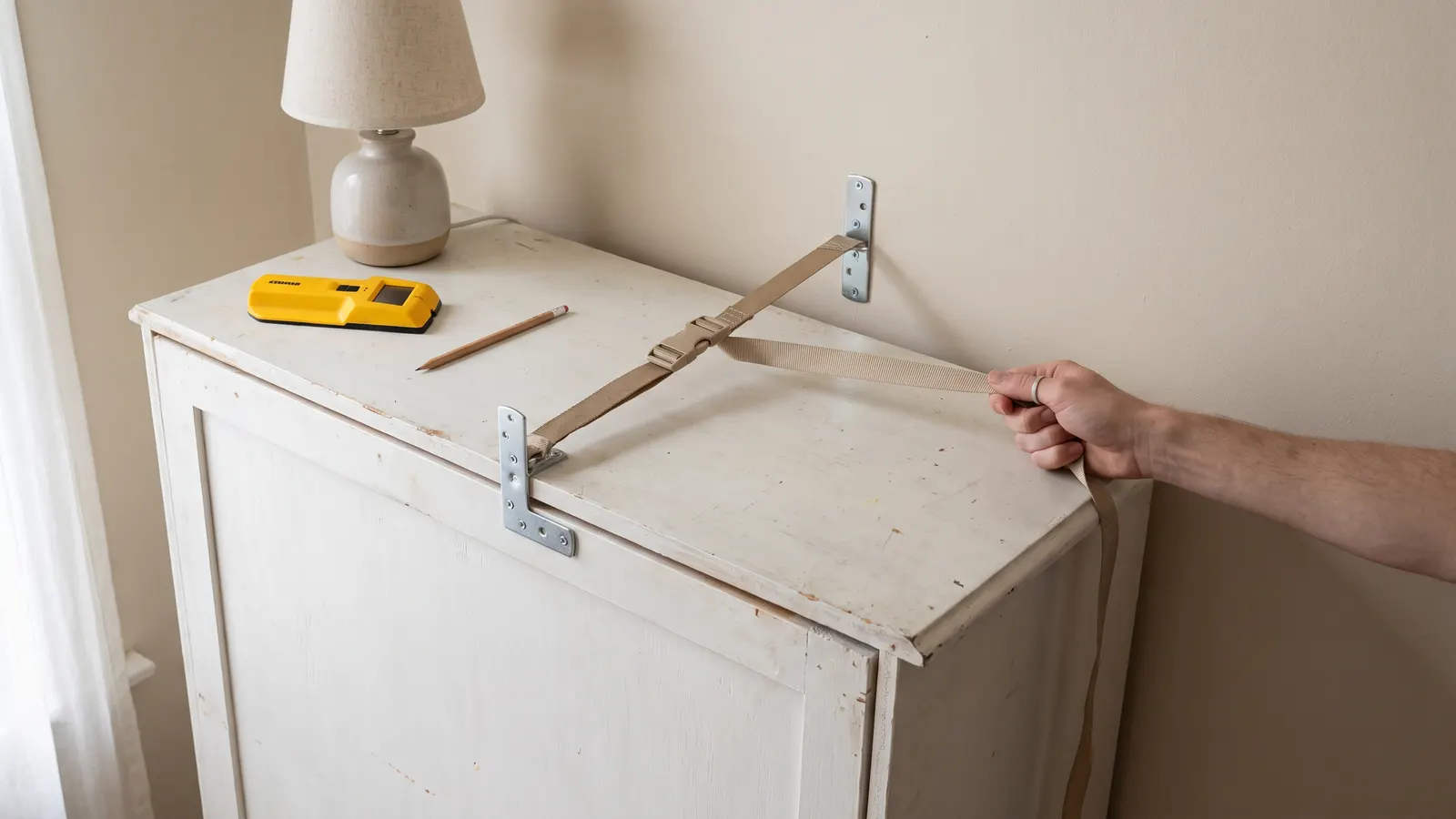
Anchor furniture and TVs by attaching one bracket to a wall stud, one to the back of the piece, connecting the strap between them, and tightening it so the piece cannot lean forward. The CPSC's Anchor It! campaign says anchoring all furniture with drawers, doors, and shelves to the wall prevents tip-over injuries and deaths, and its tool list is a furniture or TV anchoring kit, a drill and bit, a screwdriver, and a stud finder. Thirty minutes a room covers a house.
If you photographed the framing before drywall went up, you already know where every stud is; the pre-drywall walk is where new-build owners get that map. Everyone else uses the stud finder.
Why does anchoring matter?
Anchoring matters because a dresser with open drawers, a bookcase with a climbing child, or a TV on a stand tips forward with more weight than a small body can hold up, fast and silently. The CPSC's Anchor It page is built around that injury; a federal rule to prevent furniture tip-over injuries took effect September 1, 2023, which changes what new dressers are tested for but nothing about the ones already in the house. Ready.gov's earthquake page adds the second reason: secure heavy items like bookcases, refrigerators, water heaters, and televisions.
| Piece | Anchor it? | Why |
|---|---|---|
| Dressers and chests of drawers | Yes, always | Open drawers become steps and the weight moves forward |
| Bookcases and shelving | Yes, always | Tall and top-heavy once loaded |
| TVs on a stand or dresser | Yes, with a TV strap | Heavy, thin, and easy to pull |
| Wall-mounted TVs | Already anchored if the mount is in studs | Check the bolts yearly |
| Refrigerators, water heaters | In seismic areas | Both on Ready.gov's list |
| Low, wide pieces | No | Too wide to tip |
Ready.gov's other instruction is to store heavy and breakable objects on low shelves, which costs nothing and matters in any house where the ground can move.
What do you need?
You need an anchoring kit for each piece (a furniture kit has two brackets and a strap; a TV kit has straps sized for the screen), a stud finder, a drill with a bit sized for the kit's screws, a screwdriver, and a pencil. That is the CPSC's list exactly. Kits are sold at hardware stores and often come in the box with a new dresser or TV; if yours did, it is in the bag with the manual.
- One anchoring kit per piece: furniture straps or TV straps, with the screws they came with
- A stud finder, or a magnet on a string to find the drywall screws
- A drill and a bit sized for the kit's wall screw
- A screwdriver, a pencil, and a small level
- A step stool for the top of a tall bookcase, used the way a ladder should be
What are the steps?
Find the stud behind where the piece stands, mount the wall bracket to it, mount the second bracket to the piece near the top, connect the strap, push the piece to the wall, tighten, and tug. The CPSC's sequence is: attach a bracket to the wall, move the furniture close to the wall, attach the other bracket to the furniture or TV, connect the strap to both brackets, tighten the strap, then tug on the straps to confirm everything is secure.
- Empty the top drawers or shelves so the piece is light enough to move, and pull it out from the wall.
- Find the stud. Run the stud finder across the wall at the height of the piece's top; mark both edges and the center. Done when: the finder reads the same stud in two passes.
- Mount the wall bracket to the stud center with the kit's wall screw, driven straight in. If there is no stud where you need one, shift the piece or use the kit's hollow-wall anchor per its instructions.
- Mount the second bracket to the back of the piece near the top, into solid wood or the frame, not the thin back panel. On a TV, use the mounting holes on the back of the set with the kit's screws.
- Push the piece back against the wall and connect the strap to both brackets.
- Tighten the strap until there is no slack. Done when: the top of the piece cannot lean forward at all when you push it.
- Tug the strap hard, the way a climbing child would load it. If a bracket moves, redo it.
- Repeat for every tall piece in the room, then the next room. Bedrooms and playrooms first.
When should you stop and call a pro?
Stop and call a handyman or carpenter if the wall is plaster, masonry, or metal-studded, if the stud finder cannot find framing where a heavy piece has to go, or if the piece is built-in or too heavy to move alone (a loaded armoire, an aquarium stand). Call a plumber for water heater seismic straps and an electrician if a TV mount's location means moving an outlet. A wall-mounted TV a previous owner installed gets its bolts checked; if the mount moves at all, take the TV down until someone re-anchors it.
What should you record?
Record which pieces are anchored, to which wall, and when, with a photo of each strap, so a sitter, a new owner, or you after a repaint can tell at a glance. Add a yearly tug test as a recurring task: straps come loose when furniture is moved for painting, and a repaint is the usual reason one ends up unhooked. In earthquake country, put anchoring on the same list as the emergency kit; a kit under a fallen bookcase is not a kit. Property Station's Room Inventory holds the furniture list; the features page shows the rest.
Common questions
Do I need to anchor furniture if there are no children in the house?
In earthquake country, yes, for everyone; Ready.gov's list is bookcases, refrigerators, water heaters, televisions, and objects that hang on walls. Elsewhere, anchor anything tall, top-heavy, or with drawers, because visiting children, pets, and a rug that slides do not check who lives there.
What if there is no stud where the furniture stands?
Move the piece a few inches so the wall bracket lands on a stud, which is usually the simplest fix. If it cannot move, use the hollow-wall anchor the kit supplies, following its instructions exactly. A bare screw in drywall holds nothing.
Does a wall-mounted TV need a strap too?
A TV on a proper mount screwed into studs is anchored; check the mount's bolts once a year. A TV on a stand or a dresser needs its own TV strap, and the dresser under it needs a furniture strap. One kit does not cover both.
What should you do next?
Anchor the bedrooms first, then the living room TV, then the rest. Afterward, walk the escape plan with the new layout, because a piece moved for anchoring may now stand in a route. If you live where the ground shakes, the earthquake prep post covers the water heater, the cabinet latches, and the rest of Ready.gov's list.