On this page
Short-term rental maintenance is home maintenance on a shorter cycle plus a turnover inspection between guests. Every guest is a first-time user of every faucet, lock, and appliance, and none of them will tell you about a small failure, so the plan has to find those failures before the next arrival: a walkthrough at each turnover, filters and lint traps on a compressed schedule, safety items checked on a fixed calendar, and a local person who can act when you cannot.
This post is for an owner running one or a few places, often from another town. It assumes the house itself is sound; the setup and the handoff to a longer-term tenant are covered in how to hand a house to a renter.
Why does a rental need a different schedule?
A rental needs a different schedule because use is heavier, feedback is absent, and the cost of a failure is a ruined stay rather than an inconvenience. A family at home notices the dishwasher draining slowly and runs the filter under the tap. A guest runs it once, leaves a note or does not, and the next guest finds standing water. The intervals that work at home stretch too far for a house that is occupied by strangers every few days.
The failures we hear about most from rental owners are small and repeated: a toilet flapper that runs after a guest jiggles the handle, a dryer vent packed with lint after a season of beach towels, a disposal jammed with something nobody will admit to, a garbage can lid that broke and let a raccoon in, and a dead smoke alarm battery that a guest silenced by pulling the unit off the ceiling. None of them show up on a booking platform's checklist.
What should you check at every turnover?
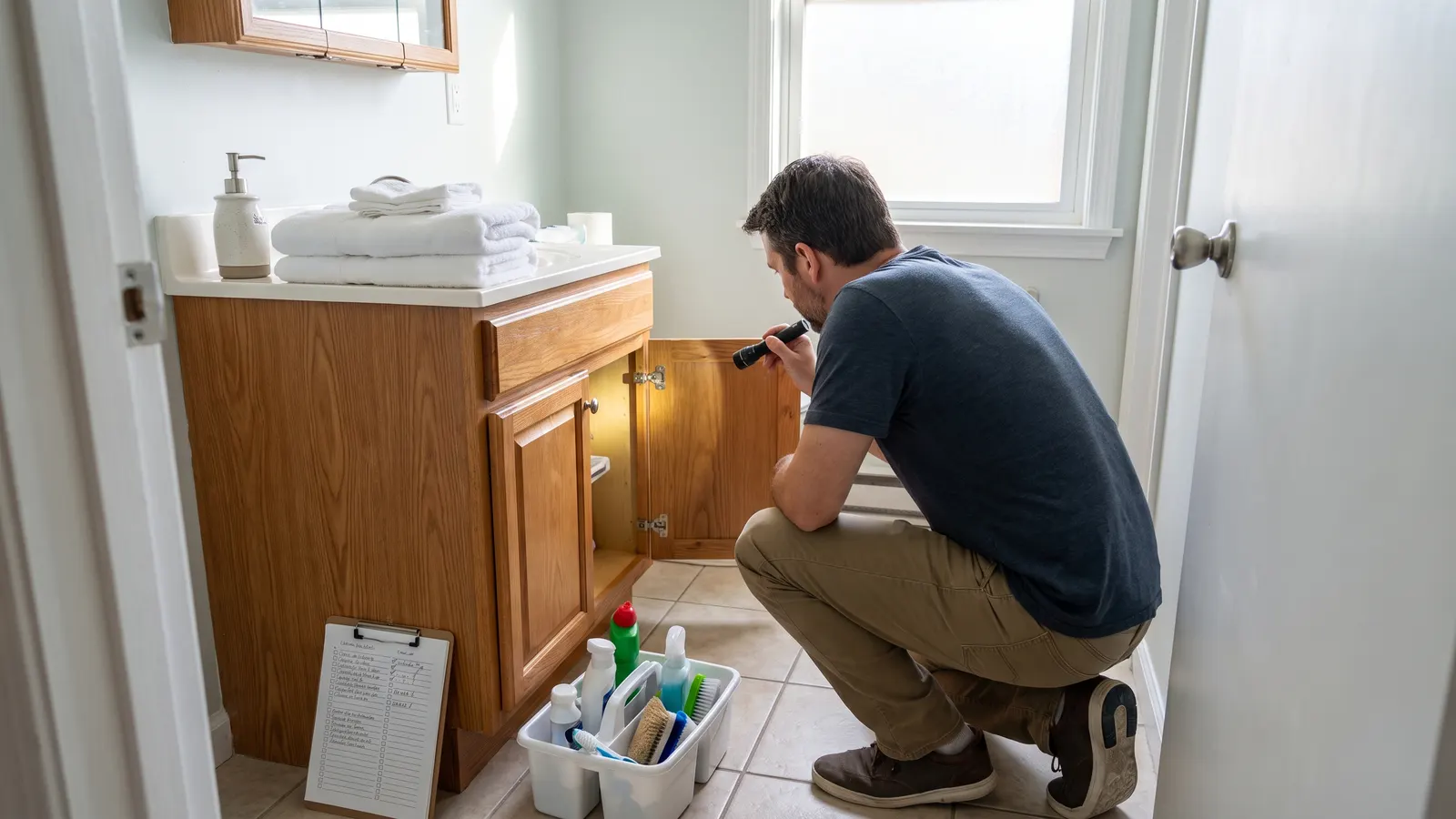
Check the things a guest touches and the things a guest breaks without knowing: every lock and keypad, every faucet and drain, the toilets for running, the appliances for basic function, the smoke alarms for a green light, the thermostat for a sane setting, and the exterior for anything the last guest moved or left. The cleaner is usually the person doing this, so the list has to be short, physical, and tickable.
Turnover walkthrough
- Keypad or lockbox code changed for the next guest and the old one retired
- Every exterior door locks and latches; sliding door bar in place
- Each toilet flushed and watched for a running tank; food coloring test if in doubt
- Under every sink: dry, no drips at the supply lines or trap
- Shower and tub drain clear; caulk intact
- Dishwasher filter clear; disposal runs; dryer lint screen empty and the dryer exhaust warm and moving outside
- Stove burners and oven light; refrigerator cold and freezer frost-free
- Smoke and CO alarms show their indicator light; none removed or covered
- Thermostat set to the standby temperature; filter checked in heavy months
- Lights and bulbs, including exterior and path lights
- Trash out, lids on, nothing left near the house that attracts animals
- Exterior: furniture back in place, grill cleaned and off, hose off, gate closed
The list takes a quarter hour on top of cleaning. The items on it that fail most are the toilet, the drains, and the lint, which is why the dryer vent and the dishwasher filter get their own entries in the schedule below.
What are the safety items you cannot skip?
The safety items are smoke alarms, carbon monoxide alarms, a fire extinguisher, and a printed guide that tells guests where the exits, the shutoffs, and the extinguisher are. The NFPA's smoke alarm guidance is to install alarms inside every sleeping room, outside each separate sleeping area, and on every level including the basement, to test them at least once a month by pressing the test button, and to replace every alarm 10 years after its manufacture date. Guests silence a chirping alarm by pulling it down, so batteries go on a calendar, not on the chirp.
The CDC's carbon monoxide guidance is to install battery-operated or battery back-up CO detectors near every sleeping area, to check the batteries when the clocks change each spring and fall, to replace the detector following the manufacturer's instructions or every 5 years, and never to run a generator, grill, or gas engine inside or within 20 feet of a window, door, or vent. The U.S. Fire Administration adds that 9-volt smoke alarm batteries should be replaced at least once a year and the entire alarm every 10 years.
For a rental, that becomes three fixed dates: the monthly test on the turnover list, the battery swap on the clock change, and the alarm replacement date in the record, taken from the manufacture date printed on the back of each unit. The detector test guide covers how to read that date. Put the grill's rule (outside, away from the house, never in the garage) in the house guide in plain words, and keep the extinguisher where guests can see it from the stove.
What goes on the monthly and seasonal list?
The monthly and seasonal list holds the tasks that are too big for a turnover and too important to leave to memory: the filter, the vent, the water heater, the exterior, and the utility bill. The intervals below are shorter than a home's, and they are a starting point; the equipment manuals and your own turnover notes will tell you where to tighten them further.
| When | Task |
|---|---|
| Monthly, or each turnover in peak season | HVAC filter checked, changed when dirty; alarms tested; keypad batteries checked |
| Monthly | Utility bills compared with the same month last year for water and power |
| Every few months | Dryer vent cleaned to the outside; dishwasher filter and disposal cleaned; faucet aerators and showerheads descaled; caulk at tubs and sinks checked |
| Each season | Gutters and downspouts cleared; exterior walked for damage; outdoor furniture and grill inspected; irrigation started or winterized; water heater drained of sediment |
| Yearly | HVAC serviced before the busy season; CO and smoke alarm batteries replaced on the clock change; extinguisher gauge checked; locks and closers adjusted; house guide reread and corrected |
The bill comparison is the one item owners skip, and it is the cheapest sensor there is: a water bill that jumps when occupancy did not usually means a toilet has been running between stays. How to read the usage line on a utility bill walks through the comparison.
How do you run it when you are not there?
Run it from a distance with three things: a person, a schedule, and a record. The person is a cleaner or a local manager who does the turnover list and a handyperson who takes the monthly and seasonal jobs. The schedule is written down with intervals and reminders, not held in your head between bookings. The record is where the last filter change, the alarm dates, the vendor phone numbers, and the keypad codes live, so the cleaner and the plumber can be sent the right thing without a phone call.
In Property Station, each task on the Maintenance page takes a Frequency (months) and an "Assigned To", and the reminder comes back before it is due; completing a task logs the date, the cost, and who did it. Trusted Vendors and Emergency Contacts hold the after-hours plumber and the local contact, and Shutoffs & Key Locations holds what the house guide should say about the water valve and the panel. See how the scheduler works for the details.
Security for a rental is the same hardware as any house with two differences: the keypad code changes at every turnover, and cameras stay outside and are disclosed. The security basics cover the door and lighting work that makes a rental less attractive between stays.
Common questions
How often should I change the HVAC filter in a rental?
More often than at home, because guests run the system harder and nobody notices a dirty filter. Check it at each turnover in busy months and change it when it looks dirty, which is the same rule the equipment guidance gives for any house. Write the date on the frame so the cleaner can see it.
Who checks the smoke alarms if I am not there?
Whoever turns the property over. Put "press the test button on every alarm" on the turnover list with a box to tick, and replace the batteries on a fixed date each year. The alarms' manufacture dates go in the record so you know when the units themselves are due to be replaced.
Should guests be able to see the cameras?
Cameras belong outside only, at entries, and the listing and the house guide should say they are there. Indoor cameras are a trust and privacy problem regardless of what the platform allows. A door sensor or a keypad log tells you what you need to know about arrivals and departures.
What do I do about a guest who reports a problem at night?
Have a local contact who can go over, and a short list of vendors who take after-hours calls for water, heat, and locks. Give guests the locations of the water shutoff and the breaker panel in the house guide so a burst supply line does not run for hours. Everything else can wait for morning.
What should you do next?
Print the turnover list and hand it to whoever cleans the place this week. Then read the manufacture date off every smoke and CO alarm, write the replacement dates in the record, and put the filter, the vent, and the bill comparison on a schedule with a name attached. The first month of doing it will show you which intervals need to be shorter.