On this page
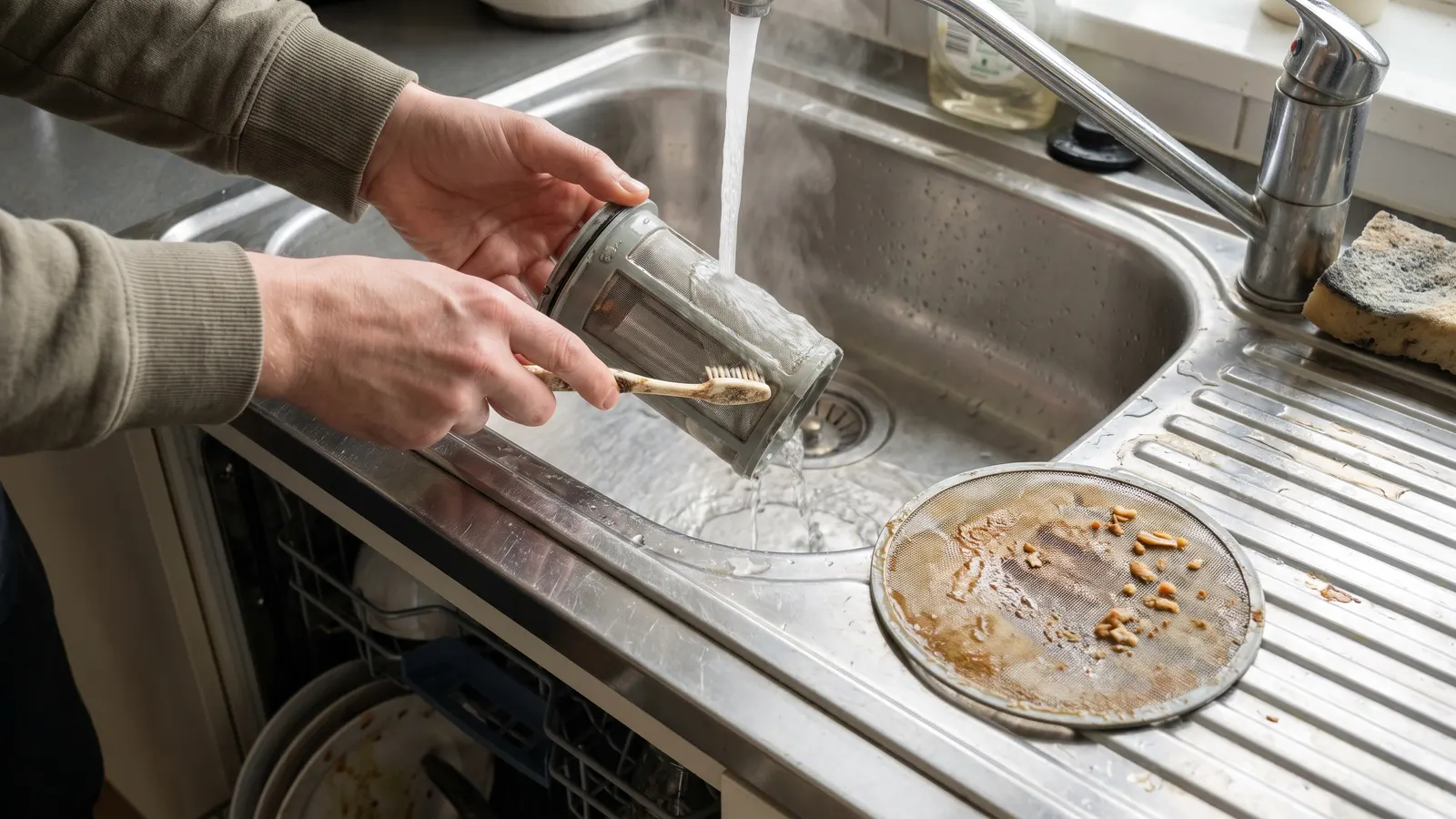
Clean the dishwasher filter once a month: twist it out of the floor of the tub, rinse it under the tap, scrub the screen with a soft brush, and put it back. Grit on glasses, a film on the tub, and a sour smell are all the same problem, a filter full of food that the machine is spraying back over the dishes.
Modern dishwashers are quiet because they have no grinder. Instead a manual filter under the lower spray arm catches food particles, and the owner is expected to empty it. Many people have never been told this. The manual for your model shows where it is and how it comes out, and if the machine has a "clean filter" light, that is what it means.
What do you need?
An old toothbrush or another soft brush, dish soap and warm water, a toothpick or a straightened paper clip for the spray arm holes, and a towel for the floor. There is nothing to buy. The filter twists out by hand, and the only tool that matters is the brush that gets the greasy film off the mesh.
- A soft brush (an old toothbrush works)
- Dish soap and warm water
- A toothpick or a straightened paper clip for the spray arm holes
- A towel for the floor
What are the steps?
Empty the machine, twist the filter out of the floor of the tub, rinse and scrub its mesh, clear any debris from the sump where it sat, check that both spray arms spin freely and their holes are clear, wipe the door gasket, and lock the filter back in place. Fifteen minutes once a month, plus an occasional hot empty cycle with a dishwasher cleaner or vinegar.
- Empty the dishwasher and pull out the lower rack.
- Find the filter in the floor of the tub, under the lower spray arm. It is usually a round cylinder with a handle or arrows on top and a flat mesh screen around its base.
- Twist the cylinder (most turn a quarter turn counterclockwise) and lift it out. Lift out the flat screen too if it is separate. Done when: you are holding the filter parts and can see into the sump.
- Rinse both parts under warm running water. Scrub the mesh with the brush and a little dish soap to remove the greasy film. Do not use anything stiff that could tear the mesh. Done when: you can see clearly through the mesh.
- Look into the sump where the filter sat. Remove any bits of glass, bone, labels, or seeds with a paper towel; do not push them down the drain.
- Check the spray arms. Spin each one by hand; it should turn freely. Look at the holes along the arms and clear any that are blocked with the toothpick. If an arm is heavily clogged, most unclip or unscrew so you can rinse it under the tap.
- Wipe the door gasket and the bottom edge of the door with a soapy cloth, especially the corners, where the slime lives.
- Put the filter back and twist it until it locks. A filter that is not locked lets debris into the pump. Done when: the arrows line up or the handle sits flush and does not lift.
- Optional, once a season: run a hot empty cycle with a dishwasher cleaner, or a cup of white vinegar in a bowl on the top rack, to clear the film from the parts you cannot reach.
Which habits make it easier?
Scrape plates, but do not pre-rinse to spotless; most machines and detergents are designed for some soil and sense it to set the cycle. Do rinse off large bones, seeds, and anything paper. Run hot water at the kitchen tap for a few seconds before starting the dishwasher, so the first fill is hot. Load so the spray arms can turn (a tall pot in the wrong spot stops the arm). Use rinse aid if glasses come out spotted; it is about drying, not cleaning.
When should you stop and call a pro?
Call an appliance technician if water stands in the bottom after a cycle with a clean filter, if the machine does not fill, does not drain, or leaks, if you hear grinding, or if the heating element does not dry the dishes at all. A dishwasher that leaks onto the floor can ruin a subfloor and cabinets quickly; stop using it until it is fixed. Do not remove the pump cover or the sump parts beyond the filter.
Check the air gap if you have one (the small chrome cylinder on the sink deck): if water comes out of it during a cycle, the drain line past it is blocked, which is a drain problem rather than a dishwasher one.
What should you record?
The date, whether the filter was heavily loaded, and anything you found in the sump (glass, a label, a seed). If the filter loads up fast, shorten the interval. Set the monthly clean as a recurring task; this is the kind of task the "clean filter" light exists to nag about, and the reminder does it more politely.
Common questions
Does my dishwasher have a filter?
Nearly every dishwasher sold in the last fifteen years has a manual filter at the bottom of the tub under the lower spray arm, usually a cylinder that twists out with a flat screen around it. Older machines had a self-cleaning grinder instead. The manual says which; if there is a round cap in the floor of the tub, it is a manual filter.
How often should I clean it?
Once a month for most households, every two weeks if you do not rinse dishes or run it daily, and any time glasses come out gritty or the tub smells. The manual may give an interval; the machine may show a "clean filter" indicator.
Why does my dishwasher smell even after cleaning the filter?
Food in the spray arm holes, a slimy door gasket, standing water in the sump, or a drain hose problem. Do the full session below, then run a hot empty cycle with a dishwasher cleaner or a cup of white vinegar in a bowl on the top rack. If standing water remains after a cycle, the drain or the air gap is the problem.
What should you do next?
The refrigerator has a maintenance task of the same size, once or twice a year instead of monthly: cleaning the condenser coils. The range hood filter is the other monthly one. Do them the same afternoon and the kitchen appliances are done.