On this page
Clean the refrigerator's condenser coils every six to twelve months, and more often with pets that shed. The coils release the heat the refrigerator pulls out of the food; when they are coated in dust and hair, the compressor runs longer and hotter to do the same job, which costs electricity now and compressor life later. The job is a brush, a vacuum, and twenty minutes.
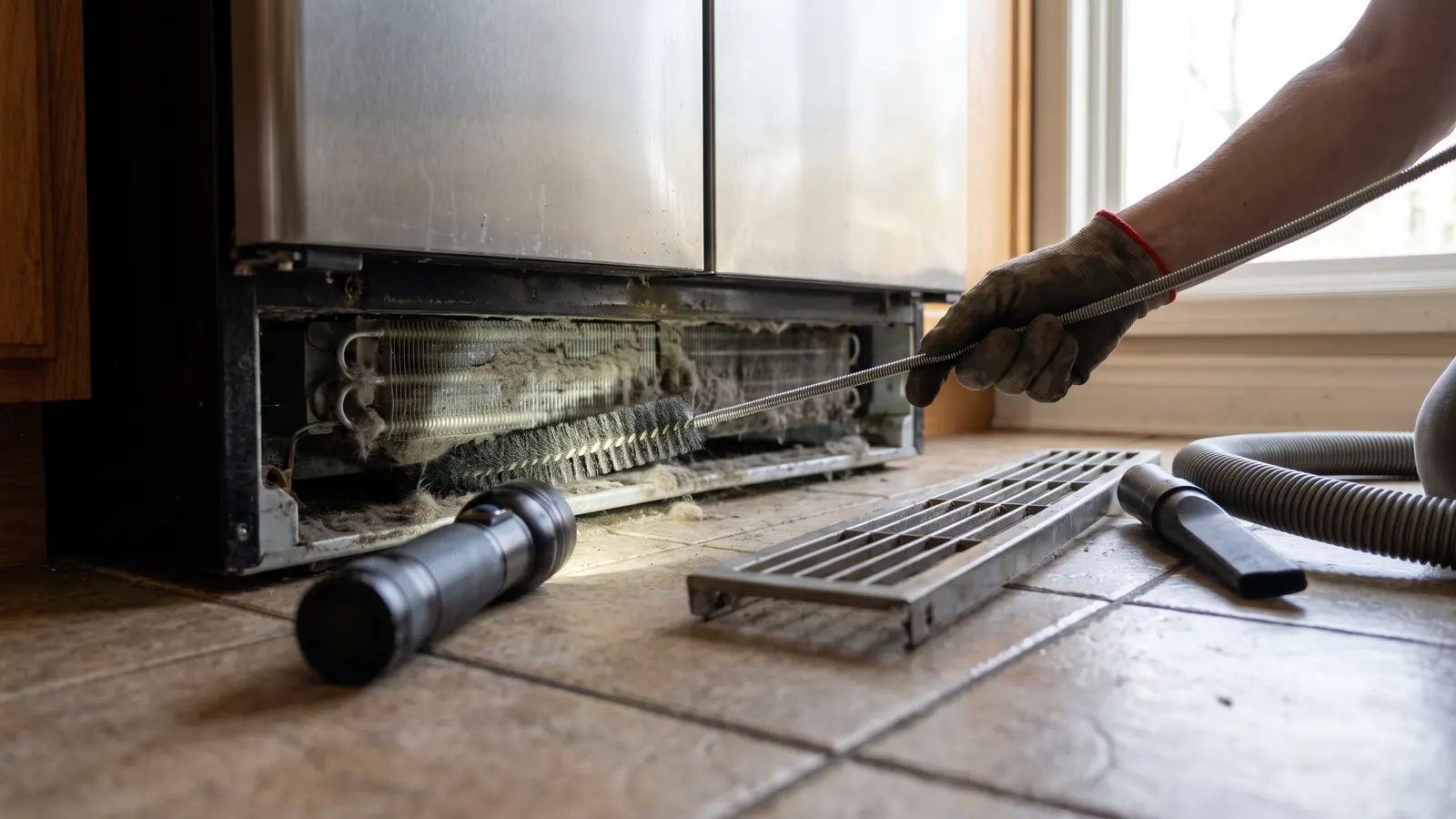
The condenser coils are the tubing, usually black, with fins or a grid, where hot refrigerant gives up its heat to the room. A fan often blows across them. On most refrigerators built in the last couple of decades they are underneath, reached through a grille at the bottom front or from the back; on older units they are exposed on the back.
How often should you clean refrigerator coils?
Clean the coils every six to twelve months in a typical home, every six months when they sit underneath the refrigerator, and every three to four months with pets that shed. A refrigerator that runs constantly or feels warmer inside than usual gets cleaned now, whatever the calendar says. The manual's interval, if it gives one, wins, and some manufacturers tie the warranty to it.
| Situation | Interval |
|---|---|
| No pets, coils on the back | Once a year |
| Coils underneath (they collect more dust) | Every six months |
| Pets that shed, or a dusty house | Every three to four months |
| Fridge running constantly, or warmer than usual inside | Now, then reassess |
Follow the manual if it gives an interval; some manufacturers specify one and tie the warranty to it.
What do you need?
A coil cleaning brush (the long, thin, flexible kind sold for this), a vacuum with a hose and crevice tool, a flashlight, and, if the refrigerator has to come out from the wall, a helper and something to protect the floor. Twenty minutes and no chemicals; the brush loosens the dust and the vacuum catches it.
- A coil cleaning brush: a long, thin, flexible bottle-brush shape sold for this purpose
- A vacuum with a hose and crevice tool
- A flashlight
- A helper if the refrigerator has to be pulled out, and something to protect the floor
What are the steps?
Unplug the refrigerator, find the coils (behind the bottom grille or at the back), brush the dust off the fins along their length while vacuuming, clean the condenser fan if you can see it, vacuum the floor and the drip pan, replace the grille, push the refrigerator back with the clearance the manual calls for, and plug it in. Done when the fins show bare metal instead of gray fuzz.
- Unplug the refrigerator, or switch off its breaker. The food is fine for the half hour this takes if the doors stay closed. Done when: the compressor is silent.
- Find the coils. Bottom front: pull off the toe-kick grille (it usually snaps or pulls forward). Back: pull the refrigerator out, walking it forward corner by corner or rolling it if it has wheels, and remove the rear access panel if there is one. Top (some built-ins): remove the upper grille.
- Look with the flashlight. You are looking at a mat of dust and hair on the fins and tubing.
- Brush the coils. Work the coil brush gently along the fins, not across them, so you do not bend them. Loosen the dust; do not try to pull it all out with the brush.
- Vacuum as you go. Hold the crevice tool where the brush is working and let it catch the loosened dust. Repeat brushing and vacuuming until the fins are visible and clean. Done when: metal, not gray fuzz.
- Clean the condenser fan if you can see it (often next to the coils underneath). Brush the blades and vacuum. A fan caked in dust moves less air.
- Vacuum the floor under and behind the refrigerator, and the drip pan if there is one and it is reachable.
- Replace the grille or panel, push the refrigerator back leaving the clearance the manual calls for (usually an inch or two at the back and sides for airflow), and plug it in. Done when: the compressor starts and runs normally.
What else should you check while you are there?
Check the door gaskets. Close the door on a piece of paper; if it slides out with no resistance at any point around the door, the gasket is not sealing there. Wipe the gaskets with warm soapy water. A gasket that is cracked or has lost its spring is a replaceable part, usually by model number.
If the refrigerator has a water dispenser or ice maker, this is also the reminder to change the water filter on the manufacturer's schedule and to note the filter part number in the record.
When should you stop and call a pro?
Call an appliance technician if the coils are clean and the refrigerator still runs constantly, is not cold enough, is making a new noise, or has water pooling underneath (a blocked defrost drain, usually). Do not attempt anything involving the sealed refrigerant system. If the power cord or plug shows any damage, do not plug it back in.
On a new home, a refrigerator that came with the house is under its own manufacturer warranty, and that warranty may require registration within a period after purchase; check the paperwork the builder handed over.
What should you record?
The date, where the coils are on your model (so the next time is faster), how dirty they were, and the water filter part number and change date if applicable. If the refrigerator was cycling constantly before and settles down afterward, note it; that confirms the interval. Set the coil cleaning as a recurring task at the interval from the table.
Common questions
Where are the coils on my refrigerator?
On most modern refrigerators they are underneath, behind a snap-off grille at the bottom front, or accessible from the back at the bottom. On older models they are a black grid on the back. The owner's manual shows the location; if you do not have it, the manufacturer's site has it by model number.
Do built-in and counter-depth refrigerators need this?
Yes, and often more so, because the coils are enclosed and the airflow is tighter. Many built-ins have the condenser at the top behind a grille. Check the manual for the access point and interval.
The fridge is running constantly and feels warm on the sides. Is that the coils?
Dirty coils are the most common cause of a fridge that runs constantly, and a warm exterior is normal on models that route refrigerant through the cabinet walls. Clean the coils and check the door gaskets first. If it still runs constantly and the inside is not cold, call for service.
What should you do next?
Coil cleaning is the longest of the three quick appliance jobs, and the other two fit in the same afternoon once the vacuum is already out. Do them together and the kitchen appliances are done for the season: the dishwasher filter and, the bigger one, the dryer vent.