On this page
Organize appliance manuals and serial numbers by giving each appliance one record and putting everything about it there: a photo of the label with the model and serial, the manual as a PDF named by the model number, the receipt, the install date, the warranty terms and the registration confirmation, and the part numbers for its filters and consumables. Keep paper manuals in one box, one sleeve per appliance. The whole job is an hour for a typical house, and it turns every later call, order, and claim into a lookup.
The record for each appliance is part of the first section of the home record, what the house is, next to the systems and the finishes. The manuals and receipts are what the Document Vault exists for; this post is about what goes in it and how to name it so you can find it.
Why keep the manual and the serial together?
Keep the manual and the serial together because every question about an appliance needs both. A parts order needs the model to find the part and often the serial to confirm the production run; a warranty claim asks for the model, the serial, and the purchase date; a recall notice names serial ranges; a technician on the phone wants the model before they will quote. The manual answers "how does it work", and the serial answers "which one exactly is this", and the two are useless apart.
The usual state of a house is that the manuals are in a kitchen drawer, the serials are on the backs of the machines, the receipts are in an email account, and the registration confirmations were never printed. Each question then starts with a search. One record per appliance ends the search.
The most common gap we see is the water heater and the furnace. Owners keep the manuals for the things they bought themselves, the washer and the refrigerator, and never open the manuals the builder or the previous owner left for the equipment that costs the most to replace. Those units have serials too, and they are the ones a warranty claim is most likely to be about.
Where do you find the model and serial?
The model and serial are on a label or a plate on the appliance itself, not in the manual, and each appliance hides it in a different place. The label is usually printed or stamped metal, carries the brand, the model number, the serial number, and often a manufacture date in a code. Reading equipment labels explains the codes; this table is only where to look.
| Appliance | Where the label usually is |
|---|---|
| Refrigerator | Inside the fresh-food compartment, on a side wall or the ceiling, or on the door frame |
| Range or cooktop | Inside the storage drawer, the door frame, or under the cooktop lip |
| Dishwasher | On the door edge, visible when the door is open |
| Microwave | Inside the door frame or on the back |
| Washer | Inside the lid or door rim, or on the back |
| Dryer | Inside the door frame, or on the back |
| Water heater | A large label on the side of the tank, or the front of a tankless unit |
| Furnace or air handler | Inside the front access panel, on the blower housing or a side wall |
| Outdoor air conditioner or heat pump | A plate on the side or back of the cabinet |
| Garage door opener | On the motor housing, often next to the light |
| Range hood | Inside the filter cavity, after the filter is removed |
| Garbage disposal | On the side of the unit under the sink |
Photograph the label straight on, with the flash off and the phone close enough to read the smallest line. Then photograph the whole appliance and its control panel once. Those three photos are the record's foundation, and taking them room by room is the same walk as building a home inventory, so do both at once.
How should you file the manuals?
File the manuals one per appliance, as PDFs named by the model number, downloaded from the manufacturer's support site, with the paper copy kept only if it has something the PDF does not. The model number is the key, because that is what the manufacturer's site, the parts supplier, and the technician all search by. A file named "dishwasher manual" cannot be matched to anything; a file named by its model can be matched to everything.
One record per appliance
- The label photo: model, serial, and manufacture code, readable
- The manual as a PDF, named by the model number, from the manufacturer's site
- The receipt or the closing document that proves the purchase date
- The install date and who installed it, if it was not you
- The warranty terms, and the registration confirmation email or number
- The part numbers for filters, bulbs, belts, and other consumables
- The service history: every visit and repair, dated
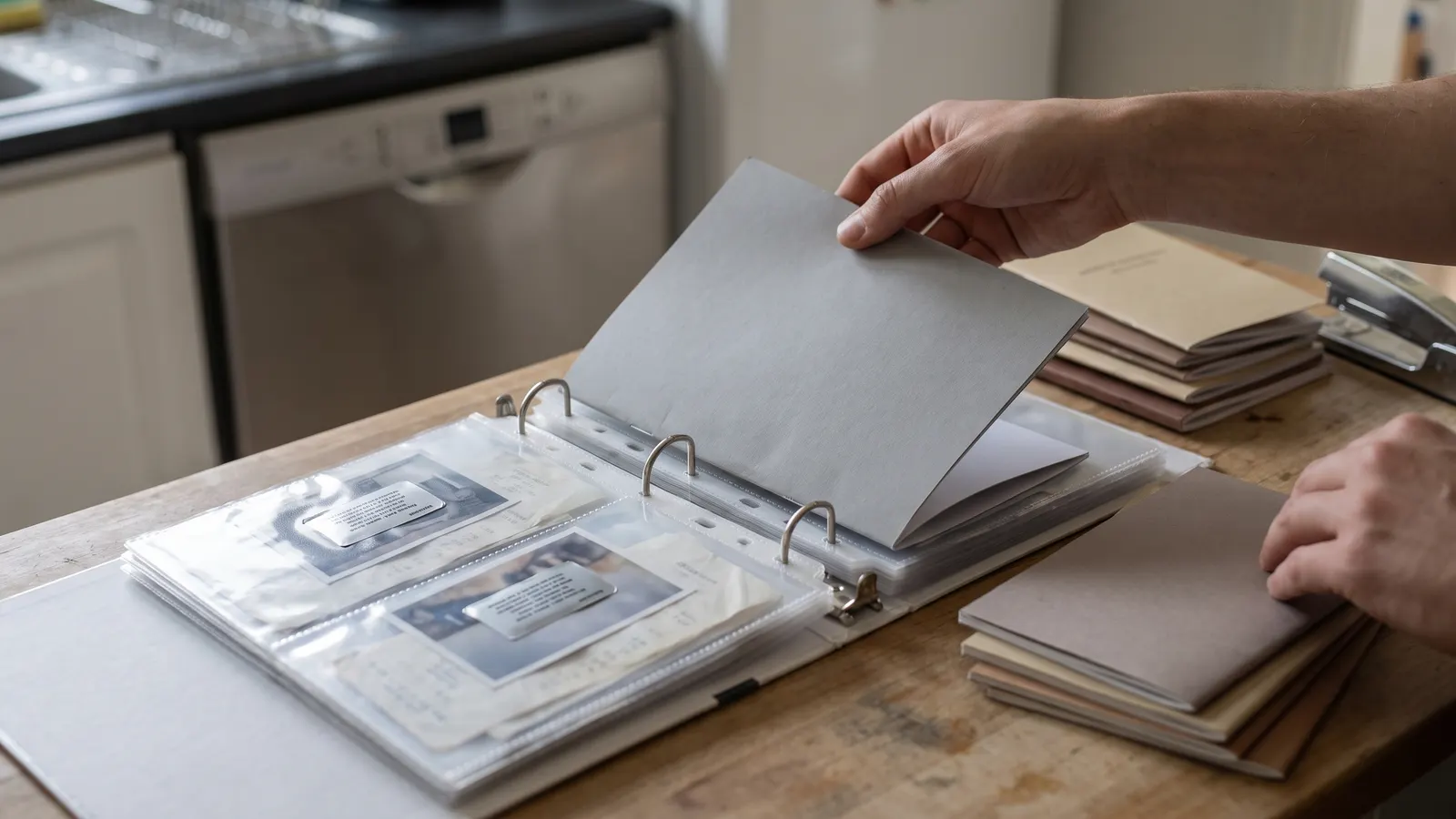
For the paper, one box or one binder, one sleeve per appliance, labeled with the room and the appliance, in the order of the table above. A new house arrives with a stack of manuals from the builder; sort them into sleeves the first week, before they are separated from their receipts. If the paper manual has an installer's note in it, such as the gas conversion or a wiring change, photograph that page and attach it to the record; it is the only copy.
What else belongs with each appliance?
Beyond the manual and the serial, each appliance record should hold the purchase and install dates, the warranty terms and the registration, the consumable part numbers, and the service history. The dates start the warranty clock; the terms say what it covers and what maintenance it expects; the part numbers make the reorder a copy-and-paste; the service history is what a claim or a buyer asks about. Keeping warranty records that hold up goes into the claim side of this.
- Purchase and install dates. From the receipt, the delivery slip, or the closing date for a new build. The manufacturer's warranty commonly runs from one of these, and the terms say which.
- Registration. Many manufacturers ask you to register the unit; registering appliance and system warranties covers why and how. Keep the confirmation with the record.
- Consumables. The refrigerator water filter, the range hood charcoal filter, the humidifier pad, the softener salt type, the furnace filter size. Written on the record, they are reordered in seconds.
- Service history. Every visit, with the invoice and the technician's remarks. This is the same entry the maintenance log holds; the appliance record is where it is read.
Where should the record live?
The record should live where the photo, the PDF, the receipt, and the dates can sit together under the appliance's name and be found by anyone in the household, which rules out the kitchen drawer and the email archive. A folder per appliance on a shared drive works. A record inside the home's own record works better, because the same entry serves the inventory, the warranty list, and the maintenance log.
In Property Station, each unit is listed under My Home (Systems & Features for the equipment, Appliances for the kitchen and laundry set), the manual and the receipt go in Documents with a title that names the appliance, and a Warranty End entered on a system, or a Warranty-type document with an Expiry Date, appears on the Warranties list. Global Search from the header finds a document by its title, so naming the manual by the model number pays off there too.
Common questions
Should I keep the paper manual once I have the PDF?
Keep the paper if it came with something you might sell or hand over with the house, and if it has anything written in it, such as an installer's note or a wiring diagram they marked up. Otherwise the PDF, named by the model number, is the copy you will actually open. Recycle the quick-start cards and the marketing inserts.
What if I cannot find the manual for an older appliance?
Search the manufacturer's support site by the model number on the label, not by the name you call it. If the model is discontinued, the site usually still hosts the manual, or a parts supplier does. If nothing turns up, photograph the label and the control panel anyway; a technician can work from those.
Do serial numbers matter for warranty and recalls?
Yes. A manufacturer's warranty is tied to the specific unit, so a claim or a registration asks for the serial as well as the model, and a recall notice names the affected serial ranges. The serial is the one field you cannot reconstruct later, which is why it gets photographed first.
Which appliances should be in the record?
Anything with a label and a warranty, which is the kitchen and laundry set, the water heater, the furnace and air conditioner, the garage door opener, the water softener, the sump pump, and the small equipment with motors, such as the disposal and the range hood. If a technician might ever be called for it, it gets a record.
What should you do next?
Walk the house with your phone and photograph every label in the table above; that is twenty minutes and it is the part that cannot be reconstructed later. Then download the manuals by model number one evening, and put the filter change for the refrigerator and the furnace on the schedule with the part numbers written on the task.