On this page
New-house smell is the mix of volatile organic compounds (VOCs) that paint, adhesives, sealants, cabinet finishes, carpet, and new furniture release as they cure, and it fades over weeks to months, faster with ventilation. The EPA's advice is to reduce or remove the sources, ventilate while the sources are strongest, and not count on an air cleaner to remove gases. A few new-house smells are not off-gassing at all, and those, gas, burning, sewer, and must, need action today rather than patience.
What is off-gassing, and where does the smell come from?
Off-gassing is the slow release of volatile organic compounds from materials as they dry, cure, and settle, and in a new house nearly every finished surface is doing it at once. The EPA's page on VOCs and indoor air quality says concentrations of many VOCs are consistently higher indoors, up to ten times higher, than outdoors, and names paints, varnishes, wax, and cleaning and hobby products among the sources, along with building materials and furnishings.
In a new build the usual contributors are paint and primer, the adhesives under flooring, the sealants at every joint, the finish on cabinets and trim, carpet and its pad, engineered wood and its glues, and whatever furniture arrived in a box the same week. Paint is loud and short; cabinet finishes and pressed-wood products are quieter and longer.
How long does the smell last?
The smell is strongest in the first days after the finishes go on and fades over weeks to months, with the last of it living in closed spaces where the air does not move. There is no single number; it depends on which products were used, how warm the house is, and how much air moves through it. You control the last of those.
The rooms that hold the smell longest are the ones with doors that stay shut: pantries, linen closets, the cabinet under the sink, and any unused bedroom. Owners who leave interior and cabinet doors open for the first month, with the ventilation running, report a neutral house sooner than owners who close everything up. A smell still there after the first full season is nearly always a specific object, not the house.
In an older house the smell leaked out; in a new one it stays until a fan removes it, which is why the tight-house guide to indoor air matters more here than in a resale home.
What does the EPA say works?
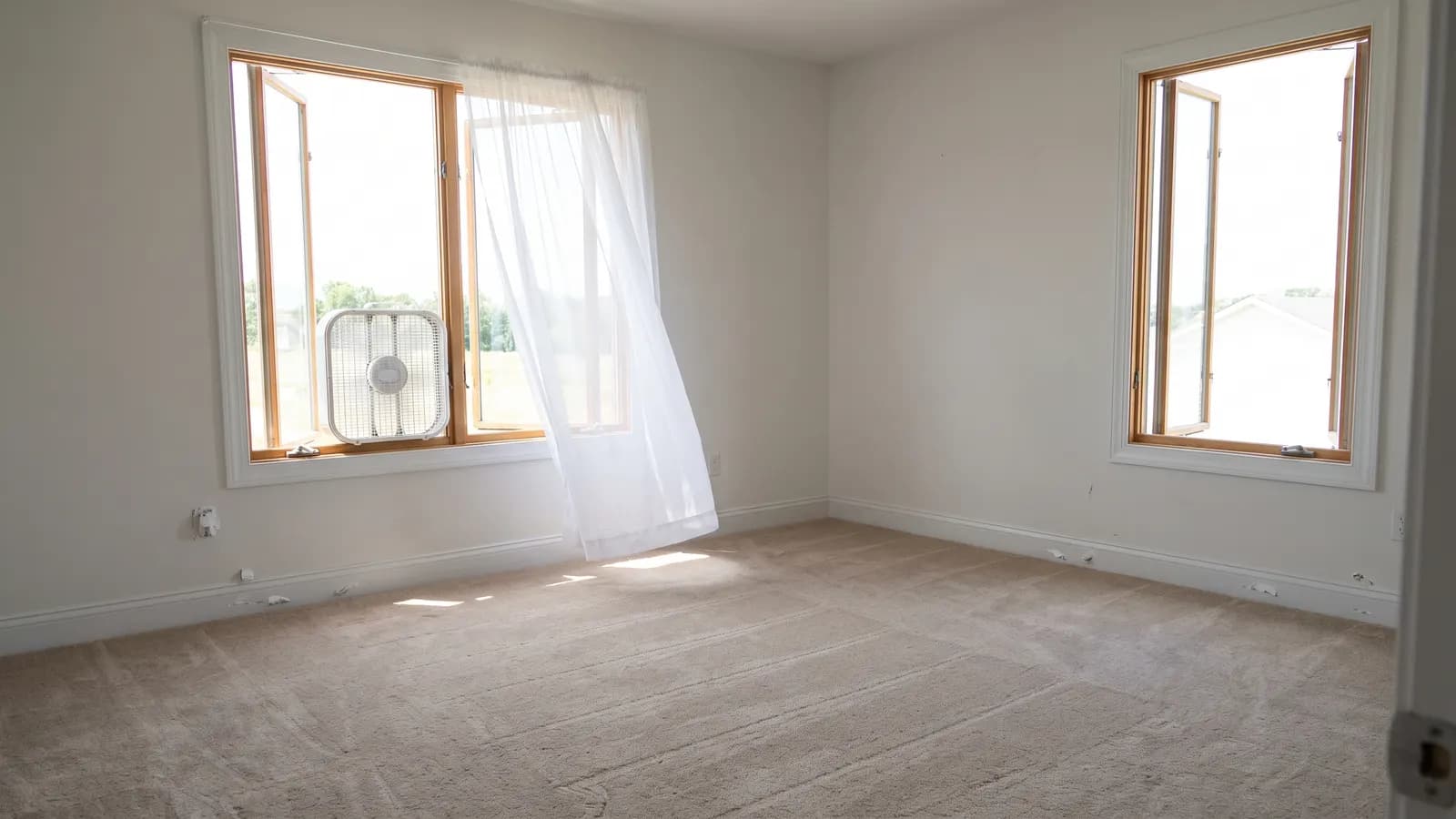
The EPA's order is source control first, then ventilation. Its page on improving indoor air quality says the most effective way to improve indoor air is usually to eliminate individual sources of pollution or reduce their emissions, and that source control is more cost-efficient than increasing ventilation. For ventilation it lists opening windows and doors, running window or attic fans when the weather permits, and using bathroom or kitchen fans that exhaust outdoors, which remove contaminants directly from the room.
| Action | What it does | What the EPA says |
|---|---|---|
| Remove or return the source | Ends the emission instead of diluting it | Usually the most effective way to improve indoor air |
| Open windows and doors when the weather allows | Raises the outdoor air ventilation rate | Listed as a way to increase ventilation |
| Run bath and kitchen fans that exhaust outdoors | Removes contaminants directly from the room | Listed as a direct removal method |
| Wait it out with the house closed | Nothing; the smell stays until the air moves | Not among the EPA's recommendations |
The ventilator most new homes have is built for this. An ERV or HRV exchanges the house's air on a steady schedule without dumping the heat; set it to boost for the first weeks and confirm it is on at all. Run the bath fans after every shower and keep them clean, and run the range hood while cooking with a clean filter. The EPA's VOC page adds: increase ventilation when using products that emit VOCs, follow the label precautions, and buy only what you will use soon, because half-used cans keep emitting in the utility closet.
Do air purifiers help with off-gassing?
An air purifier helps with construction dust and not much with the smell, and the EPA says why. Its guide to air cleaners in the home says no air cleaner or filter will eliminate all of the air pollutants in a home, and that filtration does not replace the need to control pollutants and ventilate; the improving-indoor-air page says air cleaners are generally not designed to remove gaseous pollutants. VOCs are gases.
Where a filter does earn its place in a new house is dust, which construction leaves in the ducts and on every surface for months. The EPA's air cleaner guide says to select an HVAC filter rated at least MERV 13 or as high as the system will accommodate, and the filter guide explains how to find out what your system can take. Neither a filter nor a portable unit will make the paint smell go away; the windows and the ventilator will.
Which smells are not off-gassing?
Some new-house smells are signals, not chemistry finishing, and they are the ones to act on today. Gas, burning, sewer, and must each have a specific cause and a specific response, and none of them fades with time.
| Smell | Likely cause in a new house | What to do |
|---|---|---|
| Rotten egg or sulfur, near the water heater, furnace, or range | Natural gas or propane leak | Do not light anything. Leave, then call the gas company or fire department from outside |
| Hot plastic or burning at an outlet or switch | An overheating connection or device | Switch the circuit off at the breaker and call an electrician |
| Sewer gas in a bathroom or laundry that has not been used | A trap that has dried out, or a vent that was never installed correctly | Run water into every drain; if it persists, it is a plumbing item for the builder |
| Musty or earthy | Moisture: a slow leak, a crawlspace, wet drywall, or a duct that ends in the attic | Find the water. A filter does not cure a moisture problem |
A dry trap is the most common sewer-gas cause in a new house, because a guest bath or a floor drain may not have been used since the plumber tested it. Pouring water down it is the fix; the drain care guide covers the rest. A trap that dries again in a week, or a smell that follows the wind, is a venting problem for the builder's list.
What should you do in the first weeks?
In the first weeks, move as much air as the weather allows, keep the interior doors open, take the strongest sources out of the living space, and change the filter early. The smell peaks the week the paint and floors were finished, which is usually the week you move in, so the habits start on day one.
The first-month air plan
- Open windows on opposite sides of the house whenever the weather allows
- Set the ERV or HRV to boost for the first weeks, then back to continuous
- Run the bath fans after every shower and the range hood while cooking
- Leave cabinet, closet, and pantry doors open for the first month
- Unpack new furniture and mattresses in the garage or on a porch for a day before bringing them in
- Move leftover paint, sealant, and adhesive cans out of the house, or dispose of them the way the label says; keep the color list first
- Change the furnace filter after the first month and inspect it monthly after that
- Pour water into every drain on move-in day, and again in any bathroom that goes unused
Most of that list becomes routine: the filter, the fans, and the ventilator keep the air clean for years, and they belong on the schedule from the first week. The move-in setup checklist puts them next to the shutoffs and the alarms. In Property Station the filter and the ventilator cleaning are recurring tasks on the Maintenance page with a reminder before each is due.
Common questions
How long does new-house smell last?
It is strongest in the first days after finishes go on and fades over weeks to months, with the last of it lingering in closed spaces such as cabinets and closets. Ventilation shortens it; a closed-up house in mild weather stretches it. If a strong chemical smell is still there after the first season with the ventilation running, find the source rather than waiting longer.
Is off-gassing dangerous?
The EPA says concentrations of many VOCs are consistently higher indoors than outdoors and that the way to lower them is to reduce the sources and ventilate. Anyone with headaches or eye and throat irritation that eases when they leave the house should ventilate more, remove sources, and talk to a doctor if it continues. This post is not medical advice; the EPA pages linked in it are the place to read further.
Will an air purifier get rid of the smell?
Not by itself. The EPA says air cleaners are generally not designed to remove gaseous pollutants, and VOCs are gases. A good purifier or a higher-rated furnace filter does help with the construction dust that is also in the air. For the smell, open windows when the weather allows, run the ventilator and the exhaust fans, and remove what you can.
What should you do next?
Tonight, set the ventilator to boost, open the cabinet doors, and pour water into every drain. This week, get the leftover cans out of the house and write down the paint colors before they go. Then put the filter change on the schedule for one month out.