On this page
- Which mistakes cost the most?
- What do new owners get wrong about filters and ducts?
- What do new owners get wrong about the dryer?
- What do new owners get wrong about water?
- What do new owners get wrong about schedules and records?
- How do new-build and resale owners differ?
- Common questions
- What should you do next?
The maintenance mistakes new owners make are consistent enough to list: the HVAC filter forgotten or installed backwards, money spent on duct cleaning instead of the filter, the dryer's lint screen cleaned while its vent fills up, the main water shutoff found for the first time during a flood, yearly tasks done once and never again, and nothing written down. Each is easy to fix and each compounds if it is not. Most come from a single wrong idea: that a house, especially a new one, is finished when you move in.
The fixes are small habits and a record. Here are the mistakes, in the order they tend to cost money.
Which mistakes cost the most?
The most expensive mistakes are the ones that involve water, fire, or a warranty: a leak ignored because the house is new, a dryer vent never cleaned, and a defect never reported before the warranty window closed. The cheapest mistakes to fix are the same ones: a monthly look under the sinks, a yearly brush through the dryer duct, and a photo and a date for every problem that appears. The table sorts the common ones by what they lead to.
| Mistake | What it leads to | The fix |
|---|---|---|
| Filter forgotten, or arrows pointing the wrong way | Restricted airflow, a strained blower, dust in the coil | Monthly check; arrows toward the blower; date on the frame |
| Paying for duct cleaning | Money spent, the filter still dirty | Change the filter; clean ducts only for the EPA's three reasons |
| Lint screen cleaned, vent duct never cleaned | Long dry times, an overheating dryer, a fire risk | Yearly duct cleaning; check the outside flap opens |
| Main water shutoff never located | Minutes lost during a burst pipe | Find it, test it, tag it, photograph it |
| "Yearly" tasks done once | The water heater flush, gutters, and tune-up quietly stop | Recurring tasks with dates, not intentions |
| Nothing recorded | No warranty evidence, no repair history, no dates at resale | A photo and a line for every task and every problem |
| Warranty items treated as DIY repairs | Coverage lost, defect evidence gone | Report first, repair second, inside the window |
| Wrong product on a surface | Etched stone, damaged siding, a corroded drain | The manual's cleaner, and water before chemicals |
What do new owners get wrong about filters and ducts?
New owners get the filter wrong in three ways: they forget it, they install it backwards, and they upgrade it to a rating the system cannot pull air through. Then, when the house is dusty because the filter is full, they pay for duct cleaning. The filter is the whole story in most houses: check it monthly, change it when it is dirty, and put the arrow toward the blower.
The Building America Solution Center's filter replacement guide says the arrows on the frame point into the duct (toward the furnace or air handler), that higher MERV filters can clog faster and restrict airflow, so check with the HVAC service company before jumping to MERV 13 or higher, and to write the installation date on the cardboard frame. The filter guide covers the size, the rating, and the swap.
The EPA's page on duct cleaning says the EPA does not recommend routine duct cleaning, and to consider it only if there is visible mold growth inside the ducts or on other components, the ducts are infested with vermin, or they are clogged with excessive dust and debris that is released into the home. A new house with construction dust is the one case worth a look; when ducts do and do not need cleaning walks the three conditions.
What do new owners get wrong about the dryer?
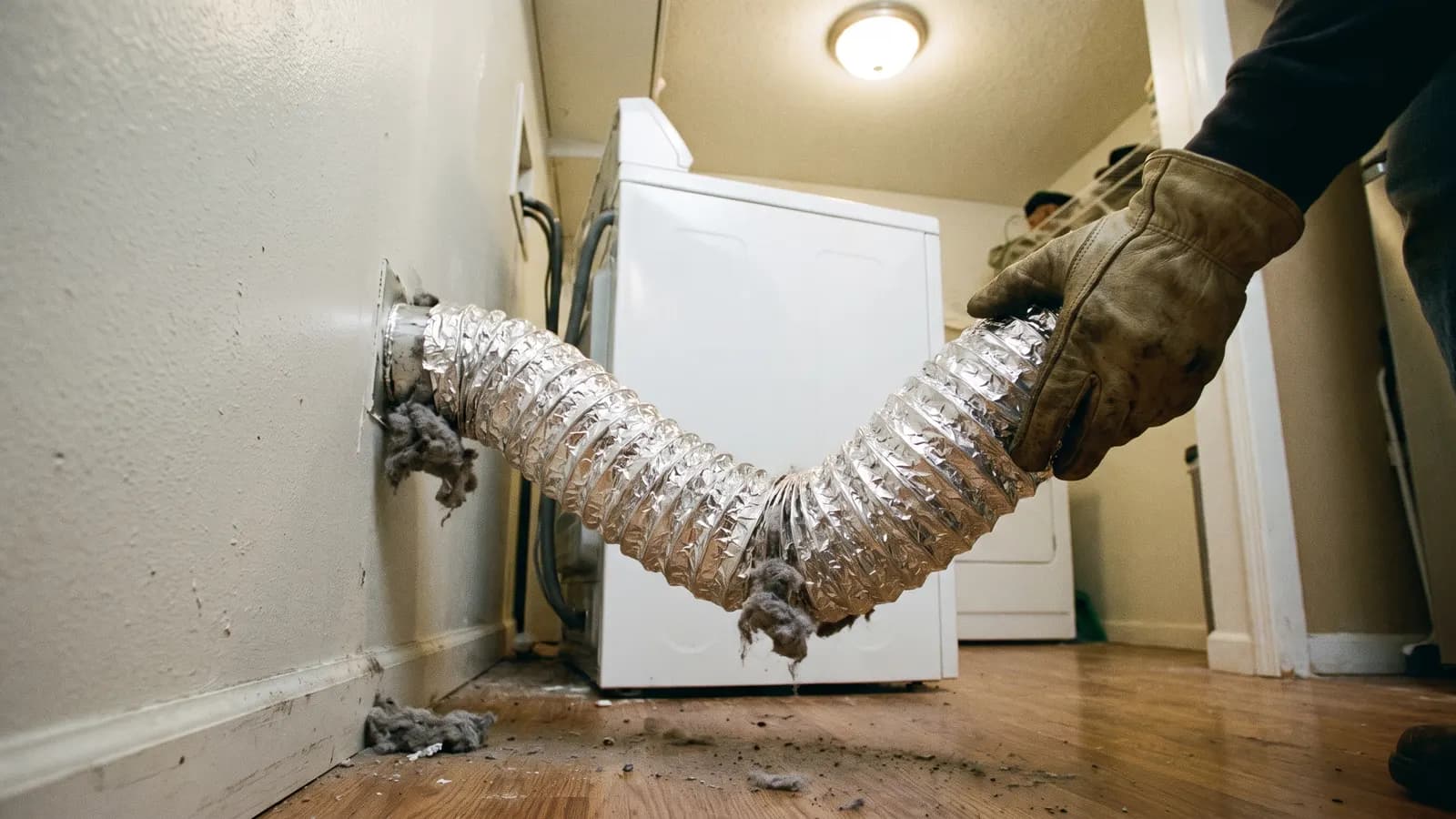
New owners clean the lint screen and believe the dryer is maintained; the vent duct behind the machine and the cap outside are the parts that fill up, and they are the fire risk. A dryer that takes two cycles to dry a load, or clothes that come out hotter than they used to, is a clogged vent, not a dying dryer, and the fix is a brush and a vacuum once a year.
The U.S. Fire Administration's dryer fire safety flyer says to clean the lint filter before and after each cycle, clean the back of the dryer where lint builds up, check the venting system behind the dryer to make sure it is not damaged, crushed, or restricted, and make sure the outdoor vent covering opens when the dryer is operating. A crushed flexible duct behind a dryer that was pushed into its alcove on move-in day is one of the commonest things we see in a new house. Cleaning the dryer vent covers the brush, the cap, and why plastic or foil duct should be replaced with metal.
What do new owners get wrong about water?
New owners find the main water shutoff during the first flood, ignore the first stain because the house is new, and run the washing machine on the hoses that came with it until one bursts. Water is the mistake that costs the most, because it does its damage out of sight and the fix, when caught early, is a valve, a washer, or a bead of caulk.
The water habits that prevent the expensive call
- Find, test, and tag the main water shutoff before you need it
- Look under every sink and around every water appliance once a month
- Treat any ceiling stain, soft floor, or musty smell as a task, not a curiosity
- Replace washer hoses on a schedule and close their stops before a trip
- Check that the water heater's pan is dry and its drain goes somewhere
- Watch where the downspouts discharge after the first heavy rain
The five shutoffs every owner should know is the afternoon that fixes the first item. The rest are part of the monthly checklist, which is short precisely so that the leak look happens.
What do new owners get wrong about schedules and records?
New owners do the yearly tasks once, in a burst of good intentions, and never schedule the second time; and they do not write anything down, so the second time cannot be scheduled from the first. The interval for each task comes from the equipment's manual and label, not from a general article, and it only becomes maintenance when it recurs with a date and a record of the last time.
In most houses we see, the water heater was flushed once, the gutters were cleaned the year the owner moved in, and the HVAC tune-up happened when the system stopped working. The tasks are known. The schedule is what is missing, and the missing schedule looks the same in a spreadsheet, a binder, and an app until it sends a reminder.
The record is the other half. A photo of a problem with a date, a line for each completed task, and the receipt for each part or service are what a warranty claim, an insurance claim, and a buyer's inspector will ask for. In Property Station each task is recurring with a Frequency in months, the reminder comes before the due date, and completing the task records the date, the cost, and who did it on the task's page. The maintenance scheduler is that loop: the task comes back on its own, and the history stays with the house.
Getting the schedule right also means knowing which jobs are yours; the DIY-or-pro rule sorts them by consequence, and what preventive maintenance actually prevents is the honest case for doing them at all.
How do new-build and resale owners differ?
A new-build owner's mistakes cluster around the warranty: fixing a defect instead of reporting it, missing the workmanship window, and assuming the builder maintains the house. A resale owner's mistakes cluster around the unknown: not finding the shutoffs, not reading the labels, and not working the inspection report. Both share the filter, the dryer vent, and the missing record.
For a new build, the first-year schedule puts the maintenance tasks and the warranty checkpoints on the same calendar, so a nail pop or a sticking door gets photographed and reported instead of patched. For a resale home, the first 90 days is the walk that finds the shutoffs, reads the labels, and turns the inspection report into a task list. In both cases the record starts on day one, with what the house is and what has been done to it, because a record that starts at the first failure is a record with the wrong first entry.
Common questions
Is a new house really maintenance-free for the first year?
No. A new house has construction dust in every duct, a filter that loads faster than it ever will again, settling that opens caulk joints, and a full set of equipment with manuals that expect owner maintenance from day one. The builder warranty covers defects, not neglect, and most warranty documents say so.
What is the single most expensive mistake?
Ignoring water. A slow drip under a sink, a stain on a ceiling, a damp spot at the base of the water heater, and a washer hose past its age all cost almost nothing to fix when found and a great deal when they are not. The monthly leak look under every sink is the cheapest habit in the house.
Should I hire a company to do all of this?
Hire the yearly HVAC tune-up and anything involving gas, the panel, refrigerant, or the roof. Do the monthly checks, the filter, the dryer vent, the flush, and the shutoff test yourself; they are minutes each and nobody else will do them on time. A service that offers to clean your ducts every year is selling something the EPA says you usually do not need.
I already made some of these mistakes. What now?
Start the record today with what you know, do the monthly six this week, and put the yearly tasks on a schedule with real dates. Nothing on this list is undone by one more month; all of it is undone by another year of the same.
What should you do next?
Pull the filter and look at the arrow, then pull the dryer out and look at the duct. Those two take fifteen minutes and are the two mistakes most likely to be in your house right now. Then find the main shutoff, and put the rest on a schedule.