On this page
- Why should drainage come before planting?
- What does the builder warranty say about your yard?
- What should you plant in the first year, and what should wait?
- Where should trees and shrubs go relative to the house?
- How should you water new sod and plants?
- What should you record about the yard?
- Common questions
- What should you do next?
In the first year around a new build, fix the water before you plant anything. Let the backfill settle, correct the grade so it falls away from the house, extend the downspouts, and only then put in beds and trees. Place trees where their mature size clears the roof and the foundation, choose deciduous shade on the south and west, keep mulch and shrubs off the siding, call 811 before digging, and read the builder warranty for what a landscaping change can void. A yard planted on a settled base outlasts one planted in month two.
Why should drainage come before planting?
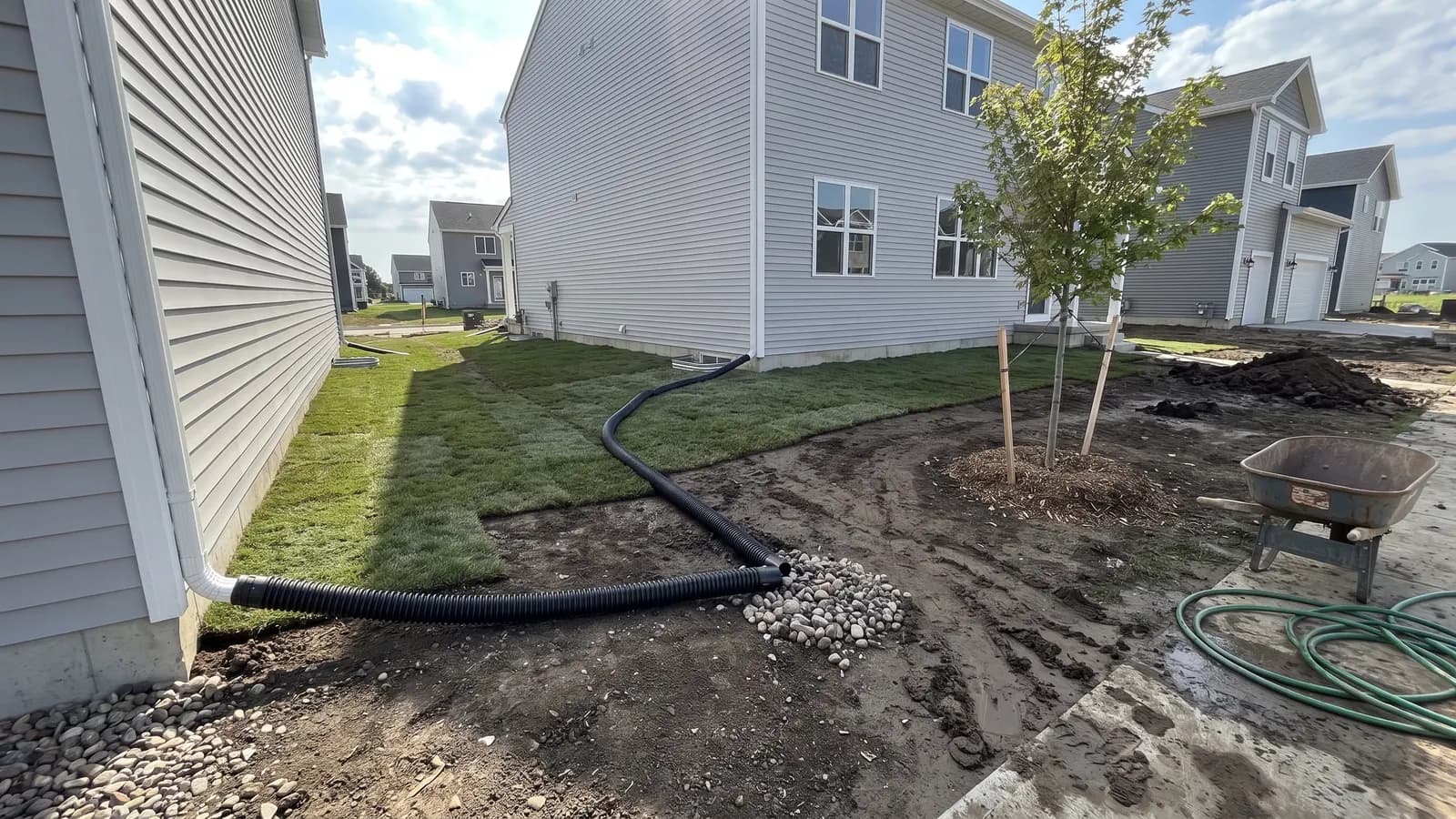
Drainage comes first because the ground around a new house is not finished moving, and every bed, tree, and border you add changes where the water goes. The backfill against the foundation settles under the first year's rain, leaving a trough along the wall that collects water. Beds built against the house raise the grade and can put soil above the siding line. Mulch holds water against the foundation. A planting plan that ignores the water becomes a drainage repair later.
The yard problems we see most in later years started as landscaping in year one: a bed that raised the soil against the wall, a downspout buried under a new lawn without an outlet, shrubs planted where the air conditioner needs clearance, and a tree set a few steps from the foundation because it looked small. All were easy to avoid on a bare lot.
The EPA's termite page gives the same instruction from a different direction: after construction, keep the soil around the foundation dry through proper grading and drainage, including the maintenance of gutters and downspouts, and do not pile or store firewood or wood debris next to the house. The grading and drainage check is the procedure; walk the perimeter after the first heavy rains and fix what it finds before you order plants. If water is already standing in the yard, why a new yard has puddles sorts what the builder owes from what is yours.
What does the builder warranty say about your yard?
The warranty document for your home almost certainly has something to say about the yard, and it is worth reading before you change anything. What is common: grading and drainage coverage conditioned on the owner not altering the grade; builder-installed sod and plants with a short warranty or none, sometimes conditioned on following specific watering instructions; and exclusions for damage caused by landscaping the owner added. The contract is the only source that counts, so read the builder warranty with the yard in mind.
If the builder provided a site plan, a grading plan, or a landscape drawing, it shows where the water was designed to go, the swales between lots, the easements, and where the utilities enter. Keep it with the rest of the selection sheets and plans, and put a copy in the documents for the home. It settles arguments with neighbors and landscapers alike.
Whatever the warranty says, photograph the yard after closing and after the first heavy rain, dated. If the builder regrades at the settling visit, the photos show what changed; if a low spot was there from the start, they show that too.
What should you plant in the first year, and what should wait?
Plant the few things that are hard to move later and that the drainage does not depend on, and wait on everything that sits against the house or changes the grade. Trees are the first-year planting, because they take longest to grow and the placement decision is permanent. Foundation beds, hardscape, and anything that needs the grade to be final wait until the backfill has been through a full year of rain.
| Do it in the first season | Do it after the first full year | Wait, or skip |
|---|---|---|
| Grading fixes and downspout extensions | Foundation beds, once the grade is stable and sloping away | Raised beds or retaining walls against the house |
| Shade trees, placed for mature size | Patios, walks, and edging that set the final grade | Mulch piled against the siding or above the sill |
| Sod or seed where the builder left bare soil, watered as instructed | Perennial borders, hedges, and fences (call 811 first) | Shrubs within reach of the air conditioner's clearance |
| A record of what went where | Buried drain lines and pop-up emitters | Any change to a swale or drainage easement without the builder's agreement |
Two federal pages agree on the tree part. The DOE's home energy checklist says to plant shade trees and shrubs around the house to reduce air conditioning costs, and ENERGY STAR's windows page says deciduous trees near south, east, and west windows shade in summer and let in winter sun. The tree planted this year is the one shading the west windows a decade on.
Plant for the tag, not the pot: the nursery tag gives mature height and spread, so set the trunk where that spread clears the roofline, the driveway, and the power drop, and where the roots will not find the sewer lateral or the water service, which the site plan shows.
Where should trees and shrubs go relative to the house?
Trees and shrubs go where they will not touch the house, block its equipment, or feed a fire toward it when they are full size. Branches over the roof drop debris into the gutters; shrubs against the siding hold moisture and hide what is behind them; anything crowding the outdoor air conditioner blocks its airflow. Trimming trees and shrubs away from the house is the annual job that keeps the clearances; planting with them in mind is what makes that job small.
In wildfire country the placement rules tighten. FEMA's wildfire preparation guide describes a defensible space of at least 30 feet from the home kept irrigated and fire resistant, with shrubs moved away from the house, bark and wood chip mulch avoided next to the structure, and branches within 15 feet of chimneys pruned. The defensible space post walks through the zones; a bare lot is the easiest place to get them right.
How should you water new sod and plants?
Water new sod and plants the way the builder's or the nursery's instructions say, then adjust to what the soil does, and watch where the irrigation lands. Builder-installed sod often comes with written watering instructions that condition its warranty; follow them exactly and keep the sheet. After establishment, water less often and deeper. Compacted subsoil under new sod holds little water, so the lawn needs more attention in its first summer than it ever will again.
The irrigation system, if there is one, was set for establishment and needs resetting once the lawn is rooted. Walk each zone with it running and look for heads spraying the siding or the foundation; overspray against the house is a moisture problem in the making and an easy fix at the head. The spring sprinkler startup covers the first-season check, and in freeze country winterizing the irrigation before the first hard frost is not optional in a new system.
What should you record about the yard?
Record the plan, the plantings, the irrigation, and the warranty terms, with photos each season. The site plan and grading plan go in the documents. Each tree and major shrub gets a line: what it is, where it went, when, and from which nursery, because a plant warranty is only useful with the receipt. The irrigation gets a zone map and the controller's settings. The sod's watering instructions go next to the builder warranty.
The yard record
- The site plan, grading plan, and any landscape drawing from the builder
- Dated photos of the whole perimeter after closing, after the first heavy rain, and each season
- A list of what was planted, where, when, and from which nursery, with receipts
- The irrigation zone map, the controller settings, and the backflow preventer's location
- The builder's sod and plant warranty terms and the watering instructions that condition them
In Property Station the seasonal jobs (irrigation startup, the gutter check, the trimming, the fall shutdown) are recurring tasks on the Maintenance page; the Seasonal Checklist's "Spring Prep" and "Fall Maintenance" packs add most of them at once, and the maintenance schedule is where the intervals live. Nobody remembers which year the maple went in; the record does.
Common questions
Can I change the grading or add beds in the first year?
Check the warranty document first. Many builder warranties condition their grading and drainage coverage on the owner not altering the grade, and a raised bed against the foundation is an alteration. Beds that keep the soil sloping away from the house, and that sit below the siding line, are usually fine; anything that traps water at the wall is not. When in doubt, photograph the plan and ask the builder in writing.
How far from the house should I plant a tree?
Far enough that its mature canopy clears the roof and its roots are not under the foundation or the sewer line, which means planting for the size it will be at maturity, not the size in the pot. The nursery tag gives the mature spread; use it. Deciduous trees on the south, east, and west sides give summer shade and winter sun, which ENERGY STAR notes as a benefit for the windows on those sides.
Why is my new sod dying?
Usually water, soil, or both. Sod laid on compacted subsoil has nowhere to root and dries out in a day of heat; sod that was watered heavily through establishment and then left alone browns in patches; sod in the path of a downspout drowns. Follow the builder's watering instructions to the letter if the sod has a warranty, and fix the drainage before you resod anything.
What should you do next?
Walk the perimeter after the next heavy rain and fix the water first. Then read the yard section of the warranty document, file the site plan, and pick the spot for one shade tree on the west side. Everything else can wait a season.