On this page
Handle a dispute with your builder by putting everything in writing, reading the warranty document for what it covers and how it says to escalate, sending the claim again with the evidence and the document's own language, and then following the escalation path in the order it names: the warranty manager, the third-party administrator if there is one, mediation or arbitration if the document requires it, and a construction attorney in your state when the item is serious. Keep the record throughout; every later step will ask for it.
This post is for owners of newly built homes whose builder has declined a claim, stopped responding, or repaired the same item repeatedly without fixing it. It is not legal advice; it is the method that makes a lawyer's hour, if you need one, count.
What counts as a dispute, and what is just a slow claim?
A dispute is a claim the builder has declined in writing, a claim the builder has ignored past the response time the warranty document states, or an item that has been repaired more than once and still fails. A slow claim is a claim inside the stated response time, or one waiting on a scheduled visit. The difference matters: escalating a slow claim wastes goodwill you will need later, and treating a real dispute as a slow claim lets the window close.
A slow claim
Sent in writing, inside the document's response time. Acknowledged, or a visit is scheduled. One repair attempt so far. The builder answers messages.
A dispute
Declined in writing, or no response past the stated time after a written follow-up. Repaired twice or more and still failing. The builder says an item is "normal" without citing the document. Messages go unanswered.
Before treating anything as a dispute, check that the claim was sent the way the document requires. A problem mentioned to the superintendent or texted to a sales agent may never have reached the warranty office. The claim procedure in the document says where a claim goes; if yours did not go there, send it there first, with the original date noted.
What should you do first?
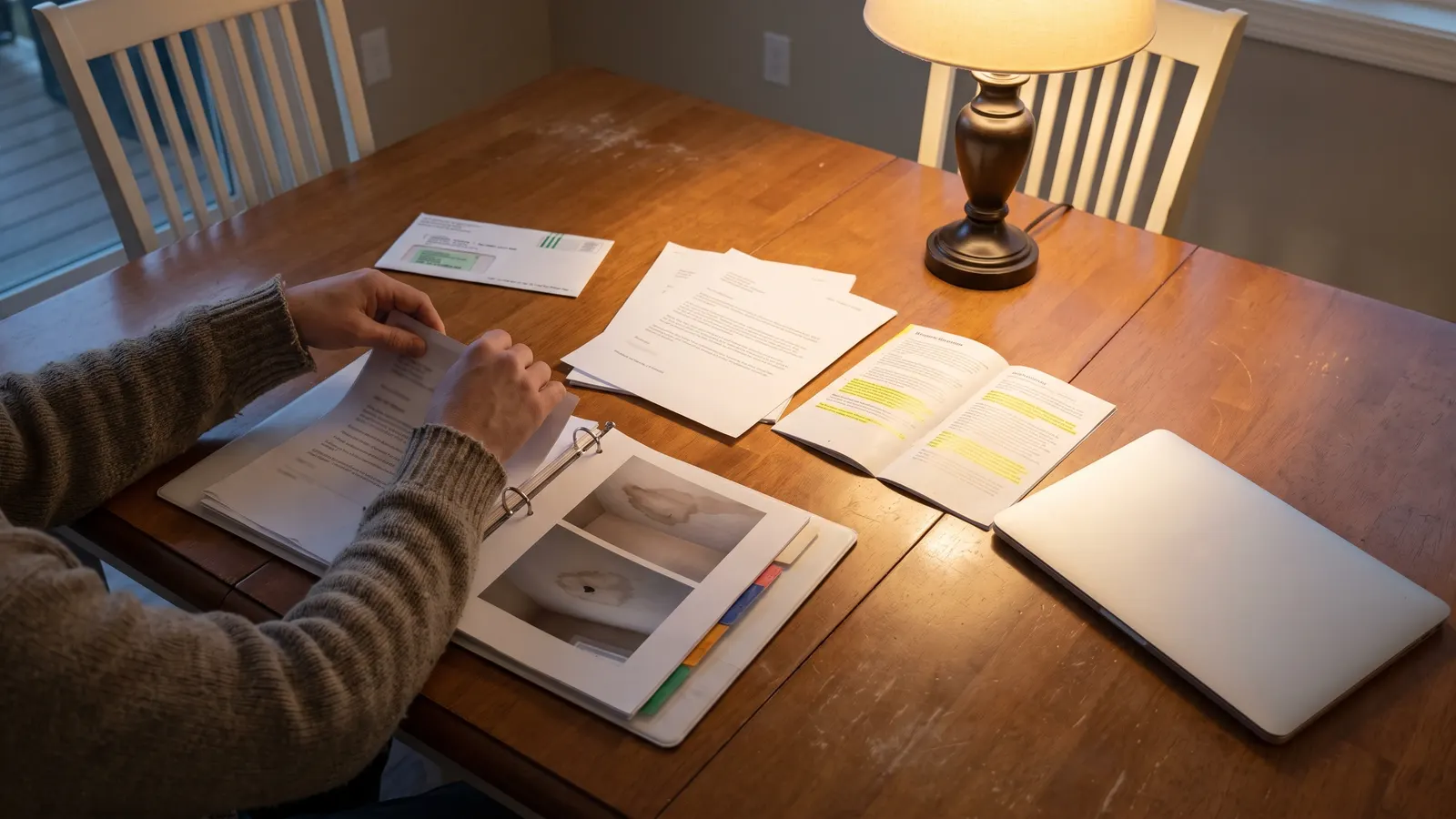
First, stop talking and start writing. Find the warranty document and read the definition of the item in dispute, the tolerance that applies, the exclusions, and the claim and escalation procedure. Then gather the record: the original claim with its date, every photo and message, every visit and what was done, and the builder's decline or silence. Most disputes are won or lost on whether that file exists, not on who is right about the crack.
The Federal Trade Commission's guidance on hiring a contractor says to get a written contract that spells out how change orders are handled and to keep every document, change order, and payment record; a builder dispute runs on the same file.
Then read the builder's reason. A decline usually says the item is within tolerance, excluded, maintenance, reported late, or not the builder's work. Each has an answer from the document and the record: a measurement in a dated photo, the exclusion quoted and shown not to apply, the maintenance log, the send date, or the subcontractor list and the closing documents.
How do you put the dispute in writing?
Write one letter or message per disputed item that states the item, when and how it was first reported, what has happened since, what the warranty document says about it (quoted, with the section), what you are asking the builder to do, and by when. Attach the photos and the earlier messages, send it through the channel the document names, and keep a copy and proof of sending. Tone is factual and short; the document does the arguing.
If your builder uses Property Station, the disputed item already has a request with its history: the description, the photos, every message, and every status change with a date. Reopen it with the note above rather than starting a new one, so the history stays on one record; the builder's team sees the reopen in their inbox, and the Conversation is the written channel from there. If the builder is not on the platform, one email thread per item does the same job.
What is the escalation path?
The escalation path is in the warranty document, and it usually runs from the person who declined the claim to that person's manager, then to a third-party warranty administrator if the home is enrolled with one, then to mediation or arbitration if the document requires it, and only then to court. Follow it in that order, in writing, with the same file at each step; many documents require each stage before the next is available.
- Warranty coordinatorThe person who handled the claim. Send the written dispute here first.
- Warranty or construction managerAsk, in writing, for the manager named in the document to review the decision.
- Third-party administratorIf the home is enrolled with a warranty company, its claim form and address are in the document, and it decides against the document's standards.
- Mediation or arbitrationMany documents require one or both before any lawsuit. Read the clause; a construction attorney should read it too.
- Attorney and regulatorsA construction attorney in your state for structural or safety items; the state licensing board for a builder who will not respond.
At every stage, ask for the decision in writing and for the document section it relies on. And keep sending new items through the normal claim channel; a dispute on one item does not pause the deadlines on the rest, and the warranty timeline keeps running.
When should you bring in a third party?
Bring in a third party when the item is structural or involves water or safety, when the builder has declined in writing and the document's next step is an administrator or arbitration, when the builder has gone silent past the stated response time after a written follow-up, or when anything you are asked to sign includes a release. The third parties are an independent inspector or engineer for the evidence, a construction attorney for the document and the strategy, and the state contractor licensing board for a builder who will not respond at all.
An engineer's letter changes a structural dispute more than anything an owner can write, because the structural tier is defined in terms an engineer measures; an independent inspector's report does the same for workmanship items. Both will also tell you when the builder is right, and that answer is worth paying for because it ends the dispute.
What record will you need?
The record a mediator, an administrator, or an attorney asks for first is the same every time: the purchase contract, the warranty document, the signed punch list, every claim with its send date and photos, every reply and visit, the maintenance log, the subcontractor list, and any inspection reports. In one place, the first meeting is short. In text threads and a shoebox, the first meeting is about finding it.
Build the file before you need it. In Property Station, the warranty document and the punch list live in Documents, the claims and their conversations on Requests, the visits in Repair History, and the maintenance the document expects in the Maintenance Log, and the whole thing exports as one archive from Data Export. The test, however you keep it, is whether you could hand a stranger the complete history of one item in a few minutes. How to get ready for a warranty service visit is where most of that record gets made, one visit at a time, and what each warranty tier covers is the map of what the dispute can be about.
Common questions
Should I withhold a payment or an escrow release during a dispute?
Do not decide that alone. Whether you can withhold anything depends on your purchase contract and your state, and getting it wrong can put you in breach while the builder is not. Ask a construction attorney before you withhold a payment, refuse to close, or release an escrow, and get the answer in writing.
Can I hire my own contractor to fix it and bill the builder?
Read the claim procedure first. Many warranty documents require the builder to be given notice and a chance to repair before anyone else does, and some reimburse owner-arranged repairs only in emergencies and only under stated conditions. A repair done without that notice can end the claim. Document the problem, send the notice, and wait the stated period unless water or safety cannot wait.
When should I talk to a lawyer?
When the item is structural, when the builder has declined in writing and the document's escalation path is next, when the builder has stopped responding past the stated response time, or when anyone mentions arbitration or a release. A construction attorney in your state can read the document and the record in an hour and tell you what the next step is worth.
Does a dispute affect the rest of my warranty?
It should not, and the rest of the warranty keeps running on its own dates while one item is disputed. Keep sending new items in writing as you find them, keep the maintenance the document expects, and keep the tone on the disputed item factual. The record you build is the same one that protects every other claim.
What should you do next?
Pull the file for the disputed item today: the original claim, the photos, the messages, and the builder's reason. Read the section the builder relied on, write the one-item letter, and send it through the named channel. If the dispute is about work you hired separately rather than the builder's, how to hire a contractor and read a quote covers the contract terms that decide those, and if your builder is on the same platform, the reopen button on the request is where the letter goes.