On this page
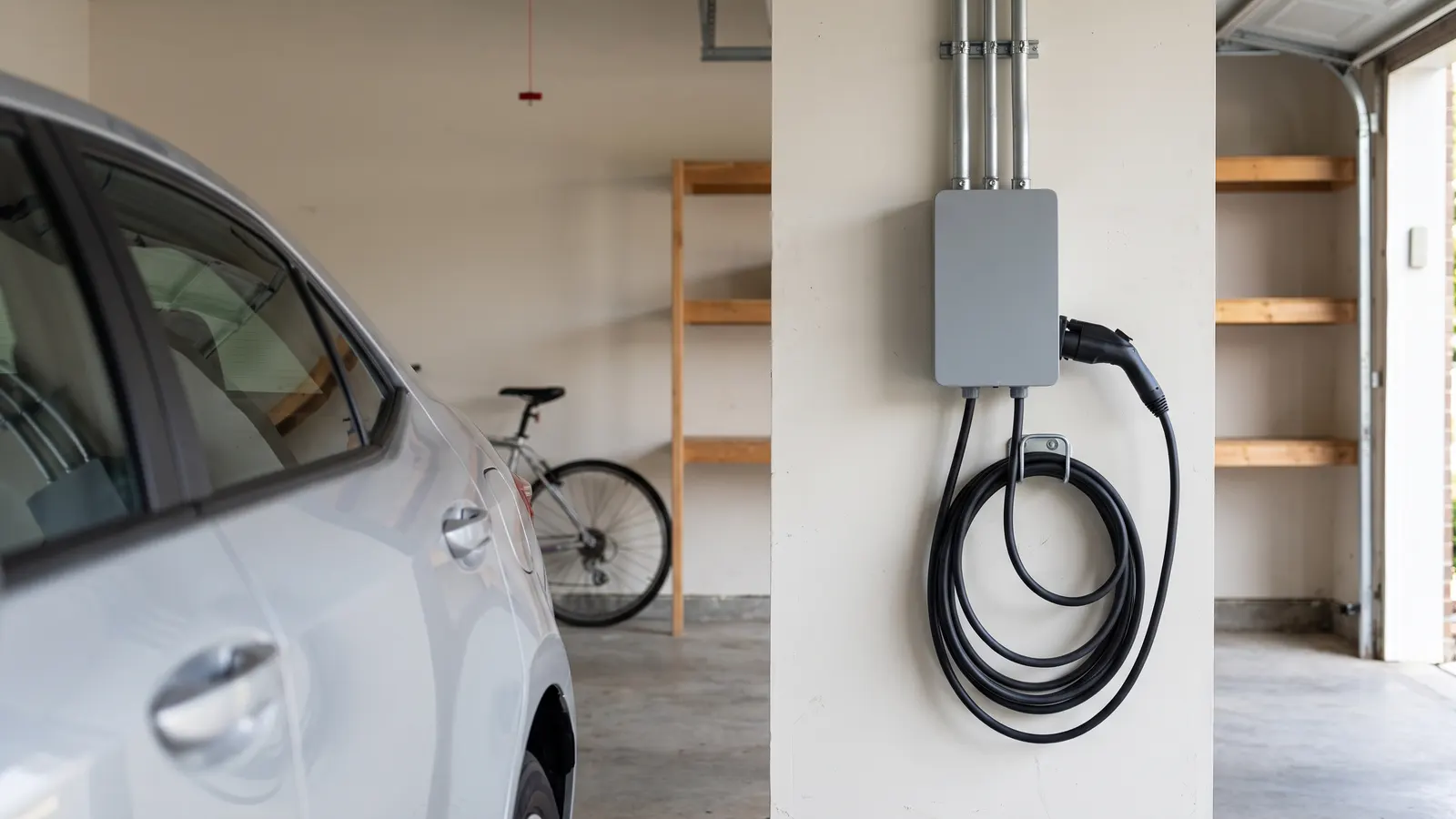
An EV charger at home starts with a question about your electrical panel, not about the charger. Most EV drivers charge overnight at home, and the DOE's Alternative Fuels Data Center says owners may install Level 2 (240 V) charging equipment for a faster charge, or opt for the Level 1 cordset provided with the vehicle. Level 1 uses an ordinary outlet on a dedicated circuit; Level 2 needs a new 240-volt circuit that a licensed electrician installs, usually with a permit and inspection. Which you need depends on daily miles, where you park, and the panel's spare capacity.
Level 1 or Level 2: which do you need?
Level 1 is enough when the car sits overnight and the daily miles are modest; Level 2 is for longer commutes, two EVs, or a car that arrives empty and leaves early. The AFDC says many owners meet their daily range needs with Level 1 overnight, "provided that a power outlet on a dedicated branch circuit is available near their parking location." That condition is the whole question: a garage outlet shared with a freezer, a workshop, or the outdoor lights is not a dedicated circuit.
| Level 1 | Level 2 | |
|---|---|---|
| Equipment | The cordset that came with the car | A wall unit or a heavy-duty outlet plus a portable unit |
| Circuit | An existing outlet on a dedicated branch circuit | A new 240 V circuit from the panel |
| Who installs | You plug it in, after an electrician confirms the circuit | A licensed electrician, usually with a permit and inspection |
| Outdoors | Needs a weatherproof outlet cover and GFCI protection | Needs outdoor-rated equipment |
| Best for | Short daily drives, a car parked all night | Longer drives, two EVs, or a fast turnaround |
The AFDC also says outdoor installations require outdoor-rated equipment, and recommends safety-certified equipment (such as ENERGY STAR certified products) and a certified electrical contractor.
Does your panel have room?
Your panel has room for Level 2 charging only if a load calculation says so, and the calculation is the electrician's job. The AFDC notes that some homes have insufficient capacity for Level 2 and that a qualified electrician can add circuits, and that the National Electrical Code treats EV charging as a continuous load under Article 625. A charger draws for hours, so the circuit is sized differently from a circuit that runs a saw for a minute.
Before the electrician arrives, label the panel and photograph the directory so the load calculation starts from what is actually there. A panel that already trips breakers regularly is a separate problem; what a tripped breaker means covers the difference between a one-time trip and a pattern that needs an electrician first.
Why do the dedicated circuit, the outdoor rating, and the permit matter?
The dedicated circuit, the outdoor rating, and the permit matter because a charger runs at full draw for hours, in a garage or outdoors, on a circuit that has to be right the first time. The AFDC says installations must comply with local and state codes and that permits may be required from the local building authority. The inspection that comes with the permit is a second set of eyes on the wire gauge, the breaker, and the connections, and the permit record is what a buyer's inspector looks for later.
Do not run the cordset through an extension cord, even a heavy one. ESFI's extension cord guidance is that a cord is a temporary solution, not a long-term extension of the house's wiring, and must not be covered or run through doorways, where the heat cannot escape. If the outlet is too far from the parking spot, that is the case for a new circuit, not a longer cord.
Anything mounted outside also needs GFCI protection on the outlet and a weatherproof cover, which the GFCI test guide covers for outlets that already exist. Whether your jurisdiction requires a permit for a single new circuit varies; do you need a permit covers the general question, and the electrician will know the local answer.
How do you hire the electrician?
Hire the electrician the way the FTC says to hire any contractor: licensed and insured, with the license verified, a written estimate, and a contract that says who pulls the permit. The FTC's contractor guidance says to get written estimates that describe the work, materials, completion date, and price, and to get a written contract that includes the contractor's license number, the contractor's obligation to get permits, and warranty information. How to hire a contractor walks through the full list.
Ask for the load calculation in writing, the charger's amperage and the breaker size, and whether the quote includes the permit and inspection fees. If you are also considering solar panels, say so at the estimate; both loads count in the same calculation, and a service upgrade priced once is cheaper than one priced twice.
What should you keep on file?
Keep the permit, the inspection sign-off, the electrician's invoice with the license number, the load calculation, and the charger's model, serial, and warranty, because all of them come up again at a warranty claim, a service upgrade, or a sale. The panel directory photo with the new breaker labeled belongs in the same file.
The charger file
- Permit and final inspection sign-off
- Electrician's invoice with license number and the load calculation
- Charger model, serial, purchase date, and warranty terms
- Breaker size and circuit label, and a photo of the panel directory
- Charger manual and the manufacturer's support contact
In Property Station these go in Documents under Permit, Receipt, and Warranty, the charger goes on Systems & Features with its Warranty Start and Warranty End, and the breaker location goes under Shutoffs & Key Locations, next to the main water shutoff. After a power outage the charger is one of the things to check, and the file is where its reset procedure lives.
Common questions
Can I just plug the car into a garage outlet?
The Level 1 cordset that comes with the car plugs into a standard outlet, and the AFDC says many owners meet their daily range needs that way overnight, provided the outlet is on a dedicated branch circuit near the parking spot. A shared garage circuit that also runs a freezer is not that outlet. Have an electrician confirm before it becomes a nightly habit.
Do I need a permit for a Level 2 charger?
Often, yes. The AFDC says installations must comply with local and state codes and that permits may be required from the local building authority. The electrician should pull it and arrange the inspection; keep the permit and the sign-off with the house records.
What if my panel is full?
The AFDC notes that some homes have insufficient capacity for Level 2 charging and that a qualified electrician can add circuits. The options run from a load-management device to a subpanel to a service upgrade, and the right one depends on a load calculation for your house. Get that calculation in writing with the quote.
Does a new-construction home come EV-ready?
Some do, with conduit or a dedicated circuit roughed into the garage. Check the plans and the selection sheet, look at the panel directory, and ask the builder before you assume. If the circuit is there, an electrician still installs and inspects the charger itself.
What should you do next?
Count your daily miles for a week and look at where the car parks. If Level 1 on a dedicated outlet covers it, have an electrician confirm the circuit and stop there. If not, photograph the panel directory, get two written quotes with load calculations, and file the permit when it comes.