On this page
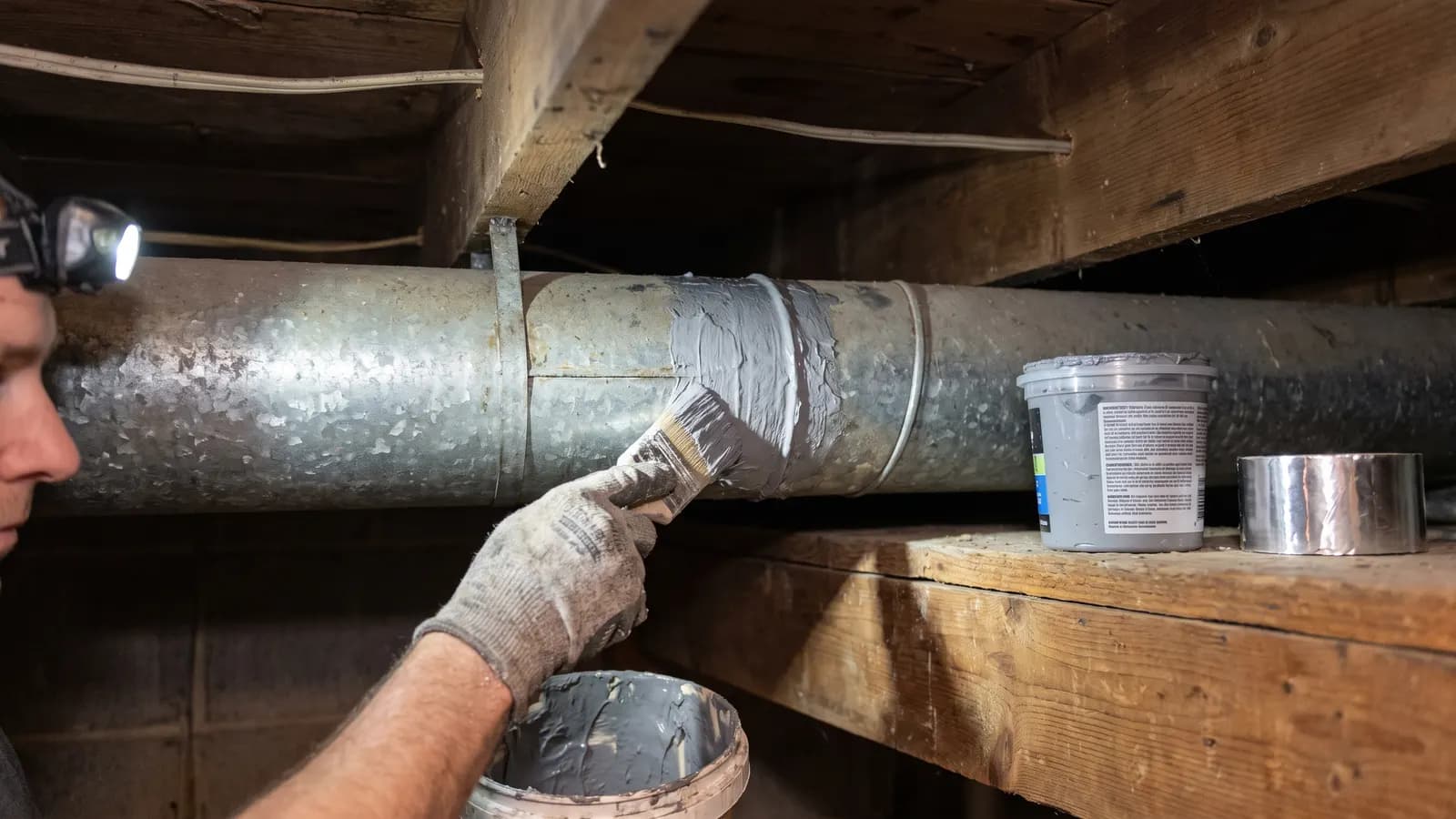
Seal ductwork you can reach by brushing mastic paste over every seam and joint on the supply and return ducts in the attic, crawlspace, basement, or garage, using UL 181 foil tape where a brush will not fit, sealing the boots where they meet the drywall at each register, and then wrapping the exposed runs in R-8 duct insulation. Skip duct tape entirely. Do the work before the heating season so the technician who checks the furnace sees the ducts as they will run all winter.
Mastic is a thick paste that dries into a flexible seal; it goes on with a cheap brush or a gloved hand. Foil tape is the second choice, for straight seams and the spots a brush cannot reach. Duct tape is neither.
Why does sealing ducts matter?
Sealing ducts matters because a leak in an attic or crawlspace duct pushes air you paid to heat or cool into a space nobody lives in, and a leak on the return side pulls attic dust, crawlspace humidity, and soil gases into the system. ENERGY STAR's page on duct sealing says that in a typical house about 20 to 30 percent of the air that moves through the duct system is lost to leaks, holes, and poorly connected ducts, and that the fix starts with mastic or metal tape on the ducts you can access.
The Department of Energy's home energy checklist says to insulate heating ducts in unheated areas such as attics and crawlspaces, and that keeping ducts in good repair can prevent heat loss of up to 60 percent at the registers.
The return-side leak is the one that explains a summer house that will not dry out. If the ducts run through a crawlspace, controlling indoor humidity starts here, not at the dehumidifier.
How often should you check the ducts?
Check the reachable ducts once a year, on the same trip as the attic check, and after any work in the attic or crawlspace: a cable run, a plumbing repair, or an insulation job can knock a duct loose or crush it. Sealing is done once and touched up; cured mastic does not need redoing unless it cracks. In a new home, look before the first heating season, because loose duct connections are a common punch-list item and the warranty is open.
What do you need?
You need fiber-reinforced mastic, cheap brushes, UL 181 foil tape, zip ties or clamps for flex duct collars, hanger strap, faced R-8 duct wrap, a utility knife, a headlamp, gloves, a mask, knee pads, and a board to lay across the joists. The Building America Solution Center's guide to air sealing and repairing ducts rates the job a difficulty 3 and specifies UL 181 mastic paste or UL 181 foil mastic tape.
- Fiber-reinforced mastic (UL 181) and disposable brushes
- UL 181 foil tape and a plastic squeegee to press it down
- Nylon zip ties or metal clamps for flex duct collars
- Hanger strap at least 1.5 inches wide
- Faced R-8 duct wrap and a utility knife
- Headlamp, gloves, an N95 or better mask, knee pads, and a plank for the joists
What are the steps?
Run the system and find the leaks by hand, turn it off, clean the joints, reconnect anything loose, brush mastic over every seam and collar, tape the seams a brush cannot reach, seal the boots at the registers from the room side, straighten and support the flex duct, then wrap the runs after the mastic cures. Recheck with the system running.
- Run the system and walk the ducts with the headlamp. Feel for air at every seam, collar, elbow, and boot, and mark each leak with a strip of tape. Done when: every reachable joint has been touched.
- Turn the system off at the thermostat so the ducts are still.
- Wipe dust off the joints you marked. Mastic holds only on a clean surface.
- Reconnect anything loose. On flex duct, slide the inner liner over the collar, cinch it with a zip tie or clamp, then pull the outer jacket over and tape it.
- Brush mastic over every seam, joint, and collar on the rigid metal duct. The Building America Solution Center says the paste should go on at least as thick as a nickel coin. Bridge gaps wider than a pencil with mesh tape and mastic over it.
- Use foil tape on straight, clean seams the brush cannot reach. Press it flat with the squeegee so no channel is left under the edge.
- Pull each register and return grille and seal the gap where the boot meets the drywall with mastic or foil tape, then replace the grille. ENERGY STAR's page names these connections as a place to seal.
- Straighten kinked flex duct and remove sags. Support it at least every 4 feet with strap at least 1.5 inches wide, per the Building America guide.
- Let the mastic cure for the time on the label. Then wrap the exposed runs with the faced R-8 insulation, facing out, and tape the seams with foil tape. The same guide says not to insulate ducts with unfaced fiberglass batts, because humidity condenses on the metal, and not to buy the thin bubble-wrap products sold as R-8.
- Run the system and recheck every marked spot. Done when: no air moves at any seam, and the wrap is continuous with no bare metal at the collars.
When should you stop and call a pro?
Call a heating and cooling contractor if the ducts run inside walls or floors you cannot open, if a duct is crushed or disconnected where you cannot reach it, if fiberglass duct board is coming apart, or if rooms still get poor airflow after the reachable seams are sealed. The Building America guide says that is the point to have someone test with a duct blaster, and ENERGY STAR's page notes that most heating and cooling contractors also repair ductwork.
Two other stops. In an older house, gray or white tape wrapped on old metal ducts may contain asbestos; the EPA's page on asbestos exposure says to leave undamaged material alone and not to take samples yourself. And if you see mold inside a duct or signs of vermin, sealing waits: the duct cleaning question explains the three conditions the EPA says justify a cleaning.
What should you record?
Photograph each sealed joint before and after, and record the products used (the mastic, the tape, the wrap's R-value), the date, and the runs you could not reach, which is the list you hand a contractor. In a new home, note what the builder fixed and when on the home record. Put the yearly duct look on a recurring schedule for the same fall week as the furnace check, so the two get done on one trip with the same flashlight.
Common questions
Why not duct tape?
ENERGY STAR says never to use duct tape on ducts because it is not long-lasting. The adhesive dries out and the tape peels off in a hot attic within a few seasons. Use mastic paste or UL 181 foil tape, which are made for the job.
Do the ducts need cleaning first?
Usually not. The EPA does not recommend routine duct cleaning; it suggests it only for visible mold inside the ducts, a vermin infestation, or ducts clogged with debris that blows into the house. Sealing and insulating is the job that changes how the system performs.
How do I know whether the ducts leak?
ENERGY STAR lists the signs as rooms that are hard to heat and cool, ducts running through an attic, crawlspace, or garage, and flex ducts that are tangled or kinked. A filter that turns gray quickly is another sign in practice. A contractor with a duct blaster can measure the leakage before and after.
What should you do next?
Go up with a headlamp while the system is running and feel the joints; that first hour tells you whether this is a weekend or a phone call. If the upstairs rooms are the complaint, a thermostat schedule will not fix them and this guide might.