On this page
Quartz and granite counters are cleaned the same way day to day, with warm water and a little dish soap on a soft cloth, and cared for differently over the years. Granite is a natural stone that usually needs a penetrating sealer reapplied when the water test says so. Quartz is an engineered surface of stone particles in resin that never needs sealing and cannot take a hot pan.
Both are far more durable than the cabinet and the drywall around them, and the damage that does happen is nearly always one of four things: a hot pan on quartz, an acid on polished granite, a stain in unsealed granite, or a chip at an edge from a heavy pot. All four are habits.
How do quartz and granite differ?
Quartz is ground stone bound in resin, made in a factory, never needs sealing, and cannot take a hot pan. Granite is natural stone that usually needs a penetrating sealer when the water test says so, tolerates heat better, and etches from acids on a polished surface. Both are cleaned with dish soap and water day to day, and neither tolerates bleach, ammonia, or abrasives.
| Quartz | Granite | |
|---|---|---|
| What it is | Ground stone bound in resin, factory made | Natural stone, cut and polished |
| Sealing | Never | Usually yes, when the water test fails |
| Heat | Trivets always; resin discolors | Trivets; sudden heat can crack |
| Acids (lemon, vinegar, wine) | Wipe promptly; may dull over time | Wipe immediately; can etch a polished surface |
| Stains | Rare; resin is non-porous | Possible in unsealed stone: oil, wine, dye |
| Daily cleaner | Dish soap and water, or a quartz cleaner | Dish soap and water, or a stone cleaner |
| Never use | Bleach, oven cleaner, abrasives, solvents | Bleach, ammonia, vinegar, citrus cleaners, abrasives |
Not sure which you have? Quartz has a uniform pattern that repeats and a slightly plastic feel at the edge; granite has irregular crystals and veins that never repeat, and feels cold. The seam, if there is one, is the same on both. The builder's finish schedule or the fabricator's invoice will say; that is the kind of paper worth keeping with the house.
What do you need?
Soft microfiber cloths, dish soap, a stone cleaner for granite or a quartz cleaner for quartz, trivets and cutting boards in daily use, and, for granite only, a penetrating (impregnating) stone sealer and a dry day to apply it. There is no special tool; the habit of wiping acids and oils at once matters more than any product.
- Soft microfiber cloths
- Dish soap
- A stone cleaner (granite) or a quartz cleaner (quartz), for spray convenience
- For granite: a penetrating stone sealer (impregnating type), and a dry day to apply it
- Trivets and cutting boards, in use every day
What are the daily and weekly steps?
Wipe spills as they happen (acids and oils first), clean daily with warm soapy water on a soft cloth and dry it, clean weekly with the stone or quartz spray and buff dry so no film builds, and keep boards under knives, trivets under heat, and heavy cast iron away from the edges and the sink cutout, where counters chip.
- Wipe spills as they happen, especially acids (citrus, vinegar, wine, tomato) and oils. On polished granite, an acid left for minutes can leave a dull etch mark that only a pro can polish out.
- Clean daily with warm soapy water on a soft cloth, then wipe dry. Drying prevents water spots and soap film, which is what makes counters look dull.
- Once a week, clean with the stone or quartz spray and buff dry. Done when: the surface has no streaks in raking light.
- Cut on a board, set hot things on a trivet, and keep heavy cast iron away from the edges and the sink cutout, which are the two places counters chip.
How do you do the granite water test and reseal?
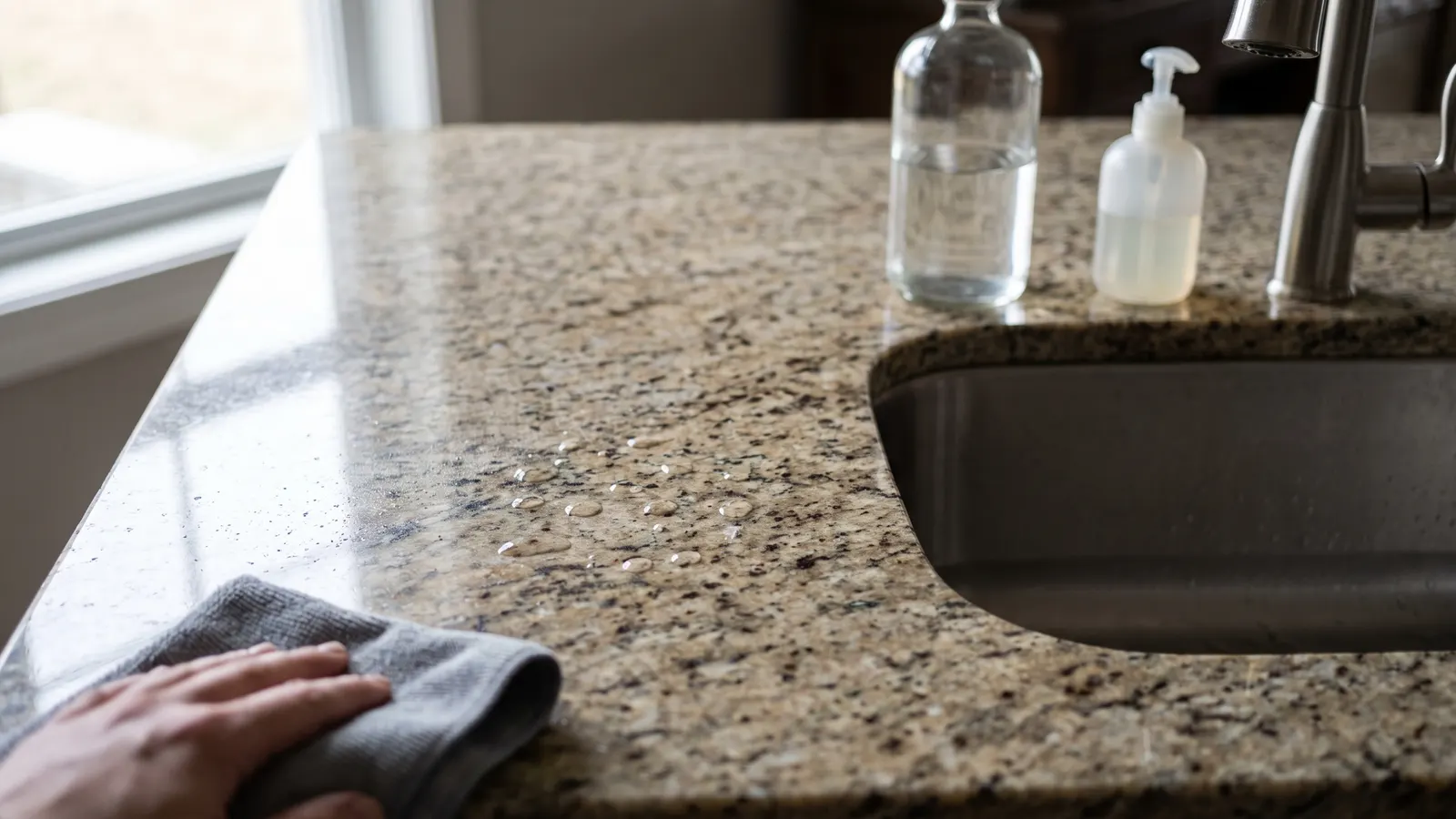
Put a few drops of water on the granite near the sink and the stove and wait a few minutes: beading means the seal is working, darkening means the stone is absorbing and needs sealing. To reseal, clean and dry the counter overnight, apply the penetrating sealer per its label, wipe off every trace of excess before it dries, let it cure, and repeat the water test. Quartz skips all of this.
- Put a few drops of water in a couple of spots, including near the sink and the stove. Wait a few minutes. If the water beads and wipes away clean, the seal is working. If the stone darkens under the drop, it is absorbing and needs sealing. Done when: you have a yes or no for each area.
- If it needs sealing, clean the counter thoroughly with the stone cleaner and let it dry completely, ideally overnight.
- Apply the sealer per its label: usually wipe or spray on, let it penetrate for the stated time, and wipe off every trace of excess before it dries on the surface. Excess sealer left to dry leaves a haze that is hard to remove.
- Let it cure for the time on the label before using the counter. Repeat the water test after curing.
Quartz skips this entirely. Sealer on quartz sits on the resin and does nothing but leave a film.
How do you deal with stains, etches, film, and chips?
A stain in granite comes out with a poultice left under plastic for a day; an etch mark needs a polishing compound or, if deep, a fabricator; a dull film on either surface is soap buildup and clears with the stone or quartz cleaner; and a small chip at an edge takes a color-matched epoxy kit. Anything larger than these is a fabricator's job.
- A stain in granite: a poultice (a paste of baking soda and water, or a commercial stone poultice) spread over the stain, covered with plastic, and left for a day draws many oil and organic stains out. Repeat if needed. Reseal afterward.
- An etch mark on granite: dull spots from acid need polishing with a stone polishing compound; deep or wide etching is a fabricator's job.
- A dull film on either: soap buildup. Clean with the stone or quartz cleaner and buff dry; skip the dish soap for a while.
- A chip at an edge: a color-matched epoxy repair kit works for small chips; a fabricator can fill and polish larger ones.
When should you stop and call a pro?
Call a stone fabricator for a crack of any length (they can sometimes stabilize it), a chip larger than a fingernail, a separated seam, a counter that has shifted or rocks, or an etch or stain that does not respond to one round of the fixes above. Do not use a grinder, sandpaper, or any abrasive pad on either surface yourself. On a new-construction home, a seam that opens, a crack that appears near the sink or stove cutout, or a counter that was installed unlevel is a workmanship item; photograph it and report it during the warranty period.
What should you record?
Which material you have, the fabricator, the color or product name, the sealer used and the date, and the result of each water test. A granite that fails the test faster each year is telling you something about the sealer. Set the water test as a yearly reminder and the resealing as a task you complete only when the test says so.
Common questions
How often does granite need sealing?
When it fails the water test, not on a fixed calendar. Some dense granites go years between sealing; some porous ones need it yearly. Put a few drops of water on the counter and wait; if it darkens the stone within several minutes, seal it.
Can I put a hot pan on quartz?
No. The resin that binds quartz can discolor or crack from a hot pan, and the damage is permanent. Use a trivet. Granite tolerates heat better but can still crack from a sudden change, and a trivet is still the habit to keep.
What cleaner is safe for both?
Warm water with a little dish soap on a soft cloth, then a dry wipe. For a spray, a cleaner labeled for stone or quartz. Avoid bleach, ammonia, vinegar, and abrasive powders on either.
What should you do next?
The backsplash and floor around the counter are usually tile, and grout is where kitchen grime actually collects. And the same "protect the finish" thinking applies to hardwood floors, where water is the enemy for the same reason.