On this page
Deep clean tile and grout with an alkaline tile cleaner, a stiff nylon brush, and time for the cleaner to work, then rinse, dry, and seal the grout so the next cleaning is easier. Grout darkens because it is porous cement: it soaks up soap film, body oils, cooking grease, and mold spores. A sealer fills those pores. A sealed floor wipes clean; an unsealed one has to be scrubbed.
This guide is for ceramic and porcelain tile with cement grout, which is what most kitchens and baths have. Natural stone tile (marble, travertine, slate) needs a stone-safe cleaner and its own sealing, and acidic products will etch it; if you have stone, follow the stone rules from the countertop guide and skip anything acidic below.
What makes grout dirty in each room?
Grout darkens from whatever the room produces: grease and tracked-in grit on a kitchen floor, splatter on a backsplash, soap film and hair products on a bathroom floor, soap scum, body oil, and mold in a shower, and grit and salt at an entry. The prevention differs by room, and the table below pairs each with the habit that keeps it clean.
| Room | What collects | What prevents it |
|---|---|---|
| Kitchen floor | Grease, food, tracked-in grit | Sweep often, degrease monthly, mat at the sink and stove |
| Kitchen backsplash | Grease film, splatter | Wipe after cooking with a degreasing cleaner |
| Bathroom floor | Soap film, hair products, moisture | Exhaust fan, weekly cleaning, bath mat |
| Shower walls and floor | Soap scum, body oil, mold | Squeegee after each shower, fan on, door open, weekly cleaner |
| Entry | Grit, salt, mud | Mats inside and out, sweep |
What do you need?
An alkaline tile and grout cleaner (a mold and mildew cleaner for showers), a stiff nylon grout brush, ideally on a pole for floors, microfiber cloths and a mop, a bucket of clean rinse water, a wet-dry vacuum if you have one, gloves, eye protection, ventilation, and a penetrating grout sealer with a small applicator. Never mix cleaning products, and never mix anything with bleach.
- An alkaline tile and grout cleaner (many are labeled "grout cleaner" or "degreaser"). For mold in a shower, a cleaner labeled for mold and mildew. Never mix products, and never mix anything with bleach.
- A stiff nylon grout brush; a grout brush on a pole for floors saves your knees
- Microfiber cloths and a mop
- A bucket of clean water for rinsing
- A wet-dry vacuum if you have one; it makes rinsing and drying a floor much faster
- Gloves, eye protection, and open windows or a fan
- A penetrating grout sealer and a small applicator brush or a sealer bottle with a roller tip
What are the steps of the deep clean?
Sweep first, apply the cleaner to a section and let it dwell without drying, scrub along the grout lines with the stiff brush, rinse with clean water changed often, dry the floor and hit any dark spots again, treat shower mold with the mold cleaner and then fix the drying (fan and squeegee), and let the grout dry overnight before sealing. Two or three hours for a typical bath and kitchen.
- Sweep or vacuum the floor thoroughly. Grit under a brush scratches tile glaze.
- Apply the cleaner to a section of grout and let it sit for the time on the label, several minutes at least. Do not let it dry; work in sections you can finish.
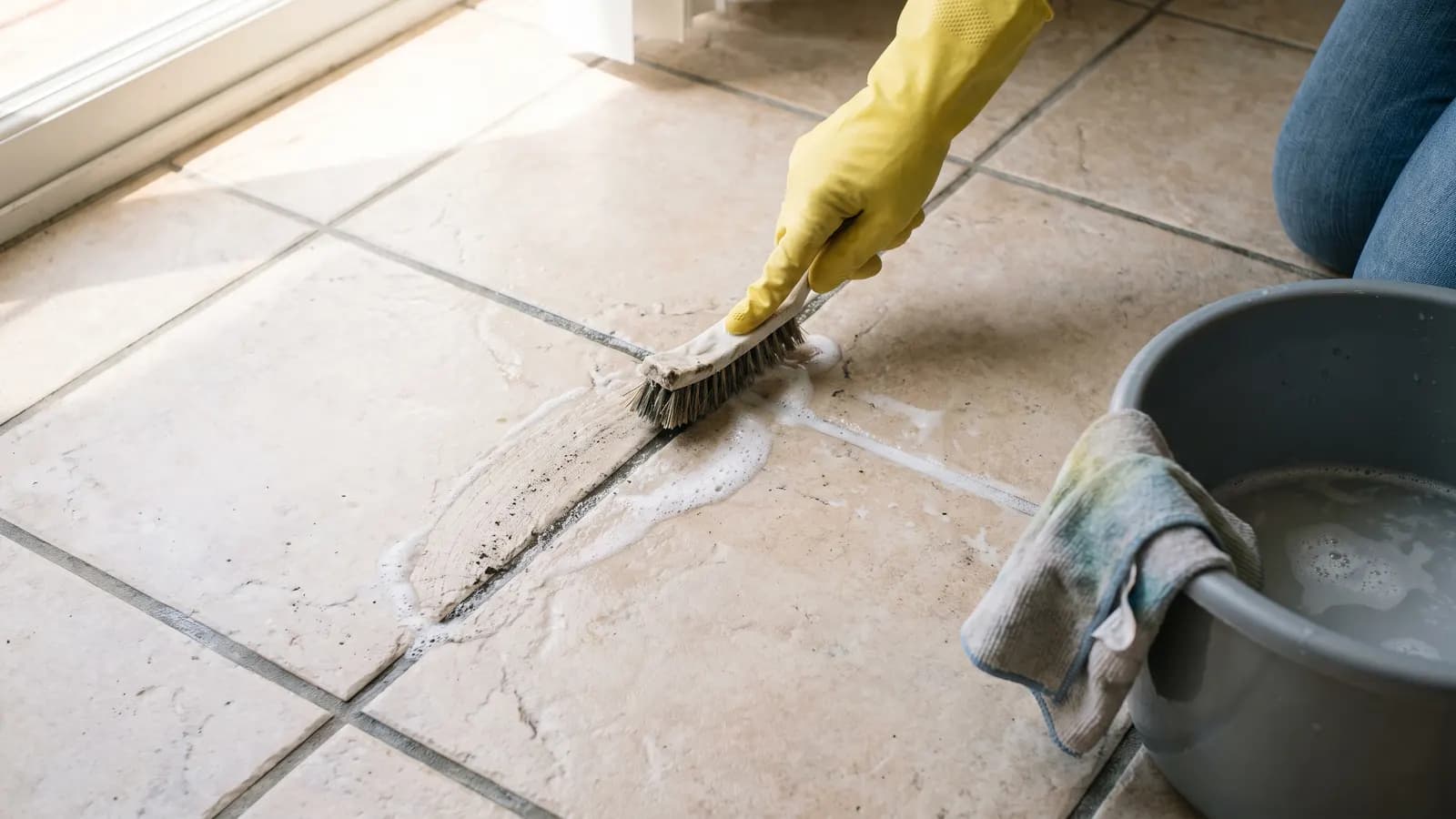
- Scrub the grout lines with the stiff brush, along the line, not across it. Done when: the grout line is a consistent color from one end to the other.
- Rinse with clean water and a cloth or mop, changing the rinse water often. Residue left behind attracts dirt and interferes with sealer.
- Dry the floor with cloths or the wet-dry vacuum. Look at the grout in good light; hit any dark spots again.
- For mold in a shower, apply the mold cleaner, wait per the label, scrub, and rinse. Then address the drying: check that the exhaust fan actually moves air (hold a tissue to it) and start the squeegee habit.
- Let the grout dry completely, at least overnight, before sealing. Sealer applied to damp grout will not penetrate.
What are the steps for sealing the grout?
Confirm the grout is cement-based and dry, apply a penetrating sealer along the grout lines with the applicator, let it soak in for the time on the label, wipe every bit of excess off the tile before it dries into a haze, add a second coat if the label calls for it, keep the floor dry through the cure, and test with water drops: they should bead on the grout line.
- Confirm the grout is cement-based and dry. Test in a corner: water that soaks in and darkens the grout means it needs sealing.
- Apply a penetrating sealer to the grout lines with the applicator, keeping it off the tile face as much as practical. On unglazed or textured tile, sealer on the tile is fine; on glazed tile it leaves a haze if left to dry.
- Let it penetrate for the time on the label, then wipe all excess off the tile with a dry cloth. Done when: no wet or hazy sealer is on any tile surface.
- Apply a second coat if the label calls for it. Keep the floor dry for the cure time.
- Test again with water drops: they should bead on the grout line.
Where should you use caulk instead of grout?
Use caulk, not grout, wherever two planes meet and move: where a tile floor meets the tub, where shower walls meet in the corners, and where a backsplash meets the counter. Grout in those joints cracks as the parts move and lets water in behind the tile. Cracked corner grout or peeling, moldy caulk gets removed and replaced with a mold-resistant kitchen-and-bath caulk.
It is a one-hour job with a caulk remover tool, rubbing alcohol, and a steady hand, and it prevents the water damage that ends with tile falling off a wall.
When should you stop and call a pro?
Call a tile contractor if grout is crumbling, missing, or cracked along many joints (regrouting), if tiles are loose, hollow-sounding, or cracked, if water is getting behind a shower wall (soft drywall or a stain on the other side of the wall), or if the tile is natural stone with etching or deep staining. In a new home, grout cracks and hollow tiles in the first year are worth reporting to the builder in writing during the warranty period; a tile job that was set on an unprepared floor shows up early.
Never use a muriatic acid or other strong acid product on grout indoors without specific training; it damages glaze, metal fixtures, and lungs.
What should you record?
The date of the deep clean and the sealing, the sealer product, and any cracked grout, loose tile, or failed caulk you found and where. Put the deep clean on a yearly reminder and the water-bead test for the sealer with it.
Common questions
Does grout need to be sealed?
Cement-based grout, which is most grout, benefits from a penetrating sealer after it has cured and again every year or two, because it is porous and absorbs stains. Epoxy grout does not need sealing. Check the grout type on the tile paperwork if you have it; if water beads on the grout line, it is sealed.
Why does the grout in my shower keep turning black?
Mold, growing in grout that stays damp. The fix is drying: run the exhaust fan during and for a while after every shower, squeegee the walls, and keep the door or curtain open afterward. Cleaning removes the mold; drying keeps it from coming back.
Can I regrout over old grout?
Not reliably. New grout needs a groove to key into and old grout on the surface will fail. Regrouting means removing the old grout to a depth with a grout saw or an oscillating tool, then packing new grout. It is a real job, and often a pro's.
What should you do next?
The floors that are not tile need the opposite treatment: hardwood wants almost no water at all. And if the bathroom fan did not move the tissue in step 6, that fan is the real cause of the mold and is worth a service call.