On this page
- What are the four signs across every system?
- Which symptoms are maintenance, not age?
- What are the signs on a water heater?
- What are the signs on a furnace or air conditioner?
- What are the signs on the roof, the sump pump, and the appliances?
- What should you do when you see the signs?
- Common questions
- What should you do next?
A home system near the end of its life shows four kinds of signs: its age is past the range the manufacturer or the Department of Energy expects, its repairs are getting closer together, its performance is falling (less heat, less hot water, more noise, longer cycles), and there is physical evidence such as rust, moisture, corrosion, or soot. Before reading any of those as the end, rule out the maintenance problems that mimic them: a clogged filter, a full dryer vent, a sediment layer, or a dirty coil produce the same symptoms and cost almost nothing to fix.
Check the cheap cause first, then the age, then the history, and write down what you find.
What are the four signs across every system?
The four signs are age, repair frequency, performance, and physical evidence, and they apply to the water heater, the furnace, the air conditioner, the roof, the sump pump, and the major appliances alike. One sign is a note. Two are a conversation with a technician. Three or four, on a unit past its expected range, is a replacement to plan before it becomes a replacement to survive.
| Sign | What it looks like | Where the fact comes from |
|---|---|---|
| Age | The install or manufacture date is at or past the expected range | The label, the manual, and for water heaters the DOE's 10 to 15 years |
| Repair frequency | A second or third repair within a few years; parts on back order | Your repair history |
| Performance | Less output, longer run times, short cycling, new noises, uneven results | Your own observation, month to month |
| Physical evidence | Rust, moisture, corrosion at fittings, soot, granules, a bulging hose | The monthly walkthrough |
Age comes from the label; reading the model, serial, and date of manufacture is the first job for every unit, because every sign below means something different at five years than at fifteen.
Which symptoms are maintenance, not age?
Several end-of-life symptoms are maintenance failures wearing a costume: long drying times, weak airflow, short cycling, a rumbling water heater, and a struggling sump pump all have a cheap first explanation. Fix that first. If the symptom stays after the filter is changed, the vent is cleaned, the tank is flushed, or the pit is cleared, then it is a sign. If it goes away, it was a task.
Looks like the end
- Clothes take two cycles to dry and come out hot
- The air conditioner runs constantly and the house is warm
- The furnace turns on and off every few minutes
- The water heater rumbles and pops when it fires
- The sump pump runs long, loud, or not at all
- The refrigerator runs warm and the compressor never stops
Usually maintenance first
- A clogged dryer vent: clean the duct and the cap
- A dirty filter or coil, or a blocked condenser: change, clean, clear
- A dirty filter restricting airflow, or a blocked return
- Sediment on the tank bottom: flush it, then listen again
- Debris in the pit or a stuck float: clear and test
- Dirty condenser coils or a failed door gasket: clean and check
The U.S. Fire Administration's report on clothes dryer fires says heavy clothes taking a long time to dry, or clothes feeling hotter than usual at the end of a cycle, indicate a clogged vent. That is the clearest example of a symptom that reads as a dying appliance and is a duct full of lint; cleaning the dryer vent is the test.
What are the signs on a water heater?
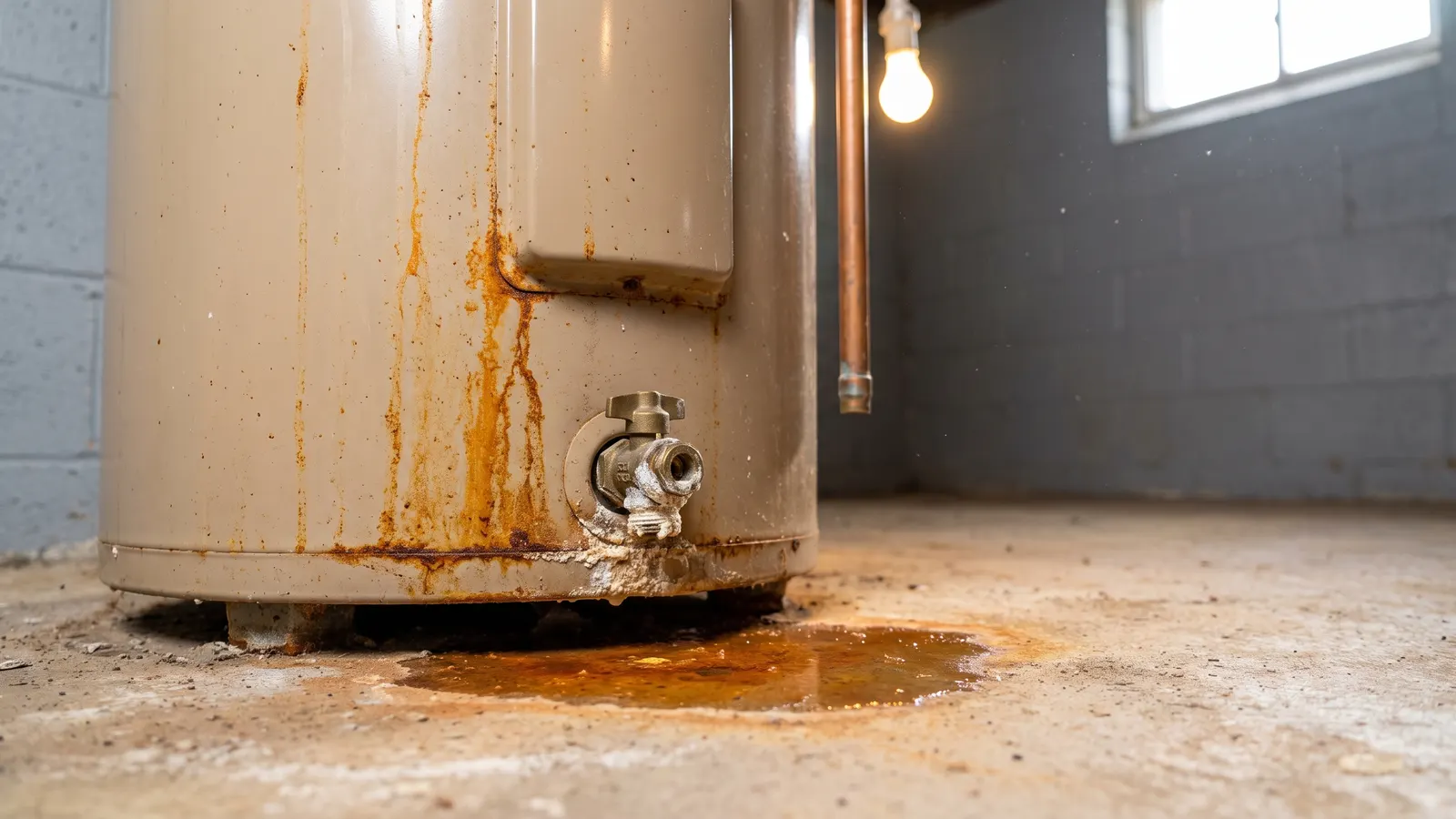
A storage water heater is near the end when it is at or past the Department of Energy's expected range, when rust shows in the hot water only, when there is moisture at the base of the tank or at the seams rather than at a fitting, and when the rumbling continues after a flush. Any water coming from the tank itself, rather than from a valve or a fitting, is not a repair; the tank has failed and the unit is replaced.
The DOE's Energy Saver guide says most storage water heaters last 10 to 15 years. A unit in that range with clear hot water and a dry base is fine; a unit in that range with rusty hot water is telling you the tank wall is going, because the rust is coming from inside it. Flushing the tank is the diagnostic as much as the maintenance: what comes out of the drain valve (clear, cloudy, sandy, rusty) is a direct look at the tank bottom, and a flush that runs rusty on a tank past ten years is the note that starts the replacement plan.
A dripping relief valve, a leaking drain valve, or a failed element are repairs on a young tank and a question on an old one; a tank above living space fails expensively, and the repair-or-replace rule weighs that consequence alongside the age.
What are the signs on a furnace or air conditioner?
A furnace or air conditioner is near the end when its age is past what the manufacturer expects for the model, when it has needed a repair in each of the last few seasons, when it no longer holds the set temperature or cycles unevenly with a clean filter, and when the technician at the yearly inspection raises the heat exchanger, the compressor, or a refrigerant type that is being phased out.
On the cooling side, warm air from the vents, ice on the refrigerant line or the coil, a compressor that is loud at startup, and a technician who keeps adding refrigerant are the signs. Refrigerant is a licensed job, and a leak in an aging system is often the point where the repair price and the replacement price meet. The annual tune-up is where these get noticed a season early.
What are the signs on the roof, the sump pump, and the appliances?
A roof is near the end when granule loss and curling are general rather than local, when leaks appear in more than one place, and when the flashing has been patched more than once; a sump pump is near the end when it runs longer for the same rain, trips its breaker, or was installed before you can remember; and an appliance is near the end when a repair approaches the price of a new unit or a part is no longer made.
- Roof: the yearly inspection tracks shingle condition and flashing; a single leak is a repair, a pattern is a plan.
- Sump pump: test it each spring by pouring water into the pit; a pump that hesitates or runs rough is a candidate for replacement before the wet season.
- Appliances: a refrigerator that runs warm with clean coils, a dishwasher that leaks at the door with a new gasket, a washer with a bearing noise, and a dryer that runs long with a clean vent are the ones whose next repair should be priced against replacement.
What should you do when you see the signs?
When you see the signs, record the date and the symptom with a photo, check the unit's age on its label, rule out the maintenance cause, and then get a technician's opinion in writing at the next service visit: what they see, what a repair would cost, and what they would do if it were their house. Start the replacement fund and decide the trigger in advance.
Replace before the season, not during it. A furnace that is on its last winter is replaced in September, with three quotes and a chosen contractor; the same furnace replaced in January is installed by whoever answers the phone, at that price. The signs give you the months; use them.
In Property Station each system has a page under Systems & Features with its install and warranty dates, Repair History holds each visit, and the Complete Task notes on the flush or the tune-up ("ran rusty", "technician flagged the exchanger") are the dated signs that make the decision; the features page shows the two together. Which jobs are yours and which are a licensed trade's is the DIY-or-pro decision, and what maintenance can and cannot do for an aging unit is what preventive maintenance actually prevents.
Common questions
How long should a water heater last?
The Department of Energy's Energy Saver guide says most storage water heaters last 10 to 15 years. Water quality, the temperature setting, whether the tank was flushed, and whether the anode rod was ever replaced move a unit within that range. The install date on the label tells you where yours is.
My furnace is old but works fine. Should I replace it anyway?
Not on age alone. An old furnace that passes its yearly inspection, holds temperature, and has no repair history is a furnace to keep, with a replacement fund started and a plan for the week it fails. Age changes the answer when a repair is quoted, when the heat exchanger is questioned, or when parts become hard to get.
Is rusty water always the water heater?
Rust in hot water only, from every tap, points to the tank. Rust in both hot and cold water points to the supply pipes or the utility. Rust at one tap points to that fixture. Run the cold tap alone into a white cup, then the hot, and compare before calling anyone.
What should I write down when I notice a sign?
The date, what you saw or heard, a photo, and the unit's age from its label. Then the technician's words at the next visit. A dated list of signs is what makes the repair-or-replace call a decision instead of a guess, and it is what a warranty claim asks for if the unit is still covered.
What should you do next?
Read the label on the water heater and the furnace today and write both dates on their records. Then, at the next flush and the next tune-up, add one line about what came out and what the technician said. Those two lines a year are the whole early-warning system.