On this page
Preventive maintenance prevents a specific set of failures: the ones caused by something accumulating (lint in a dryer duct, sediment in a water heater, dust on a filter, debris in a gutter, water where it should not sit) and the ones caused by something drifting (a sensor out of alignment, a seal drying out, a battery going flat). It does not prevent age, manufacturing defects, bad installation, or storms. What it does with those is different and still valuable: it turns a surprise into a scheduled decision, with a record.
That is the honest case. It is narrower than "maintenance prevents breakdowns" and stronger, because every item on the list has a mechanism you can name.
What does preventive maintenance actually prevent?
Preventive maintenance prevents accumulation failures and drift failures. Accumulation is a substance building up until it blocks, insulates, overheats, or corrodes something: lint, sediment, dust, grease, leaves, scale, standing water. Drift is a setting or a part slowly moving away from where it should be: garage door sensors, a thermostat's calibration, caulk shrinking from a joint, a battery losing charge. Both are predictable, both are visible before they fail, and both are undone by a task on a schedule.
| System | What accumulates or drifts | What it causes | The task that removes it |
|---|---|---|---|
| Dryer | Lint in the duct and cap | Long dry times, overheating, fire | Clean the vent yearly, the screen every load |
| Water heater | Sediment on the tank bottom | A burner working through a layer of scale, noise, early tank failure | Drain a quart every 3 months or flush yearly |
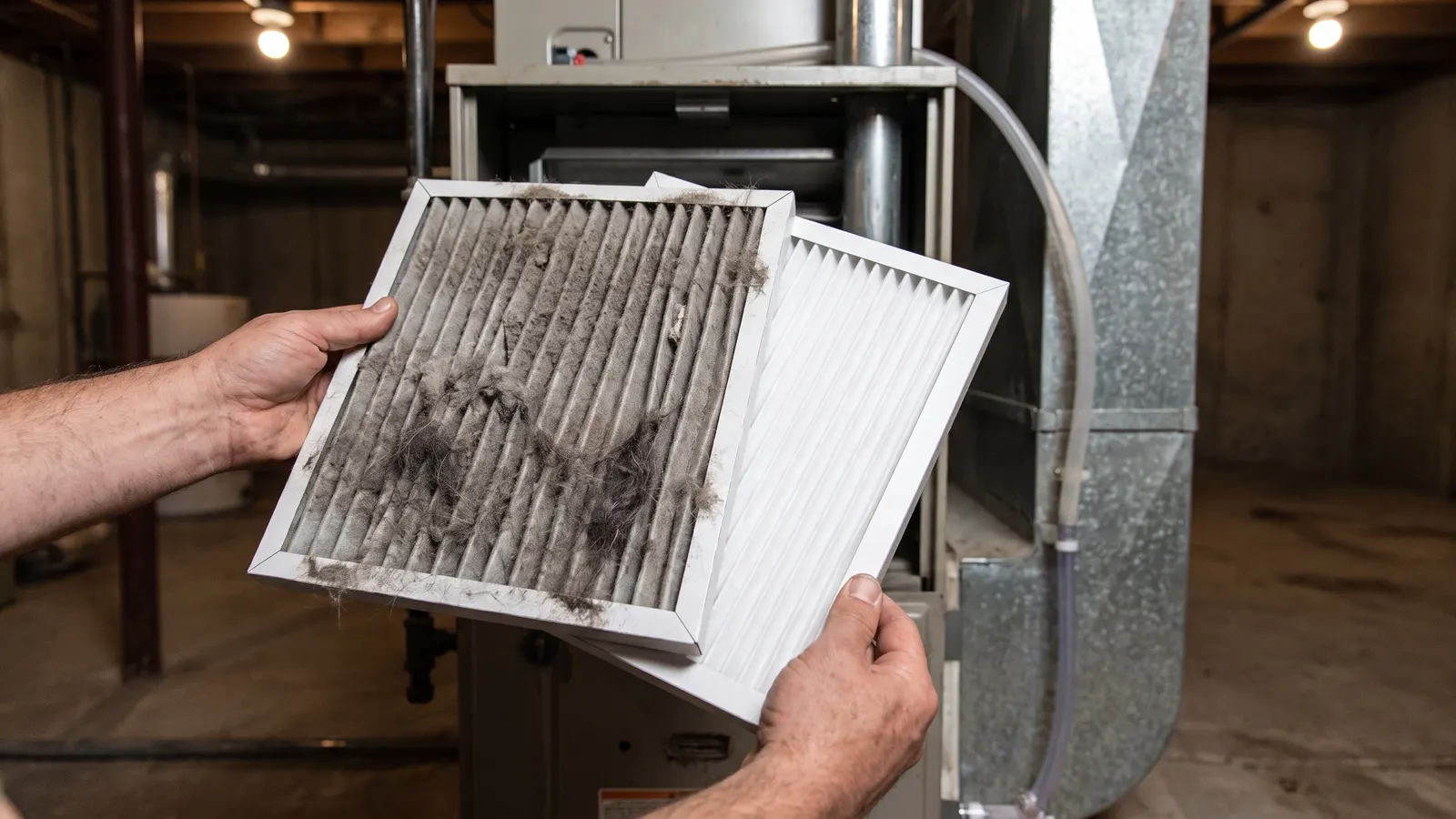
| HVAC | Dust on the filter and coil; a clogged condensate drain | Restricted airflow, a strained blower, water damage from the drain | Check the filter monthly; the yearly tune-up clears the coil and drain |
| Gutters and grading | Leaves in the gutter; soil settled toward the house | Water at the foundation, a soaked fascia, damp crawl space | Clean gutters seasonally; regrade and extend downspouts |
| Garage door | Sensor alignment, spring tension | A door that does not reverse | The monthly 2x4 test |
| Caulk and seals | Shrinkage, gaps | Water behind the tub surround, air leaks | Inspect and recaulk as gaps appear |
| Alarms | Battery charge; sensor age | A detector that does not sound | Monthly test; replace on the manufacturer's age |
The U.S. Fire Administration's report on clothes dryer fires names "failure to clean" as the leading factor contributing to dryer fires. The Building America Solution Center's dryer exhaust guide says cleaning the dryer duct annually will make clothes dry faster, save energy, and could prevent a fire, because lint blocks airflow, increases drying times, and can overheat the dryer. The Department of Energy's Energy Saver guide says to drain a quart of water from the water heater tank every 3 months to remove sediment.
What does it not prevent?
Preventive maintenance does not prevent age, defects, bad installation, or events. A water heater tank rusts through at the end of its life whether or not it was flushed; the Department of Energy's guide puts most storage water heaters at 10 to 15 years, and maintenance moves a unit toward the top of that range, not past it. A cracked heat exchanger from a manufacturing flaw, a compressor with a bad winding, a roof installed without flashing, and a tree through the garage are outside the list. Anyone who tells you maintenance prevents those is selling the visit.
The limits matter for two decisions. Under a builder or manufacturer warranty, a defect is a claim, not a maintenance failure, and the maintenance record is what shows the defect was not caused by neglect. And at the end of a unit's life, the signs a system is near the end are worth learning, because no amount of flushing turns a rusting tank into a young one.
What does it do instead of preventing?
Where maintenance cannot prevent a failure, it does three other things: it finds the failure early, it turns an emergency into an appointment, and it leaves a record. A technician at the yearly tune-up sees the heat exchanger crack before the CO alarm does. A flush that comes out rusty says the tank is going before the floor is wet. A monthly look under the sink finds the drip before the cabinet floor swells. None of those prevented anything; all of them changed what the failure cost.
This is also where the repair-or-replace rule draws its facts: the age, the repair history, and the technician's notes come from the maintenance record, and a decision made from the record is made on a Tuesday instead of a holiday.
Which tasks have the strongest case?
The strongest cases are the tasks where the mechanism is documented, the failure is expensive or dangerous, and the task is cheap: the dryer vent, the HVAC filter and the condensate drain, the water heater flush, the gutters and downspouts, and the detector tests. Each has a named source, a named failure, and a job that takes minutes to an hour with tools you own.
- Dryer vent. Fire risk, named by the U.S. Fire Administration, fixed by a yearly brush and vacuum.
- HVAC filter and condensate drain. ENERGY STAR's maintenance checklist says a plugged condensate drain can cause water damage in the house and affect indoor humidity, and puts the monthly filter check on the homeowner's list.
- Water heater flush. Sediment, named by the Department of Energy, removed by the quarterly quart or the yearly drain.
- Gutters, downspouts, and grading. Water at the foundation, which the EPA's termite page also names: keep the soil around the foundation dry through proper grading and drainage, including maintenance of gutters and downspouts.
- Detectors. The monthly test and the replacement age, because the failure mode is a device that does not sound.
How should you think about the cost?
Think about the cost of maintenance as the price of the failures it removes plus the decisions it sets up, against the hours and the few parts it takes. Most tasks on the strong list cost a filter, a brush, or an hour; the yearly tune-up and the chimney inspection are the service calls worth paying for because they reach the parts you cannot. Budgeting for maintenance builds the number from the house's own task list rather than a rule of thumb, and it separates the recurring tasks from the replacement fund that age will eventually draw on.
The other cost is attention, and that is the one most owners underprice. A task that is known but unscheduled is not maintenance. In Property Station each task has a Frequency in months and a reminder before it is due, and completing it schedules the next one, so the attention is spent once when the task is set up and not every month after. A maintenance calendar that sticks is the setup; the scheduler is the loop.
Common questions
Does maintenance make equipment last longer?
It removes the things that shorten its life: the sediment that overworks a burner, the lint that overheats a dryer, the dirty filter that strains a blower. Equipment still ages and still reaches the end of its expected life. Maintenance gets it there without the early exit, and the record tells you where it is on the curve.
Is it worth paying for the yearly HVAC tune-up?
A real tune-up cleans the coils, checks the condensate drain, tests the burner and heat exchanger, and tells you what is wearing. Those are the accumulation and drift failures on a system you cannot service yourself. Ask what the visit includes, and write down what the technician says about the unit's condition; that sentence is what you are paying for.
What if I do everything and it still fails?
Then it failed from age, a defect, or an event, which maintenance never claimed to prevent. The difference is that you will know that, you will have the record that a warranty or insurance claim asks for, and you will be replacing a unit you already knew was old instead of one you thought was fine.
Which single task has the strongest evidence?
Cleaning the dryer vent. The U.S. Fire Administration names failure to clean as the leading factor contributing to dryer fires, and the fix is a brush and a vacuum once a year. Nothing else on the list has a federal fire report behind it and a fifteen-minute fix in front of it.
What should you do next?
Pick the strong list's five tasks and put a date on each. The dryer vent this weekend, the filter on the first of the month, the water heater flush and the gutters in the fall, and the detectors with the filter. That is the maintenance with a documented mechanism, and it is the maintenance worth doing first.