On this page
A home maintenance log should include, for every task, the same six things: what was done, the date it was done, who did it, what it cost, what was found, and when it is due again. Add the equipment it applies to (the model and serial, or a link to that unit's record) and a photo wherever one would settle a question later. That is the whole log. Anything more is a note you may want; anything less is a log that will not hold up at a warranty claim or a sale.
The log is the second of the four parts of a home record (what the house is, what has been done to it, what covers it, and who worked on it), and it is the part most owners keep in their heads. Why every home needs one record makes the case for the whole; this post is about the doing.
What goes in every entry?
Every entry needs the task, the date, the person, the cost, the finding, and the next due date. The task names the job and the unit it was done to. The date is when the work happened, not when it was written down. The person is you, someone in the household, or the company and technician. The cost includes parts. The finding is what you saw. The next due date is what turns a log into a schedule.
| Field | What to write | Why it matters later |
|---|---|---|
| Task and equipment | "Replaced furnace filter" plus the unit it belongs to, or the size printed on the frame | A claim or a buyer asks what was done to which unit |
| Date done | The day the work happened | Warranty conditions and resale questions are answered in dates |
| Who did it | You, a family member, or the company and the technician's name | An invoice from a pro carries more weight than "I did it" |
| Cost | Parts and labor, with the receipt attached | Budgeting, the repair-or-replace decision, the tax basis of an improvement |
| What was found | "Filter gray, not black", "drain pan dry", "rust ring at the tank base" | The trend across entries is the early warning |
| Next due | A date, or the interval the manual gives | Turns the record of the past into the plan for the next task |
The two fields owners leave out most often are the finding and the person. The finding is what lets you compare this year to last; the person is what a warranty administrator asks about first when a claim says the unit was serviced.
Which tasks belong in the log?
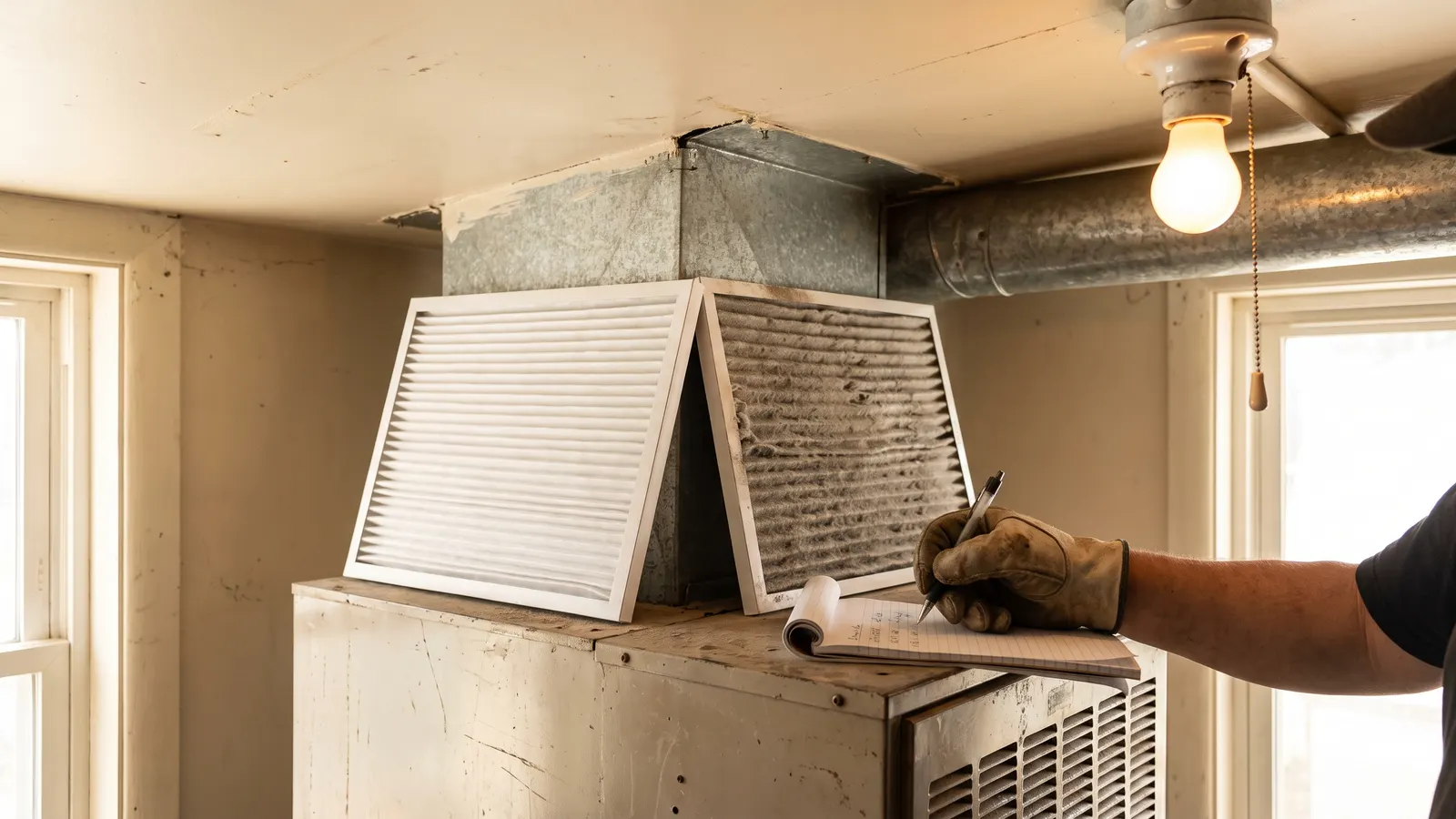
Log every task that touches a system, a piece of equipment, or the envelope: filter changes, the water heater flush, gutter cleaning, detector tests, HVAC service visits, repairs of any size, and every inspection, including the ones you do yourself. Log observations too, such as a hairline crack or a damp spot, with a photo and a date, even when you decide to do nothing yet. Skip routine cleaning that leaves no evidence and changes nothing about the house.
What to log
- Recurring maintenance: filters, the water heater flush, gutters, the dryer vent, detector tests, caulk
- Service visits: the tune-up, the plumber, the electrician, the septic pump-out, with the invoice
- Repairs: what failed, what was replaced, the part, who did it
- Inspections: the annual roof look, the attic check, a home inspection, a warranty walkthrough
- Observations: a crack, a stain, a noise, a door that started to stick, with a photo and a date
- Projects: anything with a contractor or a permit, as its own record with its documents
In most houses we see, the service invoices exist somewhere and the observations exist nowhere. The technician said "watch that capacitor" or "the anode is about done" at the door, and nobody wrote it down. Those sentences are the most valuable lines a log can hold, because they are the next failure, named in advance.
Why do the dates matter more than the details?
Dates matter because every later use of the log is a question about time: whether the filter was changed within the interval the equipment warranty asks for, when the roof was last looked at before the leak, how long the water heater has been in service, what the buyer's inspector should expect to find. A log with the right dates and thin notes answers those questions. A detailed note that begins "sometime last spring" does not.
Manufacturer warranties commonly condition coverage on the maintenance the manual describes, and a builder's warranty often excludes damage from neglected maintenance; your warranty documents are the only source for what yours require, and warranty records that hold up covers what to keep beside them. The log is the proof. Without dates, it is a story.
We recommend logging the task the day it is done, standing at the equipment, before the tools are put away. A log built from memory at the end of the month has the dates wrong, and the dates are the part that matters.
How should you write an entry in under a minute?
Write the entry the moment the task is done, from the equipment, in one line plus a photo: the task, the number you can read off the part (the filter size, the reading, the part number), and the observation. A photo of the old part or of the label carries the details you would otherwise type. A service visit takes two more minutes: attach the invoice and write down what the technician said, in their own words, before they drive off.
The model and serial of each unit should already be on its record, so an entry only has to name the unit, not describe it. If they are not, organizing the manuals and serial numbers is the hour that makes every later entry shorter.
Should the log be paper, a spreadsheet, or an app?
A paper log works until the house changes hands or the notebook does; a spreadsheet adds sorting and copies but still has no reminders and no place for the photo and the invoice; a log kept inside the home record keeps the entry, the receipt, the photo, and the next due date together, and reminds you before the next one. The right container is the one where the entry gets written the same day, which for most households is the phone in their hand.
Notebook or spreadsheet
- The entry is text; the invoice and the photo live somewhere else
- Next due dates are a column nobody reads
- One copy, in one house, with one person
- Handed to a buyer as a stack, if at all
Log in the home record
- The entry carries the receipt and the photo
- Completing a task schedules the next one and sends the reminder
- Anyone in the household can add an entry from their phone
- Exported whole at the sale, with the documents
In Property Station the log is written from the task itself. Completing a task on the Maintenance page asks for the Completed Date, the Cost, who completed it, and Notes; the entry lands in that task's Completion History; and a task with a frequency in months schedules its next due date on its own.
Common questions
Should I log work that was done before I started the log?
Yes, as far as you can prove it. Work back through receipts, invoices, emails, and photos, enter each one with its date, and mark anything you are estimating as an estimate. A dated invoice from before the log started is as good as an entry made on the day; a memory is not.
Do I need a receipt for every entry?
For anything with a cost, yes, attached to the entry. Warranty claims, insurance claims, and the tax basis of improvements are settled on receipts, not on notes. For a task with no cost, the entry and a photo are enough.
How much detail is enough?
One line and a photo for a routine task. For a service visit, the invoice plus what the technician said, in their words. The test is whether a stranger could read the entry a year later and know what was done, to which unit, and when.
What if I skip a task?
Log the skip and the reason. A gap with a reason ("filter not changed in March, unit was off for the renovation") is useful; a silent gap looks like neglect to a warranty administrator or a buyer's inspector.
What should you do next?
Write the last three things done to the house into the log today, with their dates and whatever receipts you can find, then put the next filter change on a schedule so the fourth entry writes itself. When the log has a year of dates in it, the repair-or-replace decision for the oldest unit is already half made.