On this page
The one-hour monthly walkthrough is a fixed route through the house, top floor to garage to a loop outside, in which you look at, touch, and listen to each room against last month's baseline while doing the monthly tests along the way. It finds leaks, clogs, failing seals, and small changes while they are still cheap. Carry a flashlight, a phone, a nightlight, and a paper towel, walk the same route every time, and write down the three things that were different.
A fixed order means nothing is skipped, and repetition is what makes a small change visible.
What is the monthly walkthrough?
The monthly walkthrough is an inspection, not a task list: you move through every room in the same order, checking for water, air, heat, and sound where they should not be, and you do the six monthly tests where you pass them. It takes about an hour in most houses, less in a condo, and it needs no tools beyond what fits in a pocket. The output is a short note of what changed and a photo of anything you will need to describe later.
The monthly checklist is the six tests on their own (filter, alarms, GFCI outlets, garage door reverse, drains, and a leak look). The walkthrough wraps those tests in a route and adds the parts a list cannot carry: the stain that was not there, the door that now sticks, the fan that sounds different.
What is the route?
The route runs from the top of the house down and then out: the upper floor and its bathrooms, the main floor and the kitchen, the laundry, the utility area with the water heater and the HVAC equipment, the basement or crawl space access, the garage, and a loop around the outside. Water runs down, so starting at the top means a stain on a ceiling is found before its source in the room above is forgotten. Ending outside means the last thing you see is where the water goes.
- Upstairs and bathroomsCeilings, under sinks, around toilets, tub and shower caulk, fan sound, alarm tests, window sills
- Main floor and kitchenUnder the sink, dishwasher base, refrigerator line, GFCI tests, drains, ceiling below the bathrooms
- LaundryWasher hoses and stops, dryer duct and cap, lint behind the machine, floor drain if there is one
- Utility areaWater heater pan and fittings, filter check, condensate drain, furnace and air handler sounds and smells, shutoffs in reach
- Basement or crawl space accessStains, smells, efflorescence, the sump pit, the attic hatch on the way past
- GarageThe 2x4 reverse test, the outdoor GFCI, cords and stored fuel, the ceiling under any room above
- Outside loopDownspouts, grading, hose bibs, the AC unit, siding and trim at the ground, the dryer vent cap, anything hanging
What do you look for in each room?
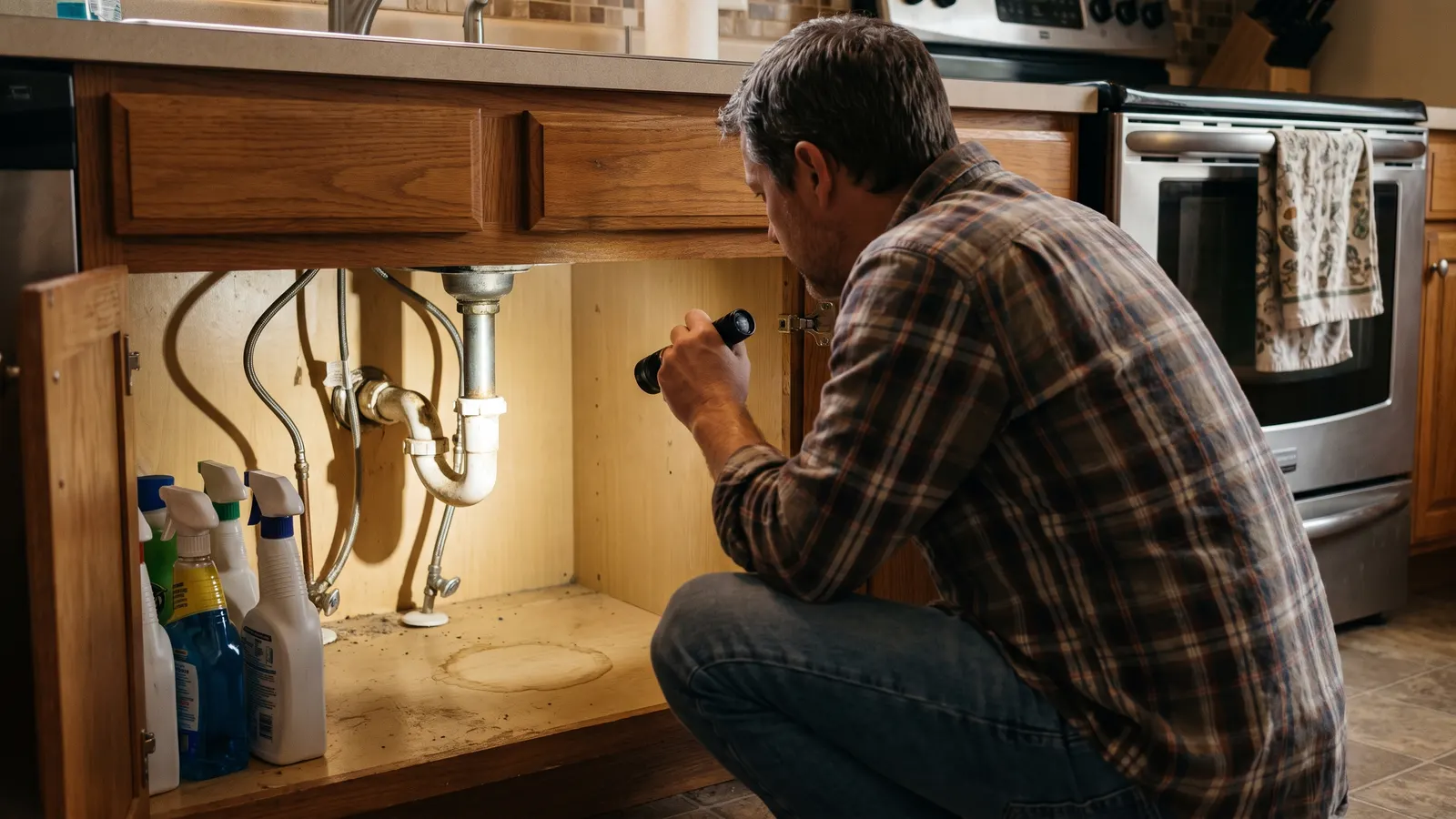
In each room you look for water where it should not be, air where it should not move, heat where it should not build, and sounds that were not there last month, and you touch the surfaces where those show up first: the cabinet floor under a sink, the base of the toilet, the drywall below a window, the water heater's pan, the wall behind the washer. Looking finds most of it; touching finds the damp that has not stained yet; listening finds the fan bearing and the dripping supply line.
| Where | Look | Touch | Listen and smell |
|---|---|---|---|
| Under every sink | Stains, mineral crust on fittings, a bowed cabinet floor | The floor of the cabinet, the trap, the supply lines | A drip when the faucet runs |
| Around toilets | Discoloration at the base, a rocking bowl, a running tank | The floor at the base; press to check for softness | Refill sounds with no one flushing |
| Tub and shower | Gaps or black lines in the caulk, loose tile, a slow drain | The caulk joint; a grout line with a fingernail | Gurgling when the drain runs |
| Ceilings and windows | New stains, cracks that grew, condensation on the glass | Window sills and the drywall below | Mustiness near an exterior wall |
| Water heater | Water in the pan, rust at fittings, a damp floor | The floor around the base, the relief valve's discharge pipe | Rumbling or popping on a burn cycle |
| Furnace or air handler | The filter, the condensate line and its drain, rust | Nothing while it runs | A new rattle, a burning smell, a click that repeats |
| Laundry | A bulge in a rubber hose, lint at the duct joint, a kinked duct | The hoses; the duct connection | A dryer that runs longer than it used to |
| Garage | The reverse test, cords across the floor, fuel near heat | The photo-eye lenses, wiped clean | The opener straining |
| Outside | Downspouts discharging away, soil sloping toward the house, hose bibs dry, the vent flap closed | Siding at the ground for softness | The AC unit's fan and compressor at start |
A stain, a smell, or a soft spot that has no obvious source is the start of a different investigation. The signs of a hidden leak covers the meter test, the places water travels, and when to open a wall.
What do you do with what you find?
Sort everything you find into three buckets before you leave the room: fix it now if it takes under ten minutes and you have what you need (a loose hose clamp, a full lint trap, a dead alarm battery), schedule it if it is a real task (recaulk the tub, replace a washer hose, clean the dryer duct), and call if it is a pro job or a warranty item (a rusting water heater, a cracked heat exchanger smell, a nail pop pattern in a new build). Photograph anything in the second and third buckets.
The note is the other half of the walkthrough. In Property Station the walkthrough is a recurring task with a Frequency of 1 month, and the Complete Task dialog's Notes field is where "tub caulk corner, dryer duct kink, rust ring on heater pan" goes, with the photo on the equipment's record. The scheduled items become their own tasks; the call becomes an entry in Repair History when the plumber leaves. The maintenance scheduler is what makes March's note findable in September.
The shutoffs you pass on the route are worth exercising once or twice a year, which the five shutoffs covers, and if the house has leak sensors, a smart thermostat, or connected alarms, those devices have their own monthly look inside the same hour.
How does the walkthrough change with the season?
The walkthrough changes at the edges with the season: the outside loop gets longer after the first heavy rain, when you watch where the downspouts discharge and whether the grading holds; the utility area gets a closer look at the start of the heating and cooling seasons, when the equipment changes modes; and the attic hatch and the crawl space access get a real visit twice a year instead of a glance. The inside route stays the same year round.
- After the first heavy rain of spring and fall: walk the outside loop during the rain and watch the downspout discharge, the window wells, and the garage floor.
- At the first cooling day and the first heating day: stand at the air handler through a full cycle, look at the condensate drain, and note the sounds.
- Before the first freeze in cold climates: add the hose bibs, the exposed pipes, and the thermostat setting to the route.
- Twice a year: the attic and the crawl space, with a mask, a headlamp, and more time than the walkthrough allows.
A maintenance calendar that sticks is where those seasonal additions live, so the monthly route stays short.
Common questions
How is this different from the monthly checklist?
The checklist is the six tests, done anywhere in any order. The walkthrough is a route through the house that includes those tests and adds looking, touching, and listening in every room. Do whichever you will actually repeat; the walkthrough finds more, the checklist takes less time, and either beats neither.
What should I carry?
A flashlight, your phone for photos and notes, a nightlight for the GFCI test, and a paper towel. The 2x4 lives in the garage. Nothing else; a walkthrough that needs a toolbox becomes a repair session and stops being a walkthrough.
Should I include the attic and crawl space every month?
No. Twice a year, ideally after a heavy rain in spring and fall, is enough for most houses, and those are separate, longer visits with a mask and a headlamp. The monthly walkthrough looks at the attic hatch and the crawl space access for stains and smells and leaves the rest to the seasonal visit.
What if I find nothing for months?
Then the record says the house was fine for those months, which is worth having at a warranty claim, an insurance claim, or a sale. A walkthrough that finds nothing took an hour and confirmed a baseline; the month it finds a damp cabinet floor pays for all of them.
What should you do next?
Walk the route once this week, slowly, and take the four baseline photos. The first walkthrough is the longest; the second is where the differences start to show, and that is the one that earns the hour.