On this page
Hurricane shutters are covers, permanent or removable, that protect windows and doors from wind-borne debris during a storm, and the main types are storm panels, accordion shutters, roll-down shutters, Bahama shutters, colonial shutters, and fabric panels, with plywood as the emergency fallback. Ready.gov's hurricane page lists shutters among the ways to strengthen a home before the season. Which type is right depends on three things: who will deploy it, how much warning you will have, and what your building department and your insurer accept.
Why do windows need protection in a hurricane?
Windows and doors need protection because the debris a hurricane carries breaks glass, and a broken opening lets the wind inside the house, where it pushes on the walls and the roof from within while the storm pushes from outside. The house is then loaded in a way it was not designed for. Roof damage, water intrusion, and the loss of everything inside follow from that first failed opening more often than from the wind alone.
Ready.gov's hurricane page makes two points that matter for shutters: hurricanes are not just a coastal problem, and strengthening the home, by de-cluttering drains and gutters, bringing in outside furniture, and considering hurricane shutters, is part of preparing for one.
What are the types of hurricane shutters?
The types differ mainly in how they are deployed and by whom, which matters more than their looks: a system that takes two people and a ladder on a Saturday is not the same product as one that closes with a switch. The table below is the practical comparison; the aesthetics and the price come after it.
| Type | How it deploys | Who can deploy it | What to know |
|---|---|---|---|
| Storm panels (metal or clear polycarbonate) | Corrugated panels slide into tracks or bolt to anchors around each opening; stored between storms | One or two people, several hours for a whole house, a ladder for upper windows | Compact storage, low visual impact off-season; heavy, labor-intensive, and easy to lose the hardware |
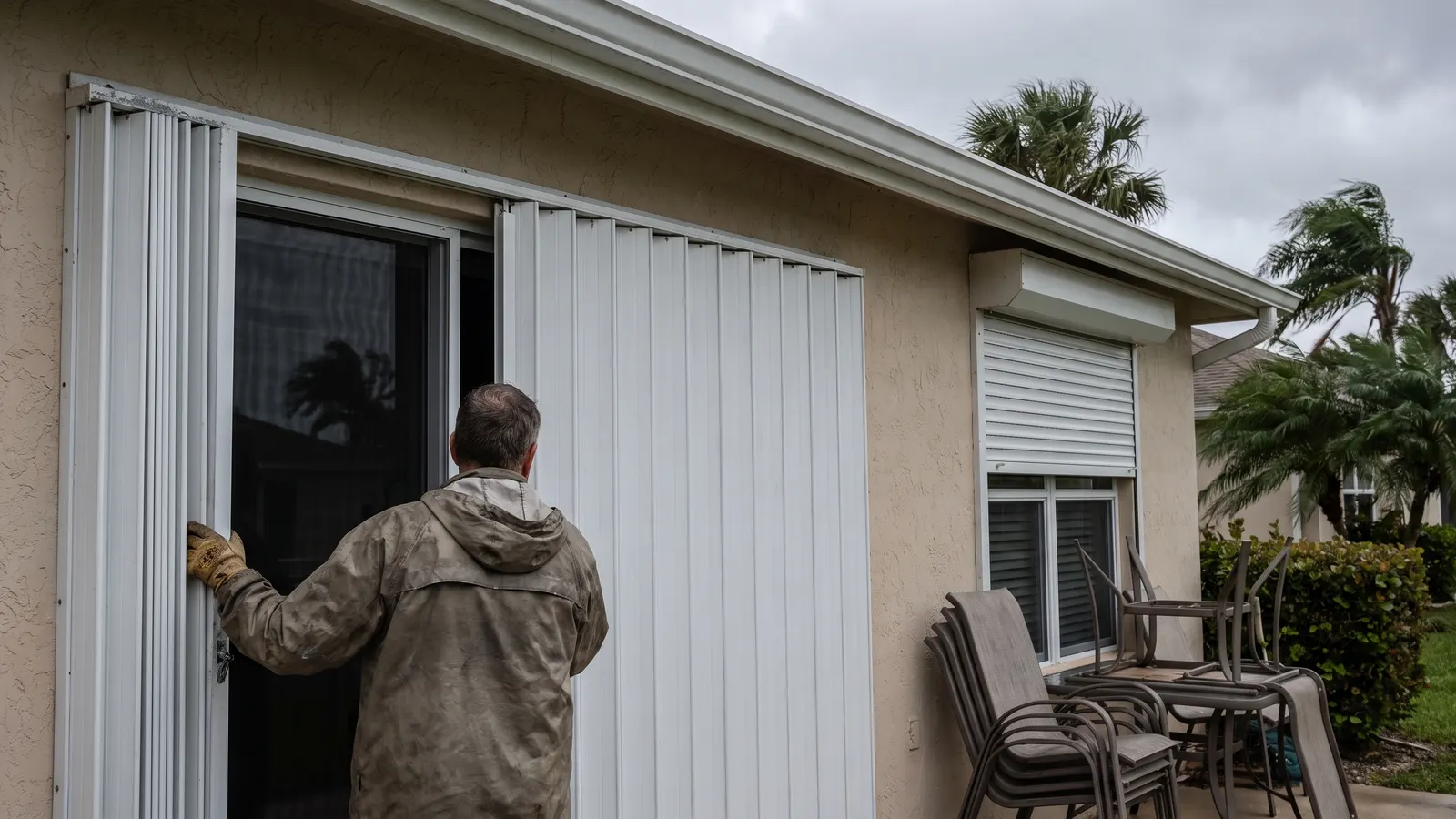
| Accordion | Permanently mounted boxes at each side of the opening; panels unfold and lock in the middle | One person, minutes per window, no ladder for ground floor | Visible housings year-round; tracks need cleaning; one of the fastest manual systems |
| Roll-down (roll-up) | A housing above the opening; the curtain rolls down by crank or motor | One person, seconds per opening with a motor; a crank for power failures | Fastest of all; motors and batteries need testing; can double as security and shade |
| Bahama | Hinged at the top, propped open as an awning, lowered and locked for a storm | One person, minutes, from outside | Provides shade year-round; blocks part of the view; limited to windows that suit the style |
| Colonial | Hinged at the sides, folded across and barred for a storm | One person, minutes, from outside | Traditional look; the storm bar must be stored and found |
| Fabric panels or screens | Woven panels clipped or bolted over the opening | One person, lighter than metal panels | Light and easy to store; still needs anchors in place and time to fit |
| Plywood | Sheets cut to size, screwed into anchors | Two people, a saw, and time | Emergency use; FEMA lists plywood among the supplies to stockpile |
In the quotes owners share with us, panels are the least expensive per opening and roll-downs the most, with accordions in between. The owners who are happiest a few seasons later are the ones who matched the system to who would be home to deploy it, not the ones who picked by price.
How do you choose for your house?
Choose by answering, honestly, who will put the shutters up when a watch becomes a warning, how many openings there are and how high, whether you are likely to evacuate or stay, and what the building department, the HOA, and the insurer will accept. A retired couple with a two-story house and twelve windows should not buy storm panels. A family that evacuates every time and has a single-story house can.
- Count the openingsEvery window, glass door, skylight, and the garage door, with the height of each
- Name the deployerWho is realistically home and able, alone, with a day's warning
- Check the rulesThe building department for permits and product approvals, the HOA for style and color, the insurer for what it recognizes
- Get quotes for two systemsOne fast and one affordable, priced per opening, with the approval paperwork included
- Decide, then recordPhotograph each opening's hardware and label the parts before the first season
Three rules that come up on every install. Permanently attached shutters often need a building permit, and the permit post explains why you want the paperwork closed out. In a community with an association, shutters are an exterior change, and the HOA's architectural committee may regulate style, color, and whether accordions or roll-down housings may stay up year-round. And ask the installer for the product approval documentation your jurisdiction requires and the label on each unit; the insurer will ask for the same documents. Who installs it matters too: anchoring into masonry or framing around every opening is contractor work, not a handyman job.
How do you maintain and store shutters?
Shutters fail on deployment day from neglect, not from storms: a panel that does not fit because the track is full of sand, a motor that has not run in a year, a missing box of wing nuts, an anchor that rusted through. Test the whole system once before the season starts, on a calm day, and put the test on the maintenance schedule so it repeats.
Pre-season shutter check
- Deploy every shutter fully and take it back down; note any that bind or do not lock
- Clean and lubricate tracks, hinges, and locks with the product the manufacturer names
- Check every anchor and fastener for corrosion; replace, do not tighten, a rusted one
- Count storm panels against the list per opening and confirm the hardware box is complete
- Run motors on roll-downs and test the manual crank; check any battery backup
- Confirm one exit can be opened from inside without tools
- Update the photo of each opening and the list of which panel goes where
In Property Station, the shutter test is a maintenance task with Frequency (months) set to 12 and a due date a month before the season opens; the Seasonal Checklist's "Storm Prep" pack adds it alongside the gutter and generator tasks with one "Add Pack" click. The photo of each opening and the panel list go on the Documents page so the person deploying the shutters is not reading your memory.
What else does the house need before the season?
Shutters are one line on the pre-season list, and the rest of it is where the water damage is actually prevented. Ready.gov's page says to know your evacuation zone and routes, have several ways to receive alerts, keep insurance policies and personal documents up to date with copies in a secure, password-protected digital space, keep phones charged with backup power, and gather supplies for days or weeks. FEMA's hurricane preparation guide adds the building-side items.
- Keep gutters and drains free of debris; the gutter guide covers the method and the ladder
- Install a water alarm and a sump pump with battery backup, and check valves in sewer lines
- Stockpile plywood, plastic sheeting, and sandbags
- Elevate the furnace, water heater, and electrical panel if the house is susceptible to flooding
- Remember that most property insurance does not cover flood losses; flood insurance is separate, and FEMA notes a new policy takes 30 days to take effect
The region-by-region storm prep post puts these in seasonal order for hurricane country, and the hurricane season checklist is the version to print in May. The flood policy is the item with the deadline; the insurance post for a new build explains the 30-day wait and why the policy is bought before the forecast, not after.
Common questions
Are impact windows better than shutters?
They are a different trade. Impact-rated glass is always in place and needs no deployment, which is the whole argument for it, and it is replaced as a window rather than added as a cover. Shutters cost less per opening in most quotes and protect existing windows. Many houses end up with both: impact glass where windows were due for replacement, shutters elsewhere.
Do I need to cover every opening?
Every window, glass door, and the garage door if it is not rated for wind. A house is only as protected as its weakest opening; once one fails, wind enters and loads the walls and roof from inside. Ask the installer specifically about the garage door and any skylights, which owners most often forget.
Can I shutter the house and leave?
Yes if you are evacuating, and that is the point of a fast system. If you are staying, keep at least one exit that can be opened from inside without tools, and know which one it is. A fully shuttered house with people inside needs a way out.
Does plywood count?
As a last resort, yes; FEMA's hurricane guidance lists plywood among the supplies to stockpile. Cut and pre-drilled panels with anchors already in the wall are far better than sheets bought the day before, and neither is a substitute for a rated system if you live where storms are regular.
What should you do next?
Walk the outside of the house and count the openings, with heights, on one sheet. Then decide who deploys, and get two quotes against that answer. If you already have shutters, do the pre-season check this month and schedule it to repeat.