On this page
The cost of improvements to your home, as opposed to repairs, can be added to its basis, which is the figure your gain is measured against when you sell. That is what the IRS says in Publication 523, Selling Your Home, and it is why the receipt for the new roof is worth keeping for as long as you own the house. The publication also says which costs do not count, which records to keep, and how long to keep them. This post is about the record, not the return; a tax professional is the source for your situation.
The purchase side of the basis comes from the closing paperwork, which is one more reason the documents from closing day stay in the record for the life of the house.
What is your home's basis, and why does it matter?
Your home's basis is, in plain terms, what you paid for it plus the cost of the improvements you made, less certain adjustments the publication describes; the IRS calls the result the adjusted basis and uses it to work out the gain when the home is sold. Publication 523 says to keep records of the purchase and of the improvements for figuring the adjusted basis. The higher the documented basis, the lower the gain, and the gain is what any tax is figured on.
Whether you will owe anything depends on the rules in the publication and on your situation, which is a conversation for a tax professional. What is not a conversation is the record: without the receipts, the improvements cannot be shown, and a basis that cannot be shown is a basis that cannot be used. That is the whole reason to read the rest of this.
IRS Publication 523 says: "Improvements add to the value of your home, prolong its useful life, or adapt it to new uses. You add the cost of additions and improvements to the basis of your property."
Which projects count as improvements?
An improvement, in the IRS's words, adds to the value of the home, prolongs its useful life, or adapts it to new uses, and the publication includes an examples chart that most owners can match their projects against. The chart groups improvements by additions, lawn and grounds, systems, exterior, insulation, plumbing, and interior. If a project is on the chart, its records belong in the basis file from the day the first invoice arrives.
| Group | Examples the IRS chart lists |
|---|---|
| Additions | Bedroom, bathroom, deck, garage, porch, patio |
| Lawn and grounds | Landscaping, driveway, walkway, fence, retaining wall, swimming pool |
| Systems | Heating system, central air conditioning, furnace, duct work, central humidifier, central vacuum, air or water filtration, wiring, security system, lawn sprinkler system |
| Exterior | Storm windows or doors, new roof, new siding |
| Insulation | Attic, walls, floors, pipes and duct work |
| Plumbing | Septic system, water heater, soft water system, filtration system |
| Interior | Built-in appliances, kitchen modernization, flooring, wall-to-wall carpeting, fireplace |
The chart is a set of examples, not a complete list, and the publication's definition is the test. A project that adds value, prolongs the life of the house, or changes what a space is used for is the kind of thing it describes; a project that only keeps the house as it was is the kind of thing the next section is about.
Which costs do not count?
Repairs and maintenance do not count. The IRS says you cannot include "any costs of repairs or maintenance that are necessary to keep your home in good condition but don't add to its value or prolong its life," and gives painting, fixing leaks, filling holes or cracks, and replacing broken hardware as examples. Two more exclusions: improvements that are no longer part of the home, and anything with a life expectancy of less than one year when installed.
Repair (not added to basis)
- Interior or exterior painting
- Fixing a leak
- Filling holes or cracks
- Replacing broken hardware
- Replacing one broken windowpane
Improvement (added to basis)
- A new roof or new siding
- A new furnace or central air
- An added bathroom, deck, or garage
- New flooring or a kitchen modernization
- Replacing all the windows, including that pane
The exception that catches many owners is the remodel. The publication says the entire job is considered an improvement if items that would otherwise be repairs are done as part of an extensive remodeling or restoration of the home, and it uses the window example above: replacing a broken pane is a repair, but replacing that window as part of replacing all the windows is an improvement. So the painting invoice inside a whole-kitchen remodel belongs in the basis file with the rest of the job, and the same invoice on its own does not.
Repairs still get logged. They are what a buyer, a warranty administrator, and an insurer ask about, and the maintenance log is where they live; the basis file is a separate, smaller folder of the projects that qualify.
What records should you keep for each improvement?
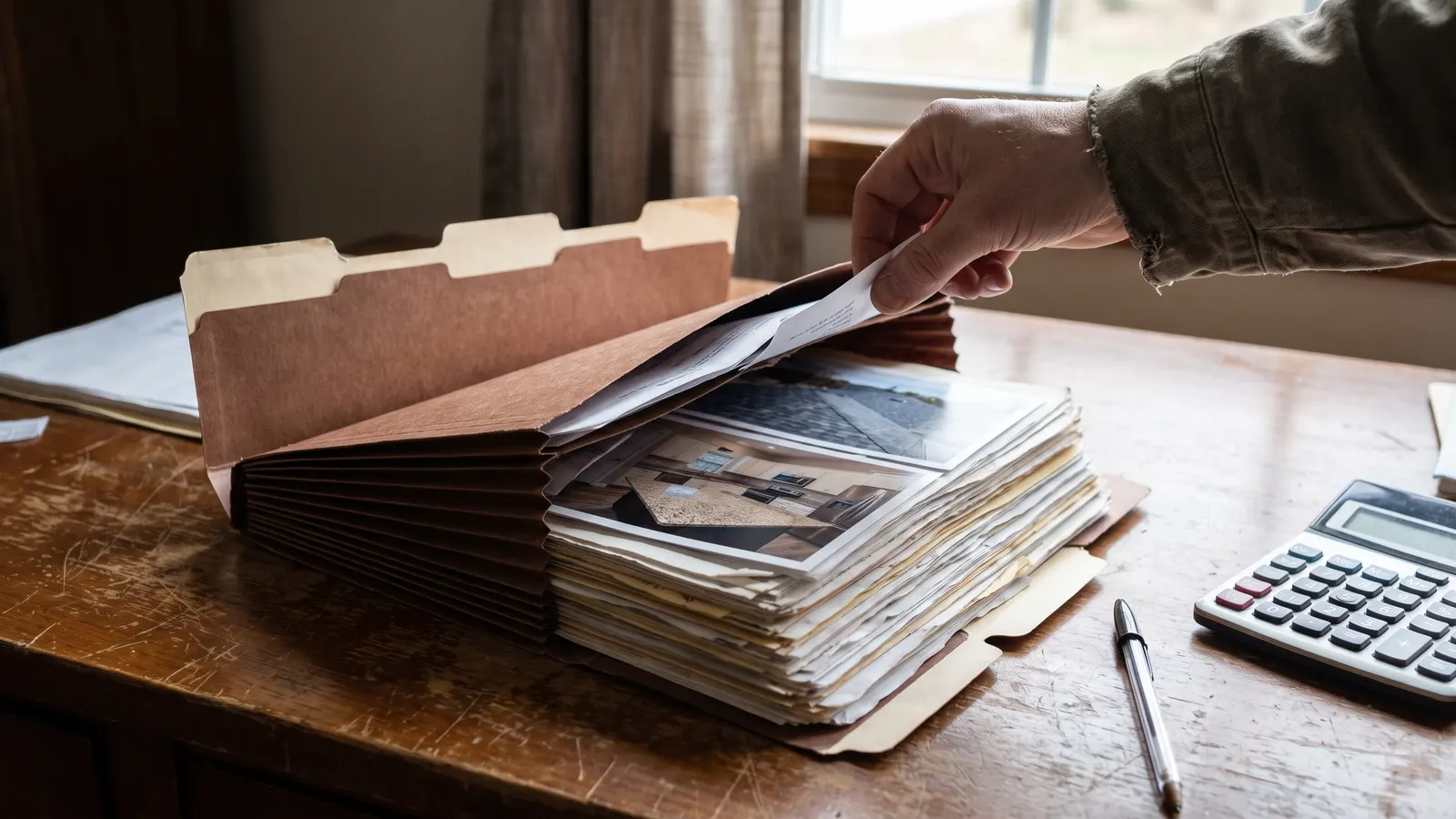
Keep, for each improvement, enough to show what was done, when, by whom, and what it cost: the contract or the estimate, every invoice and receipt, proof of payment, the change orders, the permit and its final inspection, and photos before and after. The IRS asks you to keep records of improvements for figuring the basis; the list below is what makes a record of an improvement complete enough to rely on years later.
The basis file for one project
- The signed contract or the accepted estimate, with the scope and the price
- Every invoice and materials receipt, including the ones you paid yourself
- Proof of payment: the canceled check, the card statement line, or the receipt marked paid
- Change orders, signed, with their prices
- The permit, and the record that it was closed with a final inspection
- Photos before, during, and after, dated
- A one-line summary: what was done, the dates, the total, the contractor
Most of this is the same file a contractor project needs for its own sake; tracking contractor work and permits builds it during the job, and the basis file is a copy of the finished one. The purchase side is the closing statement from when you bought, kept with the deed; the publication explains how the purchase figures are used.
How long should you keep the records?
Keep the records that support your basis until three years after the due date of the tax return for the year in which you sold the home; that is the period IRS Publication 523 gives as of September 2026. In practice that means every improvement receipt is kept for the whole time you own the house, and then for years after the sale, which is longer than most owners keep anything. The file has to survive moves, a change of computers, and a change of who in the household handles the papers.
Paper fades and the folder gets separated from the house it describes. A digital copy of each receipt, filed under the project, with the originals in one box, is the arrangement that survives; the same copy is what selling with a complete record hands to a buyer as proof of what was done, so the file earns its keep twice.
Where should the basis file live?
The basis file should live with the rest of the home record, in a form that can be exported whole when the house is sold, and with a copy outside the house. Each project is one folder: the summary line, the contract, the invoices, the permit, the photos. The folder is opened rarely, so it has to be findable by someone who did not build it, years after the project.
In Property Station, a project on the Projects page holds its documents and photos, and each receipt or contract goes in Documents under the Receipt, Contract, Permit, or Tax type so the filter shows every tax-relevant document in one list. Data Export downloads everything as one archive when it is time to hand it to a tax preparer or a buyer.
Nothing here is tax advice. Publication 523 is the IRS's own explanation and is worth reading in full before a sale; a tax professional is the person to ask what your basis is and what you owe. The record is what makes that conversation short.
Common questions
Does a new roof count as an improvement?
The IRS examples chart in Publication 523 lists a new roof under exterior improvements, along with new siding and storm windows or doors. Patching a leak is listed as a repair. Keep the contract, the paid invoice, and the permit for the roof, and ask a tax professional how it applies to your return.
Do I need to keep receipts for repairs too?
Not for basis, since the IRS says repairs and maintenance that keep the home in good condition without adding value or prolonging its life do not count. Keep them anyway in the maintenance log, because a buyer, a warranty, and an insurer all ask for them, and because the same invoice can be part of a larger remodel that does count.
What if I did the work myself?
Keep the receipts for the materials, the permit, and any labor you paid for. The publication's chart lists what kinds of projects count; how your own labor is treated is a question for a tax professional, and the materials receipts are the record either way.
How long do I keep the records after I sell?
The IRS says to keep the records that support your basis until three years after the due date of the tax return for the year you sold the home. Keep them longer if you are unsure; storage is cheap and the records cannot be recreated.
What should you do next?
List every project you have done to the house that matches the chart, find what paperwork you still have for each, and file it under the project with a one-line summary. Anything missing is worth one email to the contractor now, while they still have the invoice; years from now they may not.