On this page
A home energy audit is a structured inspection that finds where your house loses heated and cooled air, which systems waste energy, and which fixes are worth doing first. A full assessment combines an interview about comfort problems, a review of your bills, a visual inspection of the envelope and the mechanical systems, diagnostic tests such as a blower door, and a prioritized list of improvements. The report is the point: it turns "the house feels drafty" into a ranked list with the biggest leaks named.
The audit matters because the leaks that cost the most are rarely the ones you can see. The DOE's Federal Energy Management Program says in its Home Energy Checklist that the worst air leaks "are usually not windows and doors, but utility cut-throughs for pipes ('plumbing penetrations'), gaps around chimneys and recessed lights in insulated ceilings, and unfinished spaces behind cupboards and closets", and that an energy auditor with a blower door can point out the worst cracks.
What does a home energy audit include?
A home energy audit, which ENERGY STAR calls a home performance assessment, has five parts: an interview about your comfort problems and living patterns, a review of past energy bills as a benchmark, a visual inspection of the house inside and out, diagnostic testing, and a prioritized list of improvements. ENERGY STAR's description of the assessment defines the evaluation as "A visual inspection of the exterior, interior, home envelope, and all mechanical systems to determine their condition" and the testing as "A combination of diagnostic tests to identify leaks, moisture problems, or ventilation issues."
| Part | What the auditor does | What to have ready |
|---|---|---|
| Homeowner interview | Asks about rooms that are hard to heat or cool, drafts, condensation, dust, and how the house is used | A list of complaints by room and season |
| Energy bills review | Benchmarks a year of use to see where the seasonal peaks are | A year of electric and gas bills, or the utility login |
| Home evaluation | Walks the exterior, interior, attic, crawl space or basement, and every mechanical system | Clear access to the attic hatch, the panel, the furnace, and the water heater |
| Safety check and testing | Runs the blower door, often an infrared camera, and combustion safety checks on gas appliances | Fireplace cold and ashes cleaned out |
| Recommendations | Ranks the improvements by health and safety, comfort, and cost-benefit | Questions about rebates and which items need a contractor's quote |
The recommendation list is the deliverable: ENERGY STAR describes it as "A prioritized list of improvement measures based on health and safety issues, comfort, and overall cost-benefit." Ask for it in writing with the test numbers attached, because the same numbers measured again after the work are how you know a sealing job did what it promised.
What does a blower door test show?
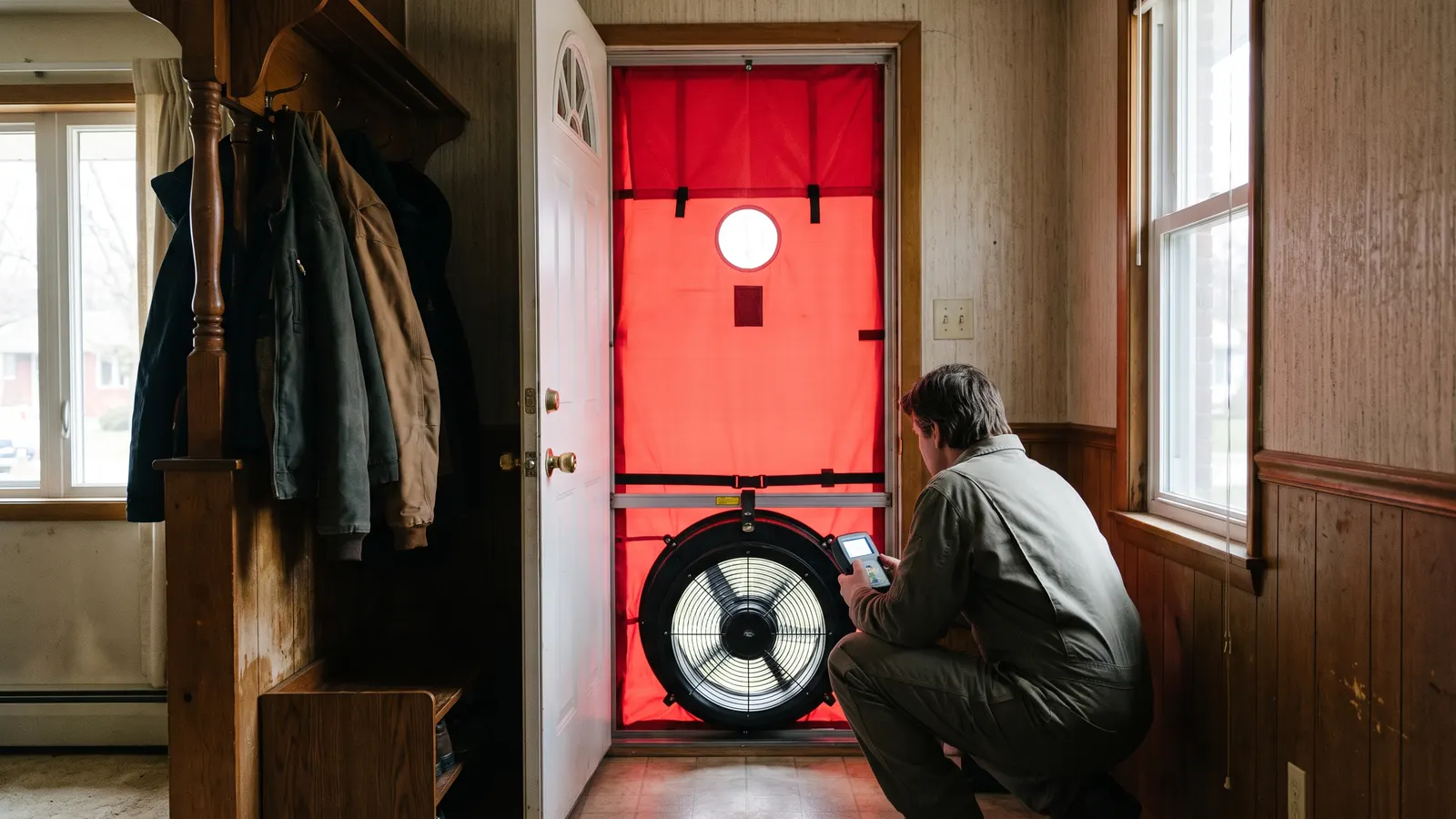
A blower door test shows how leaky the whole house is and where the leaks are. The auditor mounts a fan in an exterior doorway, pulls air out of the house so that outside air rushes in through every gap, and then walks the rooms with a smoke pencil or an infrared camera while the fan runs. Leaks that are invisible on a calm day become obvious streams of cold air. The DOE's air sealing guide recommends a professional assessment with a blower door for leaks that are hard to find, which is most of them.
In practice, the leaks that surprise owners are not at the windows. They are the attic hatch with no gasket, the plumbing wall behind a tub, the chase around a furnace flue, the top of an interior wall where it meets the attic, and the gap behind a built-in cabinet. A blower door finds these in an afternoon; a walk-through without one rarely does.
Ask the auditor to mark each leak on a floor plan or photograph it. That list of locations is what a sealing contractor prices, and it is what you check the finished work against.
What can you check yourself before paying for one?
You can find the obvious leaks, read the attic, and check the equipment settings yourself in a weekend, and that walk-through decides whether a professional audit is the next step or whether a tube of caulk is. The DOE Energy Saver guide's smoke test is the starting point: on a windy day, hold a lit incense stick near windows, doors, outlets, and fixtures, and smoke that travels horizontally marks a leak.
A weekend walk-through
- Smoke test the windows, exterior doors, outlets on exterior walls, and ceiling fixtures on a windy day; write down each leak.
- Look at the attic insulation: is it level with the joists, pulled back from the eaves, and is the hatch itself insulated and gasketed?
- Follow any ducts in the attic, crawl space, or garage and note kinked flex duct, open joints, and bare metal.
- Check the water heater setting and the date on the furnace filter.
- Note which rooms are hard to heat or cool, and when.
Fix what the smoke test finds with caulk and weatherstripping, and read the attic against the ventilation and insulation check. The settings that cost nothing are in the easy energy savings list; do those whatever an audit finds. If the house still has a room that will not hold temperature or a draft you cannot trace, that is the case for the blower door.
What should you do with the report?
Do the report's items in its order, which is almost always safety first, then air sealing, then insulation, then equipment, with windows last. Sealing before insulating matters because insulation slows heat moving through a surface but does nothing for air moving around it; insulation basics explains why the two are separate jobs. Windows come last because, as FEMP says, they are usually not the worst leak; the repair-or-replace decision for windows is a comfort and condition call more than an energy one.
Every item on the list becomes one of two things: a project for a contractor to quote, or a recurring task for you. Duct sealing and attic insulation are projects. Filter changes, the yearly tune-up, and a spring re-check of the caulk are tasks with an interval. In Property Station each one is a task on the Maintenance page with a Frequency in months, and the reminder comes back on its own.
Keep the audit report, the blower door numbers, and every receipt for the work in Documents, filed as type Inspection with the date. A sealed and insulated house is a selling point only if you can show what was done; the test numbers are the proof, and the receipts are what your improvement records are built from.
Common questions
How long does a home energy audit take?
Plan on a few hours for a full assessment with a blower door test, longer for a large house. The interview and the bill review come first, the walk-through and the testing next, and the written report usually follows a few days later.
Can I do my own energy audit?
You can do a useful walk-through with the DOE's incense smoke test on a windy day, a look at the attic insulation depth, and a check of the ducts you can reach. You cannot measure the whole house's leakage or find the hidden leaks without a blower door and an infrared camera, which is what the professional adds.
Does a new-construction home need an audit?
Usually not in the first year. It is worth one if a room will not hold temperature, if bills run far above similar homes nearby, or shortly before the workmanship warranty ends, so that a sealing or insulation defect is found while the builder still owns it.
Who pays for the fixes the audit recommends?
You do, unless a utility or state program rebates them or the audit finds a defect a builder warranty covers. Some utilities subsidize the audit itself, so ask yours before booking. Keep the report and every receipt for resale.
What should you do next?
Do the smoke test this week and write down what you find. If the list is short and local, seal it yourself. If it is long, or the house has a room that never holds temperature, book the audit, hand the auditor your list and a year of bills, and change the free settings while you wait for the report.